
Executive Summary
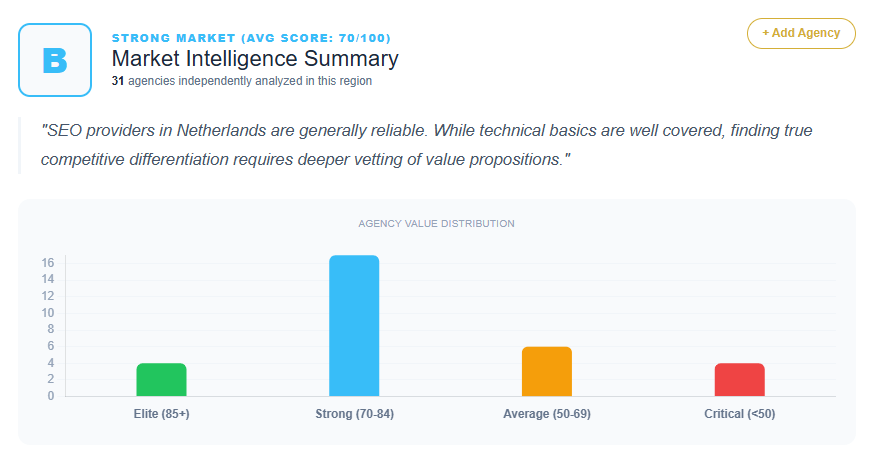
The Netherlands SEO market is highly mature and technically sophisticated, characterized by a cluster of dominant enterprise-tier players and a large mid-market segment. With an average agency score of 71, the market demonstrates high operational standards and a strong emphasis on data integration and cross-channel performance. However, a defining insight is the prevalence of “Authority Dilution”; even top-tier agencies frequently rely on broad, safe messaging and generic corporate buzzwords, leading to a landscape where technical excellence is high but strategic differentiation is surprisingly low.
Need AI SEO services in Netherlands?
See which services, capabilities, and propositions actually match what your business needs.
Market Maturity Score
- Average Agency Score: 71
- Score Distribution:
- 80–89: 7 agencies
- 70–79: 14 agencies
- 60–69: 4 agencies
- <60: 6 agencies
- Market Maturity Classification: High‑Authority but Low‑Differentiation
See why claims of being the best SEO service provider—and paid rankings—should be questioned.
Check our independent, unbiased and unpaid SEO agency rankings by country, based on our Business Strategy Value Proposition Diagnostic.
Submit missing agencies for free, compare their value propositions, and finally visit their websites to make sure they’re the right choice for you.
Differentiation Density
- % of agencies with proprietary frameworks: 13% (e.g., REAN model, “Your Digital Brain,” “Smart Marketing”)
- % with vertical specialization: 10% (e.g., Link-building/Authority, B2B SaaS, E-commerce/Commerce)
- % with strong social proof: 29% (Verified awards like Dutch Search Awards, or enterprise-level Dutch case studies)
- % with unique mechanisms: 13% (Specific methodologies like “Knowledge Sharing” or “SEO + Data Science” synergy)
Commodity Trap Index
- % using generic messaging: 39% (Frequent use of “data-driven,” “results-oriented,” “growth-focused,” and “higher in Google”)
- % relying on service lists instead of outcomes: 23% (Agencies focusing on “what” they do—SEO, SEA, Web—rather than “how” it impacts revenue)
- % with no unique mechanism: 65% (Majority of agencies lack a named, proprietary process to justify premium pricing)
Top Agencies in Netherlands (By Score)
- OrangeValley | Score: 88
- Adwise Your Digital Brain | Score: 88
- DEPT® | Score: 88
- Fingerspitz | Score: 88
- Seeders | Score: 84
Looking for the best AI SEO agency in Netherlands?
Find out who can actually improve your search visibility and bring you more customers.
Strengths of the Netherlands SEO Market
- Data-Science Integration: Leading agencies (OrangeValley, Traffic Builders) excel at merging SEO with data science and clinical technical audits.
- Enterprise Scale: Massive resource power through global networks (DEPT, iProspect, Storm Digital) allows for cross-border SEO dominance.
- Technical Maturity: High legacy standards for technical SEO, migrations, and infrastructure management among top performers.
- International Footprint: Strong capabilities in cross-border SEO and international authority building (Seeders).
Weaknesses of the Netherlands SEO Market
- Strategic Anonymity: High volume of mid-market agencies (010 Marketing, I DO Digital) using interchangeable “no-nonsense” messaging.
- Linguistic Barrier for Entry: Non-local agencies (Danish-based firms) face nearly 100% bounce rates due to lack of Dutch localization.
- Commoditized Sophistication: Premium agencies often fail to articulate how their “data-driven” approach differs from lower-cost competitors.
- “Safe Choice” Syndrome: Large-scale agencies prioritize corporate stability over aggressive, disruptive tactical SEO innovation.
ROI Impact Summary
- Estimated Conversion Loss: 15–20% (due to abstract messaging and lack of immediate tactical clarity for non-enterprise leads).
- Estimated ACV Compression: 15–25% (caused by “Price-Comparison Traps” where agencies fail to define a unique mechanism).
- Estimated Sales Cycle Extension: 10–15% (resulting from high-concept branding that requires more prospect education at the top of the funnel).
Market Archetype Classification
High‑Authority but Low‑Differentiation
The market is technically proficient and reputable, but agencies struggle to stand out, often using identical value propositions focused on general “growth” and “partnership.”
Sector Opportunities in Netherlands
- Underserved Verticals: Clinical Technical SEO (buried under general digital transformation), Strategic SEO Migrations, and “SEO + AI” specialized landing pages.
- Oversaturated Verticals: Generalist SME digital marketing (“Groei doen we samen”), regional “Full-Service” agencies in the Randstad, and generic WordPress SEO.
We’ve evaluated all most important agencies in Netherlands with our Intelligence Engine.
Now you can compare their propositions and easily decide which one offers the right value for your business.
Methodology
- Number of Agencies: 31
- Scoring System Reference: 0–100 scale based on value proposition clarity, differentiation, and market-specific authority.
- Data Source: Proprietary agency audits (2025–2026 data).
- Year: 2026