
Executive SEO Strategy Dashboard: Mango
Industry & Market Context
Global Fashion / E‑commerce Retail.
Mango competes inside one of the most structurally compressed markets in the world:
• Below, the algorithmic acceleration of Shein/Temu, redefining “fast fashion” into “real‑time retail.”
• Laterally, Zara — a logistics empire with a 15–21 day design‑to‑shelf cycle and a distribution network that behaves like a military operation.
• Above, COS and Massimo Dutti, who weaponize minimalism and craftsmanship to justify a higher price‑to‑quality ratio.
Mango’s challenge is not relevance — it’s differentiation under pressure. The brand sits in a volatile middle ground where aesthetic elevation must coexist with operational efficiency, and where every misalignment between brand promise and digital execution is punished instantly.
The Discovery
Mango exhibits a Value Blur: a premium Mediterranean identity expressed visually, but not structurally reinforced across its digital ecosystem.
As the audit states:
“La estética es sólida y coherente, pero el ‘por qué comprar’ funcional se ve eclipsado por la fotografía de ambiente.”
This is the core tension:
Mango looks like a premium brand, but behaves like a mass‑market retailer.
The brand narrative is aspirational; the digital experience is transactional.
The result is a strategic dissonance that erodes pricing power, SEO visibility, and conversion efficiency.
Strategic Fault Lines
Semantic SEO Gap
Mango’s technical foundation is strong — Core Web Vitals, crawlability, and site hygiene outperform most mass‑market peers.
But the semantic layer is underdeveloped.
The brand ranks for broad, high‑volume terms (“vestidos”, “blazers mujer”), yet systematically misses high‑intent, high‑margin long‑tail queries such as:
“vestido midi de lino sostenible para invitada de boda”
This is not a keyword issue — it’s a content architecture failure.
The absence of editorial surfaces (“Style Journal”, “How to Wear”, “Seasonal Guides”) forces Mango to rely disproportionately on Paid Social/Search to capture upper‑funnel demand.
The business impact:
• Higher CAC
• Lower organic share of voice
• Reduced discoverability for premium categories
• Lost opportunity to differentiate from Zara’s SEO weakness
Conversion Friction: Zero‑Result Filtering
Mango’s UX is visually refined but structurally brittle.
The filtering logic allows users to combine attributes that lead to dead‑end states (“Sostenible + Azul + XL”), producing “0 resultados” pages that trigger immediate bounce.
This friction is not cosmetic — it is commercially expensive.
The audit quantifies a 4–6% mobile conversion loss directly attributable to this pattern.
In a category where mobile accounts for >70% of sessions, this is a structural leak.
Zara avoids this through infinite scroll and dynamic inventory‑aware filtering, meaning Mango loses the conversion battle before the product page is even reached.
Omnichannel Deficit (O2O)
This is the largest strategic gap.
Mango’s digital‑to‑store journey is functional but not experiential.
The audit notes:
“La integración O2O es la mayor brecha técnica y estratégica.”
Key missing components:
• Real‑time store availability
• Reserve & Try with frictionless confirmation
• Store‑based personalization
• QR‑driven product discovery
• Unified wishlist across channels
In a market where Zara, Nike, and Uniqlo treat stores as experience engines, Mango’s O2O feels like a utility rather than a differentiator.
This weakens footfall recovery, increases return rates, and limits the brand’s ability to justify premium positioning.
Deleveraged Product
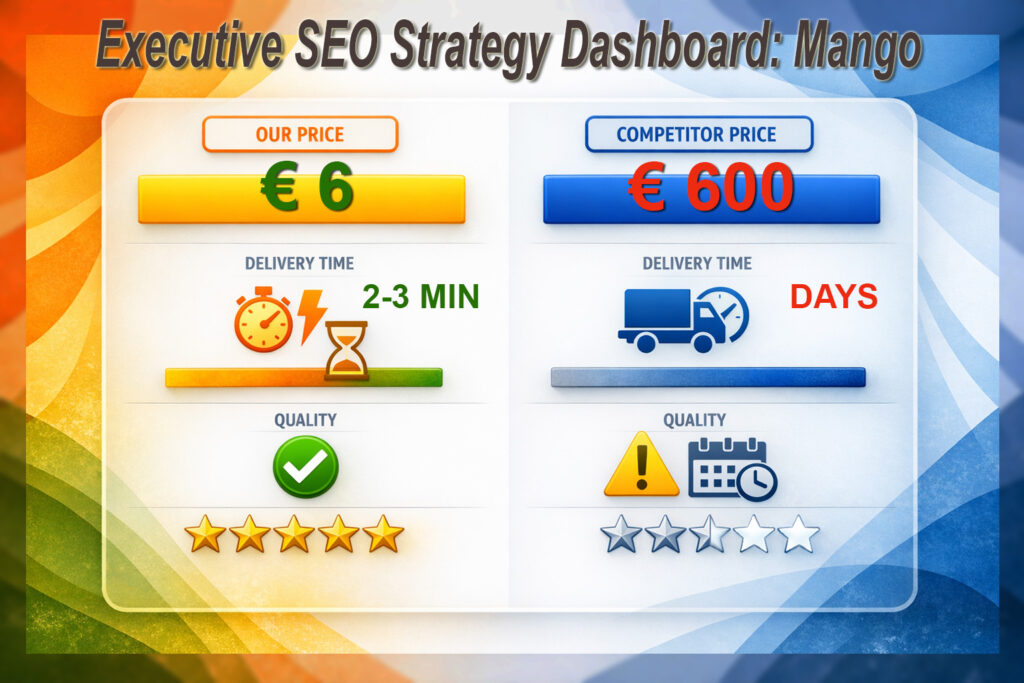
Product: Executive Strategic Audit & Top Priority Actions + Competitor analysis
Expected Price: €6.04
Full Audit: https://1euroseo.com/examples/dashboard-de-auditoria-ejecutiva-mango.html