
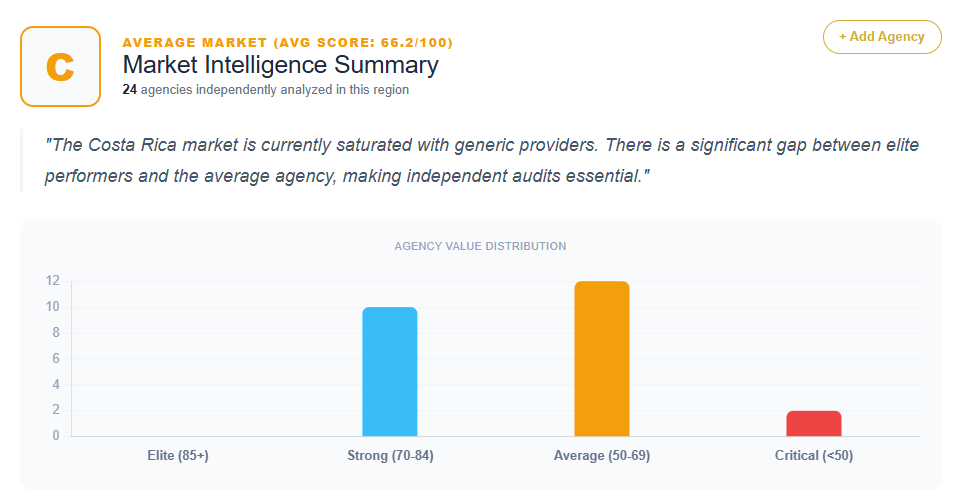
The search engine optimization market in Costa Rica presents a complex study in brand positioning and strategic execution. Based on an analysis of 24 distinct agencies operating within or targeting the region, the market is characterized by a significant divide between legacy creative powerhouses, specialized boutiques, and “commodity” providers. Scores within this dataset range from a low of 35 to a peak of 78, reflecting a wide variance in how these firms articulate their value and demonstrate technical authority.
Market Overview and Quantitative Performance
The analyzed dataset consists of 24 agencies, predominantly concentrated in San José, with specific footprints in high-value areas like Escazú, Barrio Escalante, and Curridabat. The average score across all providers is approximately 65.7. However, the distribution of these scores reveals a market struggling with “Generalist Dilution.”
Only three agencies achieved the top score of 78: B2B Digital, Digesit, and 4Geeks. These firms are characterized by clear niche targeting—specifically B2B tech and product engineering—and Google Premier Partner status. At the opposite end of the spectrum, agencies like Octopus Tech Solutions (score of 35) and legacy creative firms like McCann San José (score of 42) represent the floor of the market, primarily due to a lack of localized presence or a failure to translate creative fame into technical SEO depth.
Recurring Patterns: The Commodity Trap vs. Strategic Authority
A primary theme across the 24 agencies is the “Commodity Trap.” This is most evident in firms that rely on Exact Match Domains (EMDs) or generic service descriptions.
The Reliance on Domain Authority
Agencies like SEO Costa Rica and CRSEO (both scoring 62) leverage their domain names to capture search volume. However, their diagnoses suggest a heavy reliance on these URLs to do the “heavy lifting.” Their value propositions are often descriptive—focusing on “what we do” (rankings, links)—rather than transformative business outcomes. The prescription for these firms consistently highlights a need for a “unique mechanism,” such as a branded methodology like the proposed “CR-Impact Framework.”
Generalist Dilution in Full-Service Agencies
A significant number of agencies, including Interaction (74), Brandy Creative (74), Rocket (74), and Imagineer (72), suffer from what the data terms “Generalist Dilution.” These firms offer 360-degree digital services, but this breadth often obscures their SEO-specific expertise. For example, Pixel506 (74) and Pixel (68) are noted for their visual excellence, yet their SEO offerings are frequently perceived as supportive add-ons rather than core growth engines.
The Friction Between Creative and Technical Positioning
A recurring friction point in the Costa Rican market is the “Aesthetic-Bias.” Several agencies based in San José are perceived as “creative shops” first.
- Brandy Creative and Creativa (64) are noted for high visual and design-centric value. However, their diagnosis reveals that this focus dilutes their authority as technical SEO providers.
- Jotabequ Grey (58) and McCann San José (42) represent the legacy advertising sector. Their value propositions focus on brand prestige and emotional resonance (“Truth Well Told”), which creates a “strategic misalignment” when procurement is focused on technical search performance. The data suggests these firms are almost “invisible” in specialized SEO discourse.
Conversely, agencies like Digesit (78) and 4Geeks (78) move toward “Growth Engineering.” They bridge the gap between technical rigor and business results, though even these high-performers are cautioned against “Commodity Over-reliance” on badges like Google Partner status.
ROI Impact and Potential Revenue Leakage
The dataset provides a stark look at the financial consequences of weak positioning. For agencies scoring in the 50s and 60s, such as Marketing Digital CR (58) or Globalpyme (58), the diagnosis points to a “race to the bottom” on pricing.
The “ROI notes” for these agencies suggest significant revenue leakage:
- Brandy Creative risks a 20-30% lower capture rate of CMOs who prioritize hard data over aesthetics.
- CRSEO faces a 25-40% lower conversion rate for high-ticket B2B leads due to a lack of authority signals.
- Findasense (74) likely experiences a 25% leakage in the sales funnel where clients opt for “Search-First” boutiques over their CX-focused model.
- XUM Digital (62) is estimated to lose 25-40% of high-ticket leads to competitors who lead with specific revenue-growth case studies.
The recurring theme is that failing to answer “Why us versus a cheaper freelancer?” leads to lower Average Contract Value (ACV) and higher client churn.
Local Nuances and Geographic Specifics
The data identifies San José as the epicenter of the industry, with specific clusters in Escazú (Imagineer, Creaxion, 4Geeks, Findasense) and Barrio Escalante (Pixel, Intergraphic DESIGNS).
A critical local nuance mentioned in the analysis of Costa Rican SEO (68) is the need for bilingual search strategies. In a market where English-speaking tourists/investors and Spanish-speaking locals intersect, agencies that fail to emphasize cross-cultural keyword strategies miss high-margin niches like Tourism and Real Estate.
Furthermore, the data contrasts domestic agencies with offshore providers. Octopus Tech Solutions (35), based in India, is penalized for a lack of verified local presence, which acts as a “conversion barrier” for Costa Rican enterprises seeking cultural and regional search nuance (Google.co.cr).
Strengths and Unique Selling Propositions (USPs)
Despite the common weaknesses, several agencies demonstrate clear strengths:
- B2B Digital (78) excels through high-tier specialization in industrial and service exports.
- Imagineer (72) and Creaxion (68) leverage their status as HubSpot partners to target enterprise-level digital transformation.
- 4Geeks (78) provides a technical foundation in product engineering that most marketing-only agencies lack.
- Intergraphic DESIGNS (68) and Pixel506 (74) successfully position themselves as “nearshore” partners, bridging the gap between North American and LATAM markets.
Common Prescriptions for Market Dominance
The prescriptions provided for these 24 agencies offer a roadmap for elevating the SEO sector in Costa Rica. The most frequent recommendations include:
- Productizing the Process: Move away from generic “SEO Services” toward proprietary frameworks with branded names, such as “The CR-Authority Framework” (Marketing Digital CR), “The Samuro Growth Framework” (DSamuro), or “The XUM Organic Revenue Engine” (XUM Digital).
- Quantifying Social Proof: Shifting from “Resultados Reales” (Real Results) to quantified, industry-specific case studies. This is particularly recommended for Globalpyme and CRSEO, who are urged to highlight ROI in local “colonnes/dollars” to ground services in financial reality.
- Outcome-Driven Messaging: Replacing feature-led headers (rankings, links) with benefit-led headlines focused on “Market Dominance” and “Revenue Growth.” This was a key prescription for SEO Costa Rica and Tribu Digital.
- Verticalization: Agencies like Creativa and Pixel are encouraged to lead with vertical-specific dominance in sectors like Tourism, Medical, and Real Estate to prove regional authority.
Conclusion
The Costa Rican SEO market is currently in a state of transition. While firms like B2B Digital, Digesit, and 4Geeks set the benchmark at 78, a large portion of the market remains trapped in commoditized, generalist positioning with scores hovering in the low 60s. The data suggests that for an agency to move from a “service provider” to a “strategic partner” in the GAM area, it must decouple from aesthetic-bias, formalize proprietary methodologies, and aggressively quantify the financial impact of organic search. Without these changes, the “Authority Gap” will continue to result in significant lead leakage and price sensitivity across the local industry.
Get Your SEO Strategy