
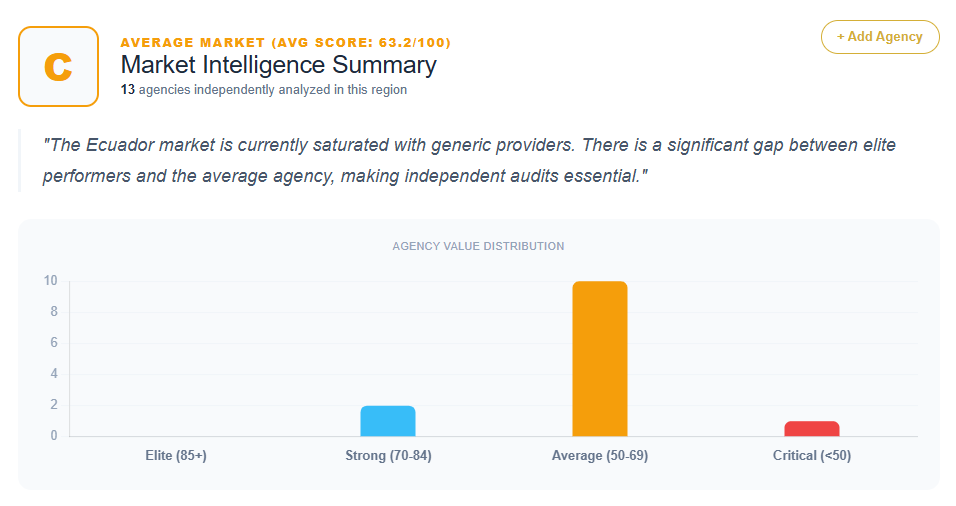
An analysis of 13 distinct SEO agencies and consultants operating within the Ecuadorian digital market reveals an industry characterized by strong foundational visibility but a profound deficit in strategic differentiation. Centered primarily in the capital, Quito, with significant regional presence in Cuenca, Manta, and Guayaquil, the market is currently navigating a difficult transition. While agencies have successfully leveraged local search intent—often through high-value domain names—the majority struggle to move beyond being “service vendors” to becoming “growth architects.”
The diagnostic data provided for these 13 providers shows a performance spectrum that peaks at a score of 78 (Digital Manta) and reaches a floor of 45 (Marketing Manta). A heavy concentration of agencies (approximately 60%) scores between 58 and 68. This evaluation uncovers a recurring crisis in the market: most Ecuadorian providers are currently caught in a “Commodity Trap,” where they sell technical deliverables and feature lists rather than business transformation and organic revenue growth.
Looking for the best AI SEO agency in Ecuador?
Find out who can actually improve your search visibility and bring you more customers.
The Performance Hierarchy: Analyzing the Scoring Tiers
The scoring data establishes three clear tiers of maturity in the Ecuadorian SEO landscape, based on their ability to bridge the gap between technical optimization and commercial impact.
The Authority Tier (Scores 74–78)
Only two agencies achieve a score above 70: Digital Manta (78) and Marketeros Agencia Digital (74). These firms represent the high-tier segment, leveraging sophisticated infrastructures. Marketeros, for example, utilizes its HubSpot Diamond Partner status to position itself in the enterprise space. However, even these leaders face strategic hurdles. Marketeros is diagnosed with “Generalist Dilution,” where its heavy focus on the HubSpot ecosystem can alienate clients seeking pure-play, aggressive organic growth. Similarly, Digital Manta is noted for its professional clinical approach but is cautioned for falling into a “Sea of Sameness” by relying on industry buzzwords rather than a unique mechanism.
The Competitive Middle (Scores 62–68)
This bracket is the most saturated, featuring agencies like Kaizen Digital Agency (68), Brander (68), Digital Cuenca (64), Estrategia Digital (64), and SEO Quito (62). These agencies are professionally stable and locally trusted, but they often use interchangeable messaging. For instance, Kaizen and Brander are noted for prioritizing process or aesthetics over assertive performance. The data suggests that for these mid-tier firms, the lack of a unique strategic “Alpha” prevents them from commanding the premium retainers associated with top-tier consultancies.
The Commodity and Generalist Tier (Scores 45–58)
Agencies such as Media Comunicación (58), Agencia Digital Quito (58), Agencia Manta (58), and Marketing Manta (45) represent the lower end of the spectrum. These providers are consistently diagnosed with “Strategic Anemia” or “Generalist Friction.” In several cases, such as Media Comunicación, SEO is marketed as one of many lateral services, including design and social media, which signals a lack of depth to sophisticated B2B buyers.
Recurring Strategic Weaknesses: Generalist Dilution and EMD Reliance
Across the 13 agencies, two dominant patterns emerge as the primary barriers to market leadership: the “Generalist Trap” and an over-reliance on Exact Match Domains (EMD).
The Generalist Trap
A significant 61% of the analyzed group suffers from “Generalist Dilution.” By attempting to be a “master of everything”—web design, branding, hardware, and SEO—firms fail to establish categorical authority. The diagnostic data for Marketeros and Brander highlights how broad digital solutions can obscure specific technical SEO power. For agencies like Agencia Manta (58), this “Jack-of-all-trades” approach forces them to compete on price rather than expertise, as clients fail to see the direct correlation between the agency’s broad focus and bottom-line revenue growth.
Authority through Domain Names
A unique characteristic of the Ecuador market is the leverage of domains like SEO Ecuador, SEO Quito, and SEO Cuenca. While these agencies (all scoring 62) hold strong organic positions due to their URLs, they are frequently diagnosed with “Functional Commodity Syndrome.” The data indicates that relying on a domain for authority rather than building a unique brand narrative attracts low-budget, high-maintenance clients (SMBs) rather than high-value enterprise accounts. For instance, Agencia Digital Quito (58) is noted for having an “authority gap” in conversion because its messaging is purely descriptive rather than outcome-oriented.
We’ve evaluated all most important agencies in Ecuador with our Intelligence Engine.
Now you can compare their propositions and easily decide which one offers the right value for your business.
Regional Nuances: Quito vs. Cuenca vs. Manta
The physical location of an agency in Ecuador significantly influences its strategic positioning and the friction points it faces:
- Quito (The Competitive Epicenter): Home to Marketeros, Digital Manta, and Kaizen. Agencies here compete on “Institutional Trust” and professional branding. However, many, like Kaizen (68), fall into the trap of selling “philosophy” over “profit,” which the data suggests creates high “comparison fatigue” among prospects.
- Cuenca (The Local Utility Hub): Agencies like SEO Cuenca (62) and Digital Cuenca (64) possess high local relevance but struggle with “Geographic Crutch Syndrome.” The data suggests these firms are often perceived as local freelancer collectives rather than national strategic partners, leading to a 30% lower lead-to-close ratio for enterprise contracts.
- Manta and the Coast: Agencia Manta (58) suffers from “Generalist Friction,” while the case of Marketing Manta (45) provides a critical market lesson. This agency’s 100% English-centric approach and global abstractions make it “invisible/inaccessible” to the target market, ignoring the local business culture that prioritizes native Spanish expertise and local SERP behavior.
See why claims of being the best SEO service provider—and paid rankings—should be questioned.
Check our independent, unbiased and unpaid SEO agency rankings by country, based on our Business Strategy Value Proposition Diagnostic.
Submit missing agencies for free, compare their value propositions, and finally visit their websites to make sure they’re the right choice for you.
Quantifying the ROI of Strategic Misalignment
The financial consequences of poor differentiation are explicitly quantified in the dataset’s ROI notes for these 13 providers:
- Lead-to-Close Leakage: Generic positioning at firms like Estrategia Digital and SEO Quito results in a projected 20-30% loss in potential high-ticket contract conversions. Prospects default to price-based decision-making.
- The “Generalist Tax”: For leaders like Marketeros (74), the lack of a sharp SEO-first narrative results in a “Generalist Tax,” where they likely lose 15-20% of specialized SEO inquiries to more focused niche competitors.
- Customer Acquisition Cost (CAC) Inflation: Digital Cuenca (64) is noted to have a 25% higher CAC because its messaging fails to highlight specific ROI metrics or industry success stories, requiring the sales team to work harder to prove value manually.
- Market Share Opportunity Cost: By failing to quantify search ROI on the homepage, agencies like Agencia Manta and Media Comunicación are estimated to lose 25-35% of potential recurring revenue, as they attract clients seeking “maintenance” rather than “dominance.”
Prescriptions for Market Dominance: Outcome-First Logic
Across the 13 agencies, the recommendations for growth center on a single movement: the transition from “what we do” to “the financial outcomes we generate.” To lead the Ecuadorian market, agencies are urged to:
- Shift to “Revenue-First” Logic: Transition headlines from service descriptions to quantifiable revenue claims. The data suggests replacing generic headers with statements like “Scaling Ecuadorian Businesses via Search Intelligence” or “Organic Revenue Acceleration.”
- Vertical Specialization: Instead of “General Digital Agency,” firms are advised to become the authority for specific high-competition Ecuadorian sectors like Tourism, Financial Services, Retail, or Real Estate.
- Productize the Methodology: Agencies like Brander and SEO Ecuador are advised to move away from hourly-rate perceptions by naming their internal processes (e.g., “The Brander Velocity Method” or “The SEOE-Drive Framework”) to create perceived intellectual property value.
- Contextual Proof: The data highlights a need for “Evidence of Impact.” Replacing generic traffic graphs with local market share growth percentages and case studies focusing on the “dollarized economy” context is a universal recommendation for agencies in the 58-68 score range.
Need AI SEO services in Ecuador?
See which services, capabilities, and propositions actually match what your business needs.
Conclusion
The analysis of these 13 Ecuadorian SEO providers reveals a market that is technically functional but strategically quiet. The industry is currently dominated by “Safe Generalists” who meet basic market expectations but fail to provide a compelling, unique reason for selection over competitors.
The agencies that will dominate the next decade in Ecuador are those that can successfully decouple their marketing from generic jargon and lead with revenue-centric narratives. Until agencies in Quito, Cuenca, and Manta stop listing services and start proving “market share capture,” they will continue to pay the “Genericity Tax” through lower margins and high client churn. The path to leadership lies in owning a unique, result-driven methodology that speaks the language of the C-suite, not just the search engine.
Get Your SEO Strategy