
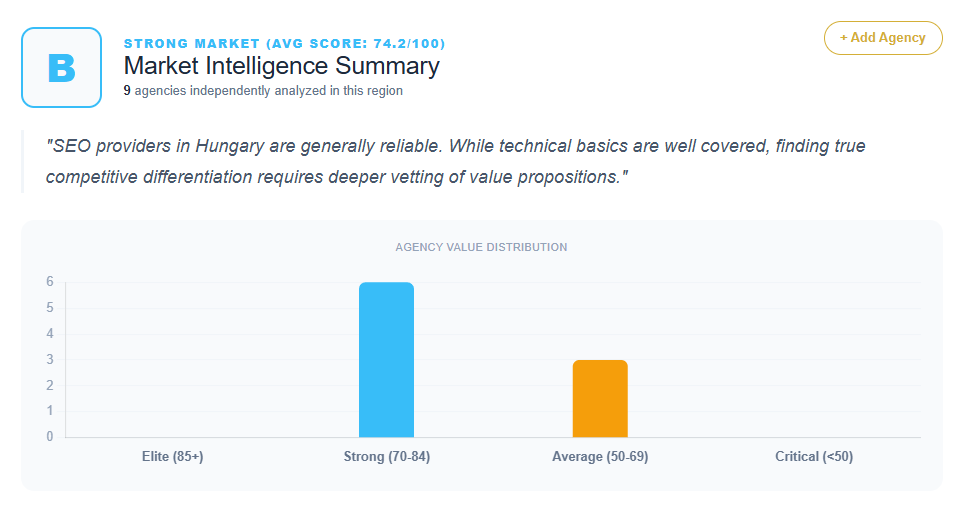
An analysis of the search engine optimization landscape in Hungary—specifically concentrated within the Budapest metropolitan hub—reveals a market characterized by high technical execution but significant strategic stagnation. Based on diagnostic data from nine distinct agencies, the market is currently a “Sea of Sameness” where standard technical competence is often mistaken for unique value.
The quantitative data provided indicates a performance spectrum peaking at a score of 84 (The Pitch Online Marketing) and floor at 64 (Marketing Astro). While the technical “floor” of the Hungarian market is stable, a pervasive theme of “Generalist Dilution” and “Commodity Messaging” prevents the majority of agencies from achieving elite-tier positioning. For businesses seeking organic growth in the .hu domain space, the challenge lies in distinguishing between “commodity vendors” who list features and “strategic partners” who architect revenue.
We’ve evaluated all most important agencies in Hungary with our Intelligence Engine.
Now you can compare their propositions and easily decide which one offers the right value for your business.
The Performance Hierarchy: Analyzing the Scoring Tiers
The hierarchy of the Hungarian SEO market is sharply defined by three tiers based on strategic maturity and authority signaling.
The Authority Tier (Scores 82–84)
At the top of the spectrum are The Pitch Online Marketing (84) and 7Digits Growth Marketing Agency (82). These firms represent the “Alpha” positioning in Budapest, yet they suffer from distinct forms of friction. The Pitch dominates through educational authority and E-E-A-T (Experience, Expertise, Authoritativeness, Trust), yet it faces a “Strategic Misalignment” on its homepage, where it often appears more as a training platform than a “Done-For-You” execution partner. 7Digits differentiates by pivoting toward “Growth Marketing,” a more sophisticated offering than the local average. However, the data suggests that their “Growth Hacking” umbrella often dilutes the perceived technical depth of their SEO-specific services, potentially losing 10-15% of pure-play SEO leads to specialists.
The Mid-Market Performance Tier (Scores 72–78)
This tier includes Selector Online Marketing (78), HD Marketing (76), BrandLift SEO (76), and SEO.hu (72). These agencies are professionally presented and locally trusted but are frequently penalized for “Commoditized Excellence.” BrandLift and Selector, for instance, are noted for focusing on “transparency” and “conscious marketing”—traits that are now considered “table stakes” in Budapest rather than unique differentiators. SEO.hu represents a unique case of “Brand Inertia”; despite owning a category-killer domain, the agency is diagnosed with stagnant messaging that fails to leverage its inherent authority into its full conversion potential.
The Generalist and Technical Utility Tier (Scores 64–68)
The lower end of the spectrum includes Webshark Kft. (68), Dog and Pony (68), and Marketing Astro (64). These firms are consistently diagnosed with an “Identity Crisis.” For example, Webshark (located at Rákóczi út 70-72) functions as a technical utility, conflating high-value SEO with custom development. Dog and Pony suffers from “Creative Over-indexing,” where a creative agency persona creates friction for clients seeking analytical rigor. Marketing Astro is penalized for “Chronic Genericism,” where the lack of a unique mechanism makes them indistinguishable from hundreds of lower-priced freelancers.
Looking for the best AI SEO agency in Hungary?
Find out who can actually improve your search visibility and bring you more customers.
Recurring Themes: The “Generalist Trap” and Strategic Dilution
Perhaps the most significant finding across the nine diagnoses is the prevalence of “Generalist Dilution.” Agencies like Dog and Pony and Webshark are primary examples of how attempting to be a “master of everything” dilutes perceived authority in the specialized SEO space.
Creative vs. Technical Misalignment
The data highlights a recurring tension between “Artsy” branding and “Clinical” SEO needs. Dog and Pony leads with storytelling, which fails to communicate the analytical rigor required for search dominance. The ROI note for this agency suggests they likely miss out on 20-30% of performance-focused revenue because prospects perceive them as too creative for technical challenges. Similarly, Webshark is viewed as a “vendor for execution” rather than a “consultant for growth” because it focuses on the “how” (technical services) rather than the “why” (business transformation).
Saturated Messaging: “Data-Driven” and “ROI-Focused”
The Hungarian market has reached a saturation point with certain buzzwords. HD Marketing (76) and Marketing Astro (64) both lean heavily on labels like “adatvezérelt” (data-driven), which the diagnostics flag as a source of friction. In a market where every agency claims to be data-driven, these terms lose their power. HD Marketing is described as a “corporate vendor” that feels “strategically quiet,” missing the aggressive vertical-specific authority found in top-tier boutiques.
Geographic Context and the “Budapest Bottleneck”
The analysis shows that physical presence in Budapest—specifically around Váci út (Selector, HD Marketing, Marketing Astro) and Lágymányosi u. (7Digits)—is a baseline requirement for local trust. However, this geographic clustering contributes to the “Commodity Trap.”
Agencies like Selector (78) and HD Marketing (76) are literally neighbors on Váci út, yet their value propositions are often interchangeable. Selector’s “Conscious Online Marketing” (Tudatos online marketing) is diagnosed as too passive for a competitive landscape where high-intent clients demand exponential growth, not just “ethical” presence. The data suggests that without a proprietary methodology—like a named “Vantage SEO Method” or “Organic Velocity Matrix”—these agencies are forced into price-based negotiations that leak potential margins.
Need AI SEO services in Hungary?
See which services, capabilities, and propositions actually match what your business needs.
The Economic Impact: Quantifying ROI Leakage
The failure to articulate a unique strategic hook has quantifiable financial consequences across the dataset:
- Lower Lead-to-Close Ratios: Generic positioning for agencies like Selector and BrandLift results in an estimated 15-22% lower closing rate. When prospects cannot distinguish an agency’s output from cheaper alternatives, procurement defaults to a “price-comparison” cycle.
- Revenue Opportunity Gaps: The Pitch is estimated to experience 15-20% leakage of enterprise leads who misidentify the firm as a training-only resource. Dog and Pony likely forfeits 20-30% of potential performance revenue due to their creative-heavy persona.
- The “Genericity Tax”: Webshark is noted to sacrifice a 20-30% premium in service fees that “Authority” agencies command because they lack a high-impact, results-first narrative.
- Higher Customer Acquisition Costs (CAC): HD Marketing and Marketing Astro face 15-25% higher CAC because they must rely on brand name or broad marketing spend rather than attracting high-intent “SEO-first” leads through specialized differentiation.
See why claims of being the best SEO service provider—and paid rankings—should be questioned.
Check our independent, unbiased and unpaid SEO agency rankings by country, based on our Business Strategy Value Proposition Diagnostic.
Submit missing agencies for free, compare their value propositions, and finally visit their websites to make sure they’re the right choice for you.
Prescriptions for Market Leadership: From Services to Systems
To move from the 60s and 70s into the 80+ “Expert” tier, the analyzed agencies are given consistent tactical prescriptions. The most urgent recommendation is the “Productization” of SEO services into named, proprietary frameworks.
Proposed methodologies include:
- The Authority 360 Method (for SEO.hu)
- The Selector Vantage SEO Method
- The HD Organic Velocity Matrix
- The Astro-Velocity Audit
- The 7D-Organic-Engine
- The BrandLift Velocity Method
By naming their processes, agencies can move from selling “SEO services” (a commodity) to selling a “proprietary mechanism” (an exclusive product). Additionally, the data urges agencies to replace service lists with “Outcome Headlines.” For example, Selector is advised to lead with “Average 140% organic growth for HU E-commerce” rather than a list of tasks.
Conclusion: The Strategic Evolution of Hungarian SEO
The analysis of these nine Budapest providers indicates that the Hungary SEO market is technically mature but strategically underdeveloped. The industry is home to “Creative Boutiques,” “IT Software Houses,” and “Education Platforms,” but very few “Search Growth Architects.”
The highest scores (82-84) are currently reserved for firms that have built massive content authority or integrated growth models. For the mid-tier majority scoring in the 60s and 70s, the path forward involves a radical decoupling from generic “data-driven” language in favor of proprietary systems and quantified, sector-specific ROI. Until Budapest agencies stop describing “what they do” and start owning a “unique mechanism” for “how they win,” they will remain trapped in a price-sensitive commodity market, regardless of their technical rigor.
Get Your SEO Strategy