
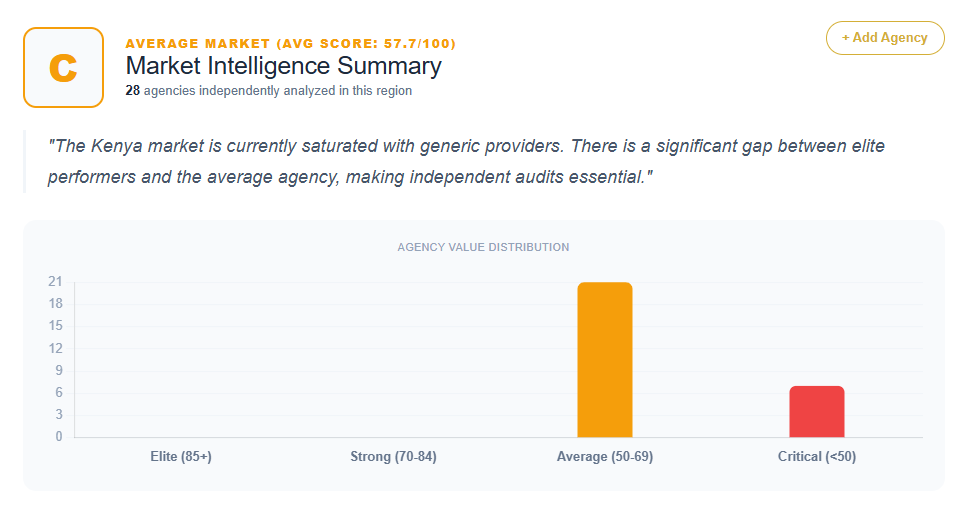
The digital marketing landscape in Kenya, particularly within the Nairobi hub often referred to as the “Silicon Savannah,” presents a market that is technically functional but strategically underdeveloped. An analysis of 18 distinct SEO agencies and service providers reveals a sector characterized by a high volume of generalist firms struggling to move beyond commodity-level service delivery. While technical execution is professionally handled by many, the diagnostic data suggests a profound deficit in unique value propositions (UVPs) and proprietary growth frameworks.
The quantitative data provided indicates a performance spectrum peaking at a score of 68 (shared by Thinkist, Exposure Ninja, and Reboot Online) and flooring at 38 (Arcane Marketing). The average score across the 18 analyzed entities hovers in the high 50s to low 60s, suggesting that while the “floor” of the market is stable, very few agencies have achieved the strategic “teeth” required to dominate the premium enterprise segment.
The Performance Hierarchy: Analyzing the Scoring Clusters
The hierarchy of the Kenyan SEO market can be divided into three distinct tiers based on strategic maturity and local relevance.
The Leading Strategic Tier (Scores 64–68)
Agencies like Thinkist (68), AdMoran (64), and HS Reliance Group (64) represent the current top-tier in terms of brand trust and professional polish. However, even these leaders face significant friction. Thinkist, located in Westlands, is diagnosed with “Strategic Misalignment,” as its “Identity-Led” messaging prioritizes creativity over the measurable search performance that high-intent SEO buyers demand. Similarly, HS Reliance Group, based in Western Heights, suffers from “Generalist Dilution,” where its authority in search is obscured by its mastery of unrelated services like photography.
The Professional Baseline (Scores 60–62)
This is the most saturated segment of the market, including 3Tech (62), Afritech Media (62), Web Solutions Kenya (62), and SEO Smart (62). These agencies typically possess verified physical presences in major Nairobi landmarks like NextGen Mall, View Park Towers, and the Kenya Cinema Plaza. While these locations provide physical accountability, their digital messaging is often trapped in what the data calls a “Commodity Loop.” They list services as features rather than business outcomes, forcing them into price-sensitive competition.
The Commodity and Misaligned Tier (Scores 38–58)
The lower end of the spectrum includes firms like Akus Digital (48), Fun Media (48), and MCR SEO Pro (48). These providers are characterized by “Generic Agency Syndrome,” relying on overused superlatives such as “Best SEO Services” without providing empirical backing. This tier also includes international firms like VJG Interactive (42) and Arcane Marketing (38), which suffer from a total lack of localized market positioning, resulting in high “Contextual Friction” for Kenyan prospects.
We’ve evaluated all most important agencies in Kenya with our Intelligence Engine.
Now you can compare their propositions and easily decide which one offers the right value for your business.
Recurring Strategic Weaknesses: Generalist Dilution and the Commodity Trap
Across the 18 diagnoses, two primary patterns emerge as the most significant barriers to market dominance: Generalist Dilution and the Commodity Trap.
The Generalist Trap
Agencies such as 3Tech, Wayne Graphic (52), and Fun Media attempt to be “masters of everything.” 3Tech positions itself as a provider of SEO, Graphics, and IT Support, while Wayne Graphic bundles technical search services with physical printing and signage. The data identifies this as a “Jack-of-all-trades” perception issue. For a sophisticated B2B buyer, this lack of specialization creates high friction during the trust-building phase, as the agency signals a lack of technical depth.
The Commodity Trap
A recurring weakness is the reliance on descriptive rather than results-oriented messaging. Afritech Media and SEO Smart are prime examples, with value propositions centered on “visibility” and “traffic”—metrics that are increasingly viewed as “vanity” by the Kenyan enterprise sector. By failing to bridge the gap between “ranking” and “revenue,” these agencies are forced into margin-eroding price wars. The data suggests that for agencies like Afritech, this lack of a distinct USP results in a 25–40% lower lead-to-close ratio.
See why claims of being the best SEO service provider—and paid rankings—should be questioned.
Check our independent, unbiased and unpaid SEO agency rankings by country, based on our Business Strategy Value Proposition Diagnostic.
Submit missing agencies for free, compare their value propositions, and finally visit their websites to make sure they’re the right choice for you.
Local Market Nuances: The Missing Moat
The Kenyan digital economy possesses unique cultural and logistical drivers that many agencies fail to leverage in their messaging. The diagnostic data identifies several “Ground Truth” factors critical for local success:
- Mobile-First Dominance: Kenya’s internet economy is heavily mobile-centric, yet firms like Arcane Marketing and Intero Digital (42) are penalized for using global templates that ignore this local reality.
- M-Pesa Integration: Transactional friction is a major pain point. Agencies like AAMAX (58) are prescribed to implement localized sub-portals featuring KES (Kenyan Shilling) pricing and M-Pesa integration to remove barriers for local SMEs.
- Vernacular and Localized Intent: The search landscape in Kenya involves nuances like “Sheng” or localized Swahili queries. The data suggests that international providers (VJG Interactive, DMA) fail on “Trust Signals” because they do not demonstrate an understanding of these regional linguistic habits.
Need AI SEO services in Kenya?
See which services, capabilities, and propositions actually match what your business needs.
The Financial Consequences of Weak Differentiation
The ROI impact of strategic misalignment is quantifiable across the dataset. The “Genericness Tax” paid by these agencies manifests in several ways:
- Lower Conversion Rates: Agencies with “Soft” creative framing (e.g., Thinkist) likely face a 25–35% loss in conversion efficiency for inbound leads.
- Wasted Marketing Spend: For international firms with zero localization (Arcane, VJG Interactive), the lack of regional context results in a “High Bounce Rate,” rendering their marketing spend for the region essentially unsustainable.
- Reduced Lifetime Value (LTV): When an agency is viewed as a “Task-Executor” rather than a “Growth Partner” (e.g., Akus Digital), clients are more prone to churn at the first sign of ranking fluctuations, leading to higher client acquisition costs (CAC).
Prescriptions for Market Dominance: The Move to Productization
To escape the “middle-market graveyard,” the dataset provides consistent prescriptions for the analyzed agencies. The most critical pivot is the “Productization” of SEO services. Instead of selling “SEO tasks,” agencies are urged to develop named, proprietary frameworks.
Examples of suggested proprietary systems include:
- The Nairobi Growth Engine (for 3Tech)
- The Akus 4-Stage Growth Framework
- The Reliance Search Framework
- The Moran ROI Framework
- The Footprint Method
By naming their methodologies, agencies shift the conversation from “labor hours” to “intellectual property,” which allows for premium pricing and reduces the likelihood of price-based comparisons. Furthermore, agencies are advised to transition their hero headlines from service descriptions (“We do SEO”) to quantifiable revenue claims (“Scaling Kenyan Brands via Data-Driven SEO”).
Looking for the best AI SEO agency in Kenya?
Find out who can actually improve your search visibility and bring you more customers.
Conclusion
The Kenyan SEO market is currently a “Utility Market” rather than an “Authority Market.” With an average score of approximately 56 across the 18 providers, there is a massive opportunity for a specialized firm to claim the “Silicon Savannah” as a strategic leader.
The data concludes that technical proficiency is no longer a differentiator in Nairobi; it is now a baseline requirement. The agencies that will dominate the next phase of the Kenyan digital economy are those that can successfully decouple from generalist IT or creative services and adopt an aggressive, ROI-centric narrative. Until agencies stop describing “what they do” and start proving “how they scale revenue,” they will remain trapped in the price-sensitive tier of the local market.
Get Your SEO Strategy