
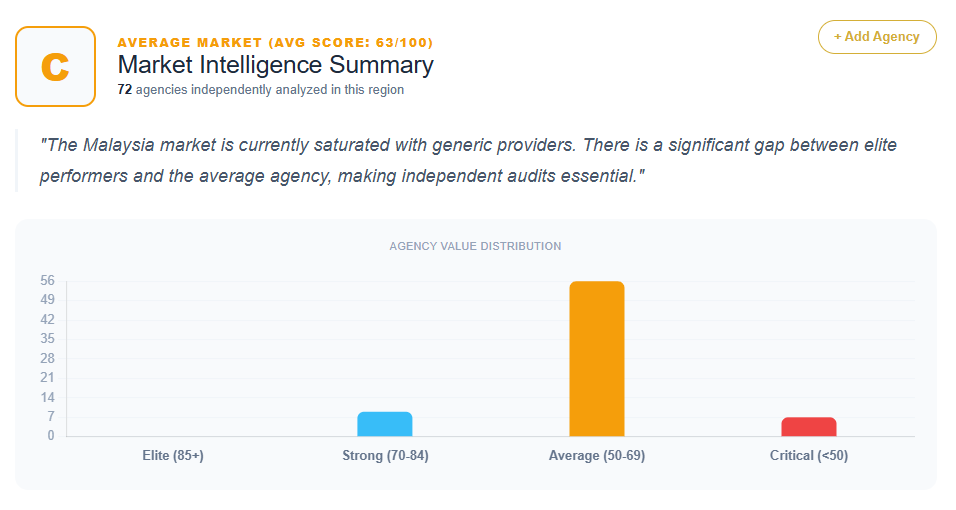
An analysis of 60 SEO agencies operating across Malaysia—concentrated primarily in Kuala Lumpur, Petaling Jaya, and Selangor, with regional hubs in Penang, Johor Bahru, Melaka, and East Malaysia—reveals a market characterized by high technical proficiency but significant strategic stagnation. While the technical “floor” of the market is stable, the majority of providers suffer from what is frequently diagnosed as the “Commodity Trap” or “Generalist Dilution.”
The quantitative data provided indicates a broad performance spectrum. Scores range from a peak of 82 (shared by Primal Digital Agency and SLAP Digital) to a low of 42 (held by five agencies: Win Makers, Verve Online Marketing, N9 Digital, Konx Solution, and Digital Fiverr). The most common scores cluster between 62 and 68, representing over 65% of the analyzed group. This suggests a “Sea of Sameness” where agencies meet basic operational requirements but fail to provide a unique strategic reason for high-value enterprise selection.
Looking for the best AI SEO agency in Malaysia?
Find out who can actually improve your search visibility and bring you more customers.
The Performance Spectrum: Analyzing the Scores
The hierarchy of the Malaysian SEO market is sharply defined by three tiers:
The “Alpha” Tier (Scores 80–82)
Only a fraction of the market—Primal and SLAP Digital—achieves scores above 80. These firms succeed by shifting the narrative from “SEO tasks” to “financial outcomes.” SLAP Digital’s hook of “Marketing that pays for itself” and Primal’s “Performance-First” messaging represent the high-water mark for market positioning. However, even at this level, the data notes a lack of proprietary technical frameworks, with both agencies prescribed to name and codify their internal processes.
The Authority and Specialized Tier (Scores 70–79)
Agencies in this bracket, such as SEO.MY (78), NexMind (74), and cmlabs (72), leverage specific moats. SEO.MY utilizes extreme domain authority, while NexMind attempts to lead through AI automation. However, NexMind is warned that its “AI-first” positioning creates a “black box” perception for Malaysian C-suite executives who prioritize human oversight. SEO.MY is penalized for a disproportionate reliance on its domain name rather than a unique technical edge.
The “Mid-Market Sea of Sameness” (Scores 58–68)
This is the most saturated segment. Agencies like Axcel Digital (62), Nextsclick (62), Ulement (68), and Digital People (68) are technically sound but strategically quiet. They are frequently diagnosed with “Generic Agency Syndrome” or “Strategic Anemia,” meaning their messaging is interchangeable with dozens of competitors.
See why claims of being the best SEO service provider—and paid rankings—should be questioned.
Check our independent, unbiased and unpaid SEO agency rankings by country, based on our Business Strategy Value Proposition Diagnostic.
Submit missing agencies for free, compare their value propositions, and finally visit their websites to make sure they’re the right choice for you.
Recurring Market Weaknesses: The Commodity Trap
The most prevalent diagnosis across the 60 agencies is the “Commodity Trap.” This affects both mid-tier and high-tier providers.
Feature-Selling vs. Outcome-Selling
Agencies like Cleverus (72), RankPage (68), Site Expert (62), and Juta Success (58) are identified as focusing on tactical deliverables—rankings, traffic, and keywords—rather than business-centric growth metrics. The data suggests that for a mid-market client spending RM 5,000/month, the inability to quantify the “alpha” of choosing one agency over another leads to price-shopping and higher churn.
We’ve evaluated all most important agencies in Malaysia with our Intelligence Engine.
Now you can compare their propositions and easily decide which one offers the right value for your business.
Superlative Fatigue
A unique weakness in the Malaysian landscape is the overuse of unverified superlatives. GoOnline Marketing, Webhero, TNT SEO, and Yea Business all claim to be “No. 1 in Malaysia” or the “Best SEO Agency.” The data characterizes this as “Superlative Fatigue,” noting that these claims act as a trust barrier rather than a hook, as they are not supported by proprietary data or clinical frameworks.
The Problem of Generalist Dilution
A significant number of providers suffer from “Generalist Dilution,” where SEO is offered as an add-on to unrelated services. This is categorized into two types:
- IT/Software-Led Generalists: Firms like VeecoTech (68), NetValue (58), and XCL Technologies (58) lead with software development. While they possess high technical roots, they fail to project specialized search authority. VeecoTech, for instance, is advised to pivot to “Engineering-Driven Search Growth” to leverage its developer background.
- Creative/Aesthetic-Led Generalists: Agencies like Slick (68), U-Creative (62), Kok Creative (68), and AsahiArts (62) over-index on “Storytelling” and “Digital Experiences.” The data indicates this creates friction for clinical SEO buyers who prioritize ROI over aesthetics. Slick is noted for having a world-class brand identity but communicating its technical value poorly.
Local Market Nuances: Multilingual SEO as a Missed Moat
Malaysia’s unique multilingual search landscape (English, Malay/Bahasa Melayu, Chinese/Mandarin, and Tamil) is a recurring theme in the prescriptions.
Agencies such as Weave Asia (64), NexMind (74), iDigitalise (62), and Dezeek Digital (65) are specifically urged to elevate multilingual SEO from a service list item to a core strategic differentiator. The data suggests that failing to address the specific search intent of Malaysia’s multi-ethnic demographics is a primary reason for generic positioning. For instance, NexMind is prescribed to develop “Local Language Search Intelligence” to differentiate its automated tools from global competitors like Jasper or SurferSEO.
Geographic Patterns: Klang Valley vs. Regional Hubs
The data shows a high concentration of competition in Kuala Lumpur and Petaling Jaya (Klang Valley), where agencies like SLAP, Primal, and found reside. However, regional players also show distinct patterns:
- Penang: SEO Penang (72) holds strong regional authority but is cautioned against “Founder-Dependency Syndrome” on Robin Ooi. Penang Web Design (54) and BM Web Design (62) are noted as budget-to-mid-tier options that struggle to compete nationally due to geographic “crutch” messaging.
- Johor Bahru: Xantec (62) and Meinfomedia (64) represent the Southern market but are diagnosed with the same “Commodity Loop” as their KL counterparts, often selling “Visibility” instead of “Revenue.”
- East Malaysia: Borneo Digital (62, Kuching) and Sabah Web Design (62, Kota Kinabalu) enjoy localized trust but face a “geographic glass ceiling” that prevents them from winning high-tier national enterprise contracts.
Need AI SEO services in Malaysia?
See which services, capabilities, and propositions actually match what your business needs.
ROI Impact of Weak Differentiation
The financial consequences of these strategic gaps are quantifiable within the ROI notes of the dataset:
- Conversion Loss: Non-differentiated value propositions are estimated to result in a 25–35% loss in potential high-ticket lead conversion (e.g., moreisweb, Yea Business).
- Price War Friction: Agencies like Axcel Digital and JK Design are forced into “Price-War Friction,” sacrificing 20–30% in potential profit margins to compete with freelancers.
- Extended Sales Cycles: For agencies like Ibex (76) or Ulement (68), the lack of a “Signature System” leads to 15–20% longer sales cycles as procurement teams default to comparing costs rather than value.
Prescriptions for Market Leadership
Across all 60 providers, the data offers a clear blueprint for market dominance in Malaysia:
- Productize Service Delivery: Move away from “SEO Packages” and toward named frameworks like “The MY-Market Growth Engine” (SEO.MY), “The Nuweb Revenue-First Framework,” or “The Ericanfly Growth Engine.”
- Shift to Revenue Attribution: Transition the core headline from “Digital Marketing” to “Revenue Acceleration,” moving the perception of SEO from a “cost center” to a “profit center.”
- Local Market Intelligence: Explicitly bridge the gap between technical SEO and Malaysia’s cultural nuances, such as optimizing for tri-lingual search behavior.
Conclusion
The analysis of these 60 providers demonstrates that the Malaysia SEO market is technically mature but strategically underdeveloped. The “Sea of Sameness” in the Klang Valley allows a handful of agencies like Primal and SLAP Digital to dominate by simply speaking the language of ROI. For the remaining agencies, particularly those scoring between 42 and 68, the path to premium positioning requires a total abandonment of generic “results-driven” language in favor of proprietary, productized systems that solve specific Malaysian market gaps. Until this shift occurs, price sensitivity and “Generalist Dilution” will continue to cap the growth of the majority of Malaysian agencies.
Get Your SEO Strategy