
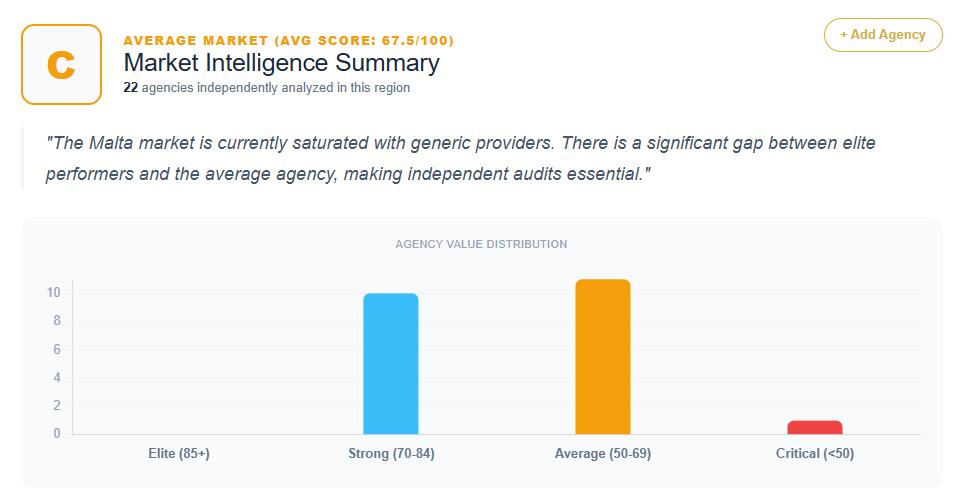
The digital marketing ecosystem in Malta is uniquely shaped by its position as a global hub for iGaming, Fintech, and high-end tourism. An analysis of 22 distinct SEO agencies operating within the Maltese archipelago—spanning the business hubs of Gzira, St. Julian’s, Birkirkara, and Valletta—reveals a market that is technically proficient but strategically homogenous. While technical fulfillment is high, a significant portion of the market struggles with what diagnostic data identifies as “Generalist Dilution” and the “Commodity Trap.”
Based on the provided dataset, agency scores range from a high of 78 (shared by 9H Digital and ICON) to a low of 48 (Vallettasoft). The performance hierarchy is tightly clustered, with over 60% of the analyzed group scoring between 62 and 74. This concentration highlights a common bottleneck: Maltese agencies are professionally presented and locally trusted, but they often use interchangeable “full-service” messaging that prevents them from achieving a dominant, elite-tier status.
Looking for the best AI SEO agency in Malta?
Find out who can actually improve your search visibility and bring you more customers.
The Performance Hierarchy: Analyzing the Scoring Clusters
The Maltese SEO market is tiered by its ability to bridge the gap between “technical services” and “market-specific ROI.”
High-Authority Strategic Performers (Scores 76–78)
Agencies like 9H Digital (78), ICON (78), and Growth Gurus (76) lead the market. These firms are characterized by high institutional trust and elite technical compliance, such as Microsoft Gold Partner status in the case of ICON. However, even at this level, there is a recurring theme of “Strategic Generalization.” 9H Digital and ICON are diagnosed with “Enterprise Dilution,” where their SEO offerings are buried under broader digital transformation narratives. This creates friction for sophisticated clients seeking specialized search dominance rather than a general digital firm.
The Specialized Performance Tier (Scores 72–74)
This bracket includes AWISEE (74), CasaSoft (74), Keen Ltd (74), The Concept Stadium (74), Switch (72), Fortis Media (72), and RockSteady (72). These agencies possess significant brand authority and local reputation. Fortis Media and AWISEE are particularly well-positioned for the iGaming and Fintech sectors. However, they frequently hit a “Vendor Trap” or “Technical Myopia.” AWISEE, despite its scale, is cautioned that its messaging feels like a “global template applied to Malta,” missing the regulatory-aware SEO intimacy that local iGaming operators prioritize.
The Competitive Mid-Tier (Scores 58–68)
Agencies like Gordon SEO (68), 4Sight Group (68), Systemato (68), Born (68), Webee (64), Untangled Media (62), Digital Creative Projects (62), and Alert Group (62) reside here. These firms are often trapped in “Commodity Messaging.” Gordon SEO is noted for “Freelancer Syndrome,” positioning its services as a set of tasks (rankings, traffic) rather than a strategic growth engine. Alert Group and Untangled Media suffer from “Legacy Dilution,” relying on their years in business rather than a proprietary methodology or modern performance-marketing urgency.
Regional and Budget Providers (Scores 48–54)
The lower end of the spectrum includes Skawoo (54) and Vallettasoft (48). These firms are diagnosed with “Commodity Fatigue,” leading with affordability and all-in-one convenience. This positioning signals a lack of specialized depth, making them invisible to high-ticket enterprise prospects who prioritize ROI over low overhead.
See why claims of being the best SEO service provider—and paid rankings—should be questioned.
Check our independent, unbiased and unpaid SEO agency rankings by country, based on our Business Strategy Value Proposition Diagnostic.
Submit missing agencies for free, compare their value propositions, and finally visit their websites to make sure they’re the right choice for you.
Recurring Strategic Weaknesses: The Generalist Trap
The most prevalent diagnosis across the 22 providers is “Generalist Dilution.” In a market as specialized as Malta, agencies that try to be a “one-stop-shop” (IT, hosting, web design, and SEO) often fail to establish categorical authority.
Creative vs. Technical Misalignment
Firms like Switch, The Concept Stadium, and Born lead with creative aesthetics and brand storytelling. While this builds brand equity, it creates friction for SEO procurement. The diagnostic data for Switch highlights that its value proposition is “heavily weighted toward human-centric branding,” making SEO appear as a secondary tactical add-on. Similarly, The Concept Stadium’s “Commercial Creative” identity attracts branding clients but obscures technical SEO depth, leading to an estimated 15–22% loss in potential search-specific lead conversion.
The Commodity Trap and Price Sensitivity
Agencies like Robowolf Digital (58) and Webee (64) are noted for using “me-too” positioning. By describing what they do (SEO, PPC) rather than how they uniquely solve problems, they force themselves into price-based competition. For Robowolf, this lack of differentiation results in a “race to the bottom” on pricing, as prospects view their service as interchangeable with a dozen identical competitors.
We’ve evaluated all most important agencies in Malta with our Intelligence Engine.
Now you can compare their propositions and easily decide which one offers the right value for your business.
Local Market Nuances: iGaming and Compliance
A unique characteristic of the Malta SEO landscape is the dominance of the iGaming hub economy. The data suggests that “Regulatory-Aware SEO” is a critical but often underutilized moat.
Fortis Media (72) and AWISEE (74) are specifically noted for their focus on this sector. However, the diagnosis for AWISEE indicates that failing to highlight “Maltese Market Nuance” and regulatory compliance creates friction with local stakeholders. The prescription for these agencies is to lean harder into the “iGaming Insider” angle to differentiate from generalist international firms.
Another local nuance is the trust gap regarding remote agencies. SEO Growth Hub (58), which operates as a global remote agency, is diagnosed with “Generic Globalism.” In a “high-trust, relationship-driven business culture” like Malta, the lack of localized social proof and physical presence results in an estimated 30% reduction in lead conversion rates.
Quantifying the ROI of Strategic Misalignment
The financial consequences of poor strategic positioning are explicitly quantified in the ROI notes for these 22 agencies:
- Lower Lead-to-Close Ratios: Generic messaging for agencies like Gordon SEO and Untangled Media likely results in a 25–35% lower close rate on high-ticket enterprise contracts.
- “Generalist Tax”: For firms like ICON and 9H Digital, the failure to isolate SEO as a specialized pillar results in longer sales cycles and the loss of high-intent search leads to boutique specialists.
- Revenue Leakage: Keen Ltd and CasaSoft are estimated to lose 15–25% of potential organic-specific contract value due to perceived lack of technical depth or creative-heavy perception.
- Retention and Churn: Commodity messaging at firms like AWISEE leads to a 15–22% reduction in potential Lifetime Value (LTV), as clients view link-building as a project-based expense rather than an essential strategic investment.
Need AI SEO services in Malta?
See which services, capabilities, and propositions actually match what your business needs.
Prescriptions for Market Dominance: Outcome Architecture
Across the 22 agencies, the prescriptions for growth are remarkably consistent. To escape the “middle-market bottleneck,” Maltese providers are urged to move from service descriptions to “Outcome Architecture.”
- Pivot to “Revenue Engineering”: Agencies like Systemato and Vallettasoft are advised to shift their narrative from “We write content” or “Web Design” to “SEO Revenue Engineering” and “Driving Measurable Organic Growth.”
- Productize Methodologies: The data recommends that agencies name and codify their internal processes. Proposed framework names include The Fortis Velocity System, The Wolf-Alpha Framework, and The Systemato Visibility Index.
- Vertical Specialization: Instead of “General Digital Marketing,” agencies are encouraged to become the “Authority in iGaming SEO” or the “Luxury Real Estate Growth Partner.”
- Proof of Impact: Replacing generic testimonials with clinical performance reports that highlight traffic-to-revenue conversion metrics is essential for firms like Keen Ltd and Born.
Conclusion: Strategic Outlook
The Malta SEO market is currently home to many “reliable providers” but very few “strategic disruptors.” The data indicates that the highest scores (76–78) are currently reserved for firms that have achieved enterprise scale or Microsoft Gold certifications, but even they are ceding ground in specialized technical niches.
The agencies that will dominate the next decade in Malta are those that can successfully decouple their SEO methodology from broad creative or IT services. Until the mid-tier agencies in Birkirkara and Gzira stop listing features and start architecting revenue-focused search strategies, they will continue to pay a “Genericity Tax” through lower margins and high client churn. In Malta’s hyper-competitive SERPs, the only sustainable moat is a unique, proprietary methodology that respects both technical data and local regulatory nuances.
Get Your SEO Strategy