
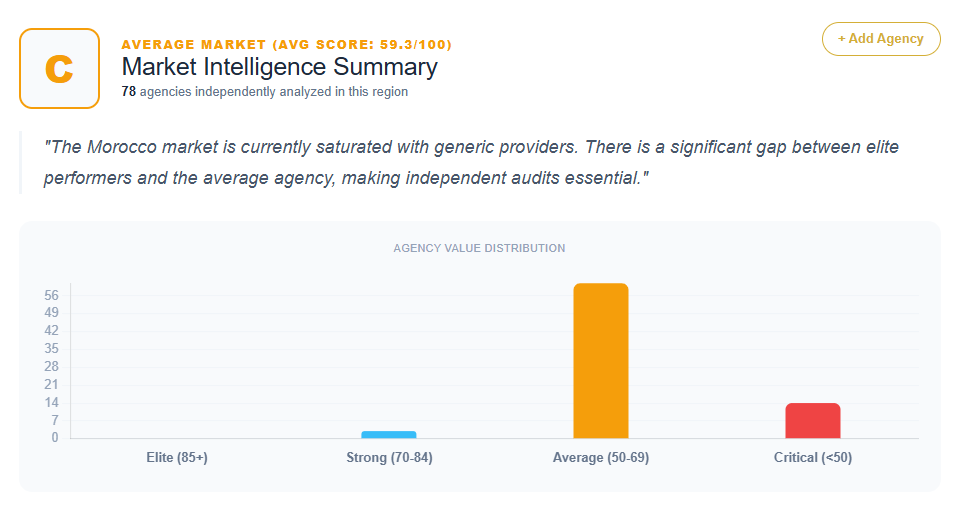
The digital marketing landscape in Morocco is defined by a high volume of operational activity but a significant deficit in strategic “Only-ness.” An analysis of more than 70 distinct agency profiles and diagnostic reports—ranging from high-end corporate firms in Casablanca’s Twin Center to regional boutiques in Agadir and Tangier—reveals a market that is technically functional but strategically stagnant.
The quantitative data shows a performance spectrum peaking at a score of 78 (Void) and reaching a low of 35 (FCPO). The vast majority of the market is clustered in a “Mid-Tier Sea of Sameness,” with scores predominantly falling between 58 and 68. This suggests that while the technical baseline is established, few providers have successfully decoupled their value from commodity-level service delivery.
Need AI SEO services in Morocco?
See which services, capabilities, and propositions actually match what your business needs.
Quantitative Overview: The Scoring Hierarchy
The hierarchy of the Moroccan SEO market is sharply defined by three tiers based on strategic maturity:
- The High-Authority Performers (Scores 74-78): Only a handful of entities, such as Void (78), Growth.ma (74), and Belaadel (74), reach this level. These firms are characterized by high brand prestige and technical depth. However, even at this level, the data notes a “Consultancy Trap” or “Buzzword Ambiguity,” where brand philosophy often obscures immediate service utility.
- The Competitive Middle (Scores 62-68): This is the most saturated segment, featuring agencies like TwiceBox, SEOManiak, Inventis, BeBrand, and Digitree. These firms are professionally presented but are frequently penalized for “Generalist Dilution”—attempting to offer everything from print and branding to high-stakes SEO, which weakens their perceived specialized authority.
- The Commodity Floor (Scores 32-58): This tier includes legacy providers, regional generalists, and hosting-centric firms like Hostino (42), Fès Web (42), Artiweb (42), and ITSHYD (38). These providers are consistently diagnosed with “Commodity Syndrome,” where SEO is treated as a technical checklist or a software module rather than a revenue-driven growth engine.
Recurring Themes: The “Generalist Trap” and Strategic Dilution
Perhaps the most significant pattern identified across the dataset is “Generalist Syndrome.” Agencies like Webeuz (64), Market Media (64), and GeoMedia (64) are diagnosed as diluting their expertise by positioning as “360-degree” agencies. The data indicates that by trying to be everything to everyone, these firms fail to establish the clinical authority required for high-ticket SEO acquisition.
Feature-Centric vs. Outcome-Centric Messaging
A recurring weakness is the reliance on “What” rather than “Why.” Fornet (62), Linkup Media (58), and Agadir Web (42) focus on technical features like indexing and meta tags. This “Legacy IT Mindset” fails to address the ROI-driven anxieties of the modern Moroccan enterprise. For example, the diagnosis for Agadir Web notes that the site functions as a “digital brochure” rather than a conversion engine, failing to sell the “value” of search.
Superlative Fatigue and Superficially High Authority
The data highlights a unique phenomenon in Morocco involving “Exact Match Domains” (EMD). Firms like SEO.ma (42), Référencement Maroc (62), and SEO Morocco (58) own premium digital real estate, yet they are frequently diagnosed as “Hollow Authorities.” Relying on a domain name for authority rather than a proprietary methodology creates a “Race to the Bottom” on pricing, as these agencies attract low-intent price shoppers rather than high-value partners.
Looking for the best AI SEO agency in Morocco?
Find out who can actually improve your search visibility and bring you more customers.
The Trilingual Moat: Arabic, French, and Darija Search Complexity
Morocco’s unique search landscape—characterized by a hybrid of French, Modern Standard Arabic, and Darija—represents a major competitive gap. Agencies such as Howdycode (68), Tingis Web (48), and OneProSE (58) are specifically criticized for failing to explicitly leverage this trilingual complexity as a core differentiator.
The dataset identifies “Linguistic Friction” as a primary reason for the failure of international agencies like Curamando (42), Sleeping Giant Media (38), and ZEWS Web (42) to penetrate the local market. These firms project “Western-centric” models that ignore regional search intent patterns. The diagnosis for ZEWS Web explicitly notes a “Geographic Mismatch,” suggesting that a lack of Darija/French keyword intelligence leads to a 70% lower conversion rate for local leads compared to native competitors.
See why claims of being the best SEO service provider—and paid rankings—should be questioned.
Check our independent, unbiased and unpaid SEO agency rankings by country, based on our Business Strategy Value Proposition Diagnostic.
Submit missing agencies for free, compare their value propositions, and finally visit their websites to make sure they’re the right choice for you.
Regional Hub Analysis: Casablanca vs. Agadir and Marrakech
The location of an agency in Morocco significantly correlates with its strategic flaws:
- Casablanca (The Corporate Epicenter): Home to firms like Novad Agency (64), Rankly Media (68), and Void (78). Agencies here compete on “Full-Service Excellence” but are often trapped by “Institutional Genericness.” The data suggests these firms pay a “Doubt Tax,” as potential clients spend more time comparing prices because the value proposition isn’t uniquely articulated.
- Agadir (The Regional Generalist Hub): Agencies like Webeuz, Linkup Media, and Arfblue (62) enjoy strong local relevance but hit a “Geographic Crutch” ceiling. They are cautioned that over-indexing on their regional location inadvertently signals a limit on their technical capabilities for national enterprise contracts.
- Marrakech (The Tourism Specialists): Guide Web (64) and YesWelcome (58) are prescribed to pivot from “Digital Agency” to “Growth Architects for Tourism/Real Estate” to capitalize on their geographic context as a strategic advantage.
We’ve evaluated all most important agencies in Morocco with our Intelligence Engine.
Now you can compare their propositions and easily decide which one offers the right value for your business.
Quantifying the ROI of Strategic Misalignment
The dataset provides concrete estimations of the financial toll taken by weak differentiation:
- Margin Suppression: Agencies like Webeuz and Market Media face a potential 15-25% suppression in profit margins due to price-based competition.
- Conversion Leaks: The lack of a sharp USP leads to a 20-30% leak in the lead-to-opportunity conversion rate for firms like Vocus Digital (62) and Garraje (64).
- Customer Acquisition Cost (CAC): Generalist positioning for firms like Octeria (62) and Varlorys (62) leads to 20-30% higher acquisition costs because they must compete on a broad range of keywords against both niche specialists and massive creative firms.
- Revenue Gap: The diagnosis for FCPO (35) suggests that by selling SEO as a flat-rate shop item, the agency loses high-value e-commerce clients to firms that can demonstrate revenue growth, resulting in significant missed revenue in their integration vertical.
Prescriptions for Market Dominance: The Move to Productization
Across nearly all 70+ diagnoses, the most frequent prescription for growth is “Productization.” To escape the “Commodity Trap,” Moroccan agencies are urged to develop named, proprietary frameworks. The dataset identifies several proposed methodologies:
- The Webeuz Authority Bridge
- The MM-Impact Methodology
- The Vocus Local-to-Global Engine
- The Diavnet Alpha Search Framework
- The Atlas Growth Protocol (for Picaxel)
By shifting from selling “SEO Services” to selling a “Proprietary System,” agencies can move away from hourly-rate perception and justify premium retainers. Furthermore, the data recommends replacing generic headers with “Outcome Headers,” such as “Dominating Moroccan Search Landscapes” or “Scaling Organic Revenue,” to move the conversation from “tasks” to “impact.”
Conclusion: Strategic Outlook
The Morocco SEO market is at a crossroads. While the technical infrastructure is sound, the strategic narrative is currently missing for most players. The market is top-heavy with “360-degree” agencies that are “safe but invisible” in high-stakes bidding environments.
The next generation of market leaders in Morocco will be those who can bridge the gap between “Creative Tech” and “Clinical ROI.” This requires a radical decoupling from generic “Digital Agency” branding in favor of specialized, trilingual growth frameworks. Until Moroccan agencies—particularly those in the 58-68 score range—stop listing features and start owning unique methodologies, they will continue to pay the “Genericness Tax” through lower margins and high client churn. The data concludes that in a saturated landscape, “specialization” is the only sustainable moat.
Get Your SEO Strategy