
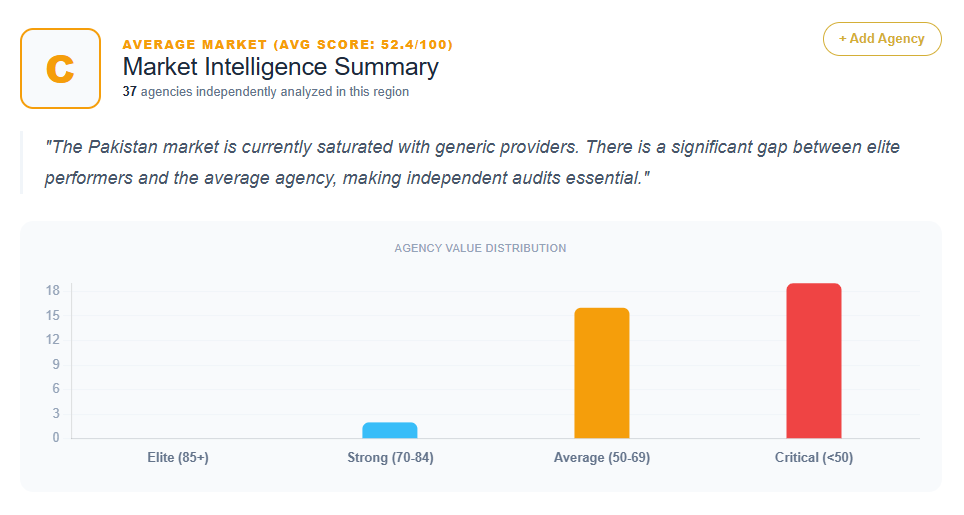
The SEO market in Pakistan presents a significant paradox: it is home to immense technical talent and large-scale operational infrastructure, yet it suffers from a profound deficit in strategic differentiation. Based on diagnostic data from 37 distinct SEO agencies and consultants operating in major hubs like Karachi, Lahore, Islamabad, and Faisalabad, the market appears heavily weighted toward “commodity” fulfillment. While technical execution is often verified, the majority of providers fail to articulate a unique “Growth Engine” or proprietary methodology that justifies premium enterprise-level pricing.
The quantitative scores across the 37 analyzed entities range from a market high of 78 (Digitz-Digitas) to a low of 32 (Hyderabad Web Design). The heavy concentration of scores in the 42–58 range—representing over 50% of the dataset—signals a “Sea of Sameness” where messaging is indistinguishable from low-cost freelancers, leading to significant revenue leakage and higher churn rates for the agencies involved.
The Performance Hierarchy: Analyzing the Scoring Tiers
The Pakistani SEO market is tiered by its ability to bridge the gap between “technical tasks” and “business outcomes.”
The Authority Tier (Scores 68–78)
Only a handful of agencies achieve scores above 70. Digitz-Digitas (78) leads the market, leveraging its Publicis Groupe network pedigree. However, even at this elite level, the agency is diagnosed with a lack of technical transparency, as its SEO messaging is often buried under broad creative rhetoric. Digital Eggheads (72) follows with a strong brand presence in Karachi but is penalized for a generic SEO value proposition that doesn’t separate it from specialized boutiques. Sybrid (68) and Navicosoft (68) represent high-authority providers that are currently hampered by “Conglomerate Dilution” and legacy hosting identities, respectively.
The Mid-Market Performance Tier (Scores 60–67)
Agencies like BrainX Technologies (64), Artimization (64), Vizz (64), Webicosoft (62), and Rank Higher (62) represent a technically competent middle ground. These firms often have high operational capacity but are frequently trapped by “Generalist Friction.” For instance, BrainX and Vizz prioritize their identities as software houses, treating SEO as a secondary add-on. This misalignment results in a “Generalist Tax,” where they likely experience 30–40% lower conversion rates on pure SEO inquiries compared to specialized firms.
The Commodity Floor (Scores 32–59)
The largest segment of the market scores below 60. This includes firms like SEO.com.pk (58), IT-Vision (46), B9 Solutions (42), and ITSHYD (38). These agencies are consistently diagnosed with “Strategic Anemia” or “Commodity Syndrome.” Their value propositions rely on generic superlatives like “Best Agency” or “No. 1 SEO,” which act as trust barriers rather than hooks. The ROI notes for this tier indicate that these firms are often forced into price-driven negotiations, resulting in a 30–50% suppression of Average Contract Value (ACV).
Recurring Strategic Weaknesses: The “Generalist Trap”
A dominant pattern observed across nearly all 37 diagnoses is “Generalist Dilution.” In the Pakistani market, there is a recurring trend where software development houses or BPO conglomerates attempt to bundle SEO as an auxiliary service.
Software House Myopia
Firms such as KoderLabs (42), BrainX (64), and VativeApps (42) identify primarily as developers. Their SEO value propositions are characterized by a feature-heavy narrative (“what we do”) rather than a result-driven narrative (“what we solve”). The data suggests that this dev-first mindset creates high friction; for instance, VativeApps is noted for potentially losing 25–35% in high-ticket service revenue because its messaging fails to address the specific algorithmic challenges of the modern search landscape.
Conglomerate Dilution
Large entities like Sybrid (68) and ITSHYD (38) treat SEO as a modular commodity within a 360-degree marketing suite. This creates strategic friction for high-intent clients who seek specialized expertise. The diagnosis for Sybrid notes that they likely lose 15–25% of high-value contracts to smaller “expert-labeled” competitors because their corporate messaging is too “safe” and non-aggressive.
Themes in Value Propositions: Commodity Messaging vs. EMD Reliance
The dataset reveals a high reliance on “Exact Match Domains” (EMD) and generic industry jargon as surrogates for actual strategy.
- EMD Reliance: Agencies like SEO Pakistan (48), Pak SEO Services (42), SEO.com.pk (58), and SEO Experts Pakistan (58) rely heavily on the organic strength of their domain names. However, the data notes that this often leads to a “Commodity Trap” where the brand lacks a unique strategic identity beyond its URL.
- Jargon Satiation: Messaging centered on “rankings,” “traffic,” and “top-notch services” is ubiquitous. B9 Solutions (42) and Rank Higher (62) are specific examples where “Chronic Genericism” prevents prospects from distinguishing the agency from a low-cost freelancer. The result is a “Comparison Tax” estimated at 25% for Rank Higher, as clients audit them purely on price.
Regional Hub Analysis: Hub Specificity and Geographic Friction
The location of an agency in Pakistan significantly influences its competitive positioning and strategic flaws.
- Karachi (The Corporate Center): Home to Digitz-Digitas, Digital Eggheads, and Sybrid. Agencies here focus on “Digital Transformation” but struggle with “Generalist Dilution.” Digital Solutions (42) represents the lower-tier commodity segment in this hub, losing up to 45% in profit margins due to price-based competition.
- Lahore (The Tech Hub): Hub for Navicosoft, BrainX, and Vizz. This region is the epicenter of the “Software-Led SEO” trap. Lahore-based firms like Xperts Digital (48) and TheTechtics (58) are cautioned for being “strategically invisible,” competing on service breadth rather than vertical dominance.
- Faisalabad & Multan (The Regional Challengers): Agencies like Webicosoft (62) and IT-Vision (46) in Faisalabad, or Multan IT Solutions (42), compete on “accessibility” but hit a ceiling when targeting national enterprise accounts. Multan IT, for instance, faces a 60–70% loss in potential conversion because its hyper-local keywords undermine its authority for high-ticket global clients.
- Hyderabad (The Trust Gap): The most extreme case of “Geographic Friction” is Hyderabad Web Design (32). By targeting a generic city name that exists in both India and Pakistan but providing Indian contact details, the agency suffers a “Trust Tax,” with conversion rates expected to drop by 70–80% for Pakistani prospects.
Quantifying the ROI of Strategic Misalignment
The financial consequences of poor differentiation are explicitly quantified in the dataset:
- Lead-to-Close Leakage: Generic positioning at Xperts Digital (48) and Pak SEO Services (42) leads to a projected 30–50% loss in lead-to-close efficiency.
- Opportunity Cost: ITHeight (52), a legacy generalist, is estimated to lose 35–45% of potential annual recurring revenue (ARR) due to an inability to justify premium pricing over freelancers.
- CAC Inflation: Agencies like TechLooper (58) and ISB Digital (48) face higher Customer Acquisition Costs because their websites fail to pre-qualify leads or provide clinical proof of authority.
Prescriptions for Market Dominance
Across the 37 agencies, the prescriptions for growth are remarkably consistent. To move into the “Expert” tier (scores of 80+), Pakistani providers are urged to:
- Productize the Process: Instead of selling “SEO services,” agencies are advised to develop named, proprietary frameworks. Suggestions include “The Pak-Alpha Framework” (SEO Pakistan), “The Vizz Velocity SEO Audit” (Vizz), or “The 4-Pillar Pak-Growth Engine” (Pak SEO Services).
- Outcome-First Messaging: Pivot from “we provide keywords” to “we scale revenue.” This is a critical recommendation for firms like VativeApps and Artimization.
- Vertical Specialization: Agencies are encouraged to move away from the “one-stop-shop” model and own a specific niche, such as “SEO for Pakistani Exports” (B9 Solutions) or “SEO for Real Estate” (SoftSq).
- Local Market Intelligence: Use localized success stories and PKR/USD growth metrics to establish authority. This is specifically recommended for SoftSq (48) and Soft Solutions (58).
Conclusion: The Path from Utility to Strategy
The Pakistan SEO market is currently characterized by a surplus of technical providers and a shortage of strategic partners. With an average score lingering in the mid-50s, the market is ripe for disruption by agencies that can successfully decouple from the “Service-Provider” model.
The data concludes that while the technical infrastructure (hosting, software development, BPO scale) is world-class, the strategic narrative is stagnant. For an agency in Lahore or Karachi to capture the top 10% of the market share, it must stop describing SEO tasks and start owning a unique, productized methodology that directly links search dominance to business revenue growth. Until this strategic pivot occurs, price-sensitivity and “Generalist Dilution” will continue to cap the market’s potential.
Get Your SEO Strategy