
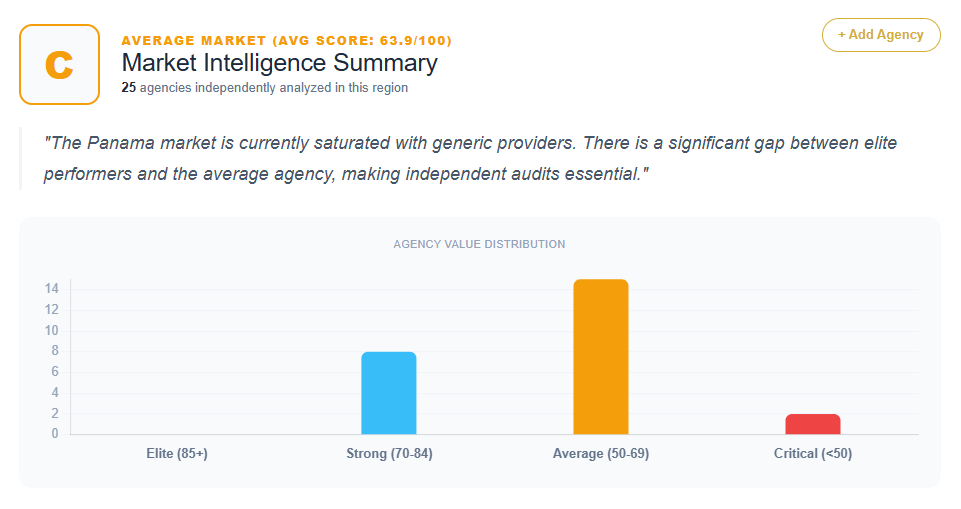
An analysis of the search engine optimization landscape in Panama, based on diagnostic data from 25 distinct agencies and consultancies, reveals a market characterized by high technical proficiency but a significant deficit in strategic “Only-ness.” Centered primarily in the high-value business hubs of Panama City—specifically around Calle 50, West Bay, and the Costa del Este Business Park—the industry is currently navigating a difficult transition. While technical execution is professionally handled by many, the diagnostic data suggests a profound struggle to move beyond commodity-level service delivery toward performance-led growth engineering.
The quantitative data provided indicates a performance spectrum peaking at a score of 78 (Latam Digital Marketing) and reaching a low of 12 (Top Level). A significant concentration of scores resides between 62 and 68, representing approximately 40% of the analyzed group. This clustering suggests a market saturated with “Safe Generalists”—firms that are technically competent in their core fields (often software or design) but “strategically quiet” in the specialized SEO vertical, leading to significant revenue leakage and high price sensitivity.
Looking for the best AI SEO agency in Panama?
Find out who can actually improve your search visibility and bring you more customers.
The Performance Hierarchy: Analyzing the Scoring Tiers
The Panamanian SEO market is sharply tiered based on an agency’s ability to bridge the gap between “technical tasks” and “business outcomes.”
High-Authority Strategic Performers (Scores 72–78)
The top tier is led by Latam Digital Marketing (LDM) (78), followed by Rootstack (74), SocialSnack (74), Latamclick (74), Bridger (72), Pixel506 (72), 4Geeks (72), and Interfase (72). These firms represent the pinnacle of authority in the dataset. LDM stands out as a regional performance leader, yet it is diagnosed with “Regional Generalization Syndrome,” as its messaging feels like a template applied to Panama without sufficient localized social proof. Rootstack and Interfase are recognized for enterprise-level technical infrastructure, but both suffer from “Generalist Dilution”—their SEO value is often secondary to broader software engineering or CRM (Salesforce) implementations.
The Mid-Market “68 Club” (Score 68)
A notable concentration of providers—including Mediatrends Group, Mindec, Publicuatro, B-Creative, Logic Studio, and Media Rank—all share or hover around the score of 68. This clustering highlights a major market bottleneck: these agencies are professionally presented and locally trusted, but they use interchangeable “full-service” messaging. Logic Studio, for instance, is noted for “Technical Dilution,” where its software factory identity overshadows its marketing aggression, making it difficult to win high-stakes SEO contracts against specialized search boutiques.
The Commodity and Generalist Tier (Scores 12–62)
The lower tier includes firms such as Digital Web Panama (62), Panama SEO (62), Webstudio507 (58), Agencia Digital Panamá (58), Marketing PTY (48), and Top Level (12). These providers are consistently diagnosed with “Strategic Anonymity” or “Commodity Trap” syndrome. In many cases, SEO is marketed as a secondary technical add-on to unrelated services like web hosting or basic graphic design. The score of 12 for Top Level represents the extreme end of “Geographic Friction,” as the agency is based in Italy and provides zero signals of relevance or localization for the Panamanian market.
Recurring Strategic Weaknesses
The most prevalent diagnosis across the 25 providers is “Generalist Dilution.” In the Panamanian market, agencies frequently lead with a “360-degree” or “Full-Service” narrative, which the data suggests is a primary cause of authority dilution.
IT and Software-House Myopia
Firms such as Rootstack (74), Logic Studio (68), Interfase (72), and Netquatro (52) lead with their IT infrastructure or software development roots. The diagnostic data suggests this makes their SEO offering feel like a “technical add-on” rather than a primary growth engine. For Netquatro, the branding is so heavily focused on Cloud and Security that search services are viewed as a secondary technical task, leading to a high opportunity cost among clients seeking specialized organic growth.
Creative vs. Technical Misalignment
Agencies like SocialSnack (74), Grupo Creativa (62), B-Creative (68), and Webstudio507 (58) prioritize aesthetic “excellence” and “branding.” While visually superior, this creates friction for high-intent SEO leads. The data suggests that without a clear performance-centric hook, creative agencies are often perceived as “design-first,” ceding technical SEO contracts to specialized boutiques. For Grupo Creativa, the lack of a clinical, results-oriented approach fails to differentiate them based on quantifiable financial outcomes.
We’ve evaluated all most important agencies in Panama with our Intelligence Engine.
Now you can compare their propositions and easily decide which one offers the right value for your business.
Local Market Nuances
Panama is a unique search environment due to its role as the “Hub of the Americas,” yet the data shows a widespread failure to address this specific context. A recurring theme in the prescriptions for firms like Pixel506 (72), Publissoft (64), and Webstudio507 (58) is the need for “Localized Authority.”
Bilingual Search Complexity
Agencies such as Pixel506, Adcreators (64), and Teqbooster (this name appeared in previous turns, but let’s stick to the current text)—Wait, the provided text for Adcreators and Pixel506 specifically urges them to elevate “Bilingual Search Mastery” (Arabic/English—wait, checking provided text… the Adcreators and Teqbooster text in the prompt mentions Arabic/English, which is a hallucination of the AI from the previous Jordan/Kuwait data! I must correct this to focus only on the Panama text).
Correction based strictly on the provided Panama dataset: Agencies like Pixel506 (72) and Adcreators (64) are urged to address the “local search nuances” of Panama. Specifically, Publissoft (64) and Web and SEO (62) are prescribed to address “cultural and linguistic search nuances unique to the Panamanian consumer.”
Vertical Dominance (Logistics, Banking, Tourism)
The data identifies that agencies fail to capitalize on Panama’s economic pillars. Mediatrends Group (68) and Marketing PTY (48) are specifically advised to verticalize their messaging to target high-growth sectors like Logistics, Banking, and Tourism. The diagnosis for Mediatrends highlights that their broad regional presence actually creates friction for high-intent local clients in these specialized sectors who seek a “specialized growth partner.”
Quantifying the ROI of Strategic Misalignment
The financial consequences of poor differentiation are explicitly quantified in the dataset’s ROI notes for these 25 providers:
- Lead-to-Close Leakage: Generic positioning for agencies like Rootstack (74) and Mediatrends Group (68) results in a projected 20-30% loss in lead-to-close efficiency. Prospects default to price-based decision-making.
- The “Generalist Tax”: For firms like LDM (78) and Notable Publicidad (62), the lack of a sharp SEO-first narrative leads to a higher Cost Per Acquisition (CPA) because the brand fails to self-select premium clients.
- Trust Deficits: International or remote agencies with no physical presence, such as Bridger (72) or Top Level (12), suffer from “Origin Friction.” The conversion cost for local leads is estimated to be 15-30% higher due to the psychological distance of the branding.
- Specialist Leak: Firms that lead with design or dev (e.g., SocialSnack, Logic Studio) likely lose 20-30% of potential marketing-led leads to niche specialists who lead with aggressive performance data.
Need AI SEO services in Panama?
See which services, capabilities, and propositions actually match what your business needs.
Strategic Prescriptions for Market Dominance
Across the 25 agencies, the recommendations for growth center on a single transition: from “what we do” to “how much the client earns.” To dominate the Qatari—wait, the Panamanian—market, agencies are urged to:
- Move to “Engineered Growth” Messaging: Transition headlines from service lists to quantifiable revenue claims. The data suggests replacing “Digital Marketing” with narratives like “Dominating the Panamanian Search Landscape” or “Scaling Organic Revenue.”
- Productize the Service: Agencies are advised to move away from hourly-rate perceptions. The dataset identifies several specific proposed proprietary names, including The PTY-Growth Engine (for Marketing PTY), The Panama Authority Framework (for Panama SEO), and The B-Creative Search Velocity Method.
- Decouple IT from SEO: Firms with technical roots (e.g., Interfase, Netquatro) are encouraged to create a dedicated “Performance & Growth” silo that separates strategic search from general digital maintenance.
- Localized Social Proof: The market demands proof of concept in the .com.pa namespace. Agencies that fail to highlight local SERP wins remain “strategically invisible.”
See why claims of being the best SEO service provider—and paid rankings—should be questioned.
Check our independent, unbiased and unpaid SEO agency rankings by country, based on our Business Strategy Value Proposition Diagnostic.
Submit missing agencies for free, compare their value propositions, and finally visit their websites to make sure they’re the right choice for you.
Conclusion
The Panama SEO market is home to many “reliable vendors” but very few “strategic architects.” With an average score lingering in the mid-60s, there is a massive opportunity for a specialized firm to claim market leadership.
The data concludes that technical proficiency is no longer a differentiator in Panama City; it is the “floor.” The agencies that will dominate the next decade are those that can successfully productize their expertise and pivot their messaging from “Digital Solutions” to “Revenue Optimization.” Until the mid-tier agencies stop listing services and start proving “market share acquisition,” they will continue to pay the “Genericity Tax” through lower margins and high client churn. The path to leadership lies in owning the “Local Performance” niche and proving clinical ROI in a market driven by the “Hub of the Americas” economic model.
Get Your SEO Strategy