
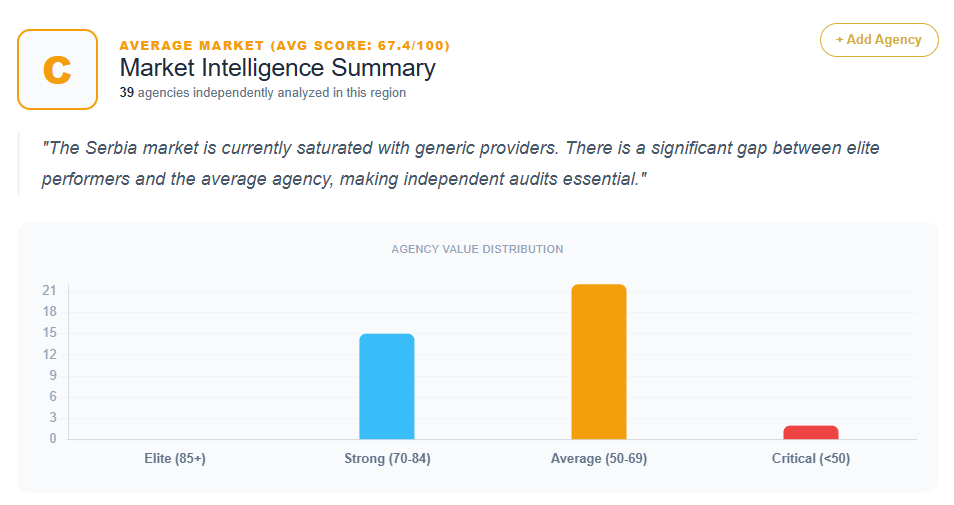
An analysis of 39 distinct SEO agencies and digital consultancies currently operating in Serbia reveals a market characterized by high technical proficiency but significant strategic stagnation. Centered primarily in Belgrade, with active hubs in Novi Sad, Niš, and Subotica, the industry is currently navigating a difficult transition from generic “digital service” provision to performance-led growth engineering. Based on diagnostic data, the vast majority of Serbian providers struggle with what is frequently identified as the “Generalist Trap”—a condition where full-service breadth dilutes technical search authority.
The quantitative data provides a clear performance hierarchy. Scores across the 39 analyzed entities range from a market high of 82 (shared by Four Dots and Flow Ninja) to a low of 42 (shared by Marketing NP and B9 Solutions). A heavy concentration of scores resides between 62 and 72, representing nearly 60% of the analyzed group. This clustering suggests a market saturated with “Safe Generalists”—firms that are technically competent but strategically quiet, leading to significant revenue leakage and high price sensitivity in the domestic mid-market.
Looking for the best AI SEO agency in Serbia?
Find out who can actually improve your search visibility and bring you more customers.
The Performance Hierarchy: Analyzing the Scoring Tiers
The Serbian SEO market is sharply tiered based on an agency’s ability to bridge the gap between “technical implementation” and “commercial outcomes.”
The “Alpha” Tier (Scores 78–82)
The top tier is led by Four Dots (82) and Flow Ninja (82). These firms represent the pinnacle of authority in Serbia, yet they face distinct strategic hurdles. Four Dots is recognized for its elite status as an agency that builds its own SEO software (Dibz, Reportz), yet its diagnosis points to “Corporate Generalization,” where generic marketing language masks its proprietary technical edge. Flow Ninja, conversely, dominates a high-end niche in Webflow Enterprise development, but suffers from “Platform-Locked Positioning,” which creates a barrier for the 70% of Serbian enterprises using legacy CMS platforms.
Following closely are SEO Expert Serbia (78), Lobo House (78), Videnov Digital (78), and Brisbane Digital (78). These firms are distinguished by their focus on individual authority or high-intent performance metrics. SEO Expert Serbia leads in organic visibility for core Serbian terms like “SEO optimizacija,” but is cautioned against the “Expert Trap”—where the brand is perceived as a high-end consultancy rather than a scalable growth engine.
The Mid-Market Performance Tier (Scores 68–76)
This bracket includes agencies like Homepage (76), W3 Lab (74), Studio Present (74), Funnelist (74), and Deluminal (72). These firms are professionally stable but often suffer from “Strategic Misalignment.” For instance, Homepage is noted for a creative-first identity that demotes SEO to a secondary service, while Studio Present’s elite technical capability in Drupal is occasionally masked by generalist messaging.
A significant cluster at the 68 mark includes Digital Cortex, Semrail, Coframe, Broworks, Active Media, CodeIT, and Digital Push. These agencies are professionally presented but are frequently diagnosed with “Commodity Syndrome.” The data suggests that for agencies like Semrail, a lack of a sharp differentiator forces them into price-based negotiations, likely resulting in a 20-30% reduction in potential client lifetime value (LTV).
The Regional and Utility Tier (Scores 42–64)
The lower end of the spectrum includes regional providers and legacy IT firms such as SmartWeb (64), Webelement (64), M-Web (62), Cronos Dev (62), MaTeam (62), Chillbyte (62), NiNet Company (62), and AS Media (62). The bottom tier, featuring Marketing NP (42) and B9 Solutions (42), is characterized by “Chronic Genericism,” where the lack of a unique mechanism makes them indistinguishable from low-cost freelancers.
Need AI SEO services in Serbia?
See which services, capabilities, and propositions actually match what your business needs.
Recurring Strategic Weaknesses: The Generalist Trap
The most prevalent diagnosis across the 39 providers is “Generalist Dilution.” In the Serbian market, agencies frequently lead with a “360-degree” or “Full-Service” narrative, which the data suggests is a primary cause of authority dilution.
IT and Software House Dilution
Firms like Ingsoftware (58), KoderLabs (42), and CodeIT (68) lead with software development roots. While they possess superior technical resources, they treat SEO as a “bolt-on” or “auxiliary” service. The diagnosis for Ingsoftware notes that its SEO value proposition is “strategically invisible” because it uses generic marketing copy despite having elite engineering depth. Similarly, NiNet Company is noted for a “Utility Trap,” where its primary identity as an ISP and hosting provider makes its SEO services appear as a low-value technical add-on.
Aesthetic Overreach and the “Creative Bias”
Agencies like Homepage (76), Pioniri Communications (72), Luxury World Web (62), and Studio 33 (68) prioritize aesthetics, branding, and “luxury” experiences. The diagnostic data suggests that this “Aesthetic Overreach” fails to satisfy the analytical requirements of modern SEO. For Luxury World Web, this creative-first focus likely results in a 30-40% lower conversion rate for high-intent enterprise leads who prioritize algorithmic performance over visual prestige.
We’ve evaluated all most important agencies in Serbia with our Intelligence Engine.
Now you can compare their propositions and easily decide which one offers the right value for your business.
Local Market Nuances: Cyrillic Dynamics and Export Gaps
The Serbian digital economy possesses unique cultural and linguistic drivers that many agencies fail to leverage. A recurring theme in the prescriptions is the failure to explicitly market localized expertise.
- Linguistic Complexity: Lobo House (78) is specifically praised for implementing localized case studies that address Serbian-specific search nuances, such as Cyrillic vs. Latin search dynamics.
- Export SEO: Semrail (68) and Oxford Web Studio (64) are prescribed to target the “Export SEO” niche for Serbian tech and manufacturing companies looking to enter US/EU markets. The data identifies this as a high-value gap in the local market.
- Hyper-Local Friction: Regional firms like Marketing NP (Novi Pazar) and Webelement (Subotica) are cautioned that while they dominate regional intent, they lack the “Authority Signals” required to compete for high-budget national enterprise contracts.
Quantifying the ROI of Strategic Misalignment
The financial consequences of poor differentiation are explicitly quantified in the dataset’s ROI notes for these 39 providers:
- Conversion Leakage: Generic positioning for agencies like W3 Lab and NBG Digital (72) result in a projected 15-22% reduction in lead-to-close conversion rates.
- The “Price Trap”: Agencies that do not quantify their impact through revenue-first messaging (e.g., M-Web, Active Design) experience an estimated 25-40% lower average contract value (ACV).
- Sales Cycle Inflation: For high-authority boutiques like Videnov Digital (78), the lack of a named, proprietary methodology results in longer sales cycles as prospects weigh the agency solely on price.
- Opportunity Cost: Generalist providers like Ingsoftware (58) and MaTeam (62) likely lose 30-50% of potential high-ticket contracts to specialized boutiques that promise specific market-share growth.
See why claims of being the best SEO service provider—and paid rankings—should be questioned.
Check our independent, unbiased and unpaid SEO agency rankings by country, based on our Business Strategy Value Proposition Diagnostic.
Submit missing agencies for free, compare their value propositions, and finally visit their websites to make sure they’re the right choice for you.
Prescriptions for Market Dominance: Outcome-First Logic
Across the 39 agencies, the recommendations for growth center on a single movement: the transition from “what we do” to “the financial outcomes we generate.” To lead the Serbian market, agencies are urged to:
- Productize the Service: Instead of selling “SEO tasks,” agencies are advised to develop named, proprietary frameworks. The dataset identifies several proposed names: The Brisbane Authority Framework, The Lobo Revenue-First Framework, and The Markething 360 Framework.
- Shift to “Revenue-Driven Search Strategy”: Transition headlines from service descriptions to quantifiable revenue claims. This is a universal recommendation for firms like SmartWeb, Web Studio, and Digital Cortex.
- Leverage Technical Moats: Agencies with dev roots (e.g., Cronos Dev, CodeIT) are encouraged to pivot to “Search Performance Engineering,” leveraging their code expertise as a unique competitive edge.
- Bridge the Global-Local Gap: Firms with international reach, such as Four Dots and Brisbane Digital, must explicitly highlight their ability to provide “International Standards at Regional Efficiency.”
Conclusion: Strategic Outlook
The Serbia SEO market is technically mature but strategically quiet. The industry is currently divided between “Full-Service communication powerhouses” that are too broad and “Regional Web Shops” that are too tactical.
The data concludes that technical proficiency is no longer a differentiator in Belgrade; it is a baseline expectation. The agencies that will dominate the next decade are those that can successfully productize their expertise and pivot their messaging from “Optimization” to “Revenue Optimization.” Until the mid-tier agencies stop listing services and start architecting market share, they will continue to pay the “Genericity Tax” through lower margins and high client churn. The path forward lies in owning a unique, result-driven methodology that speaks the language of the C-suite.
Get Your SEO Strategy