
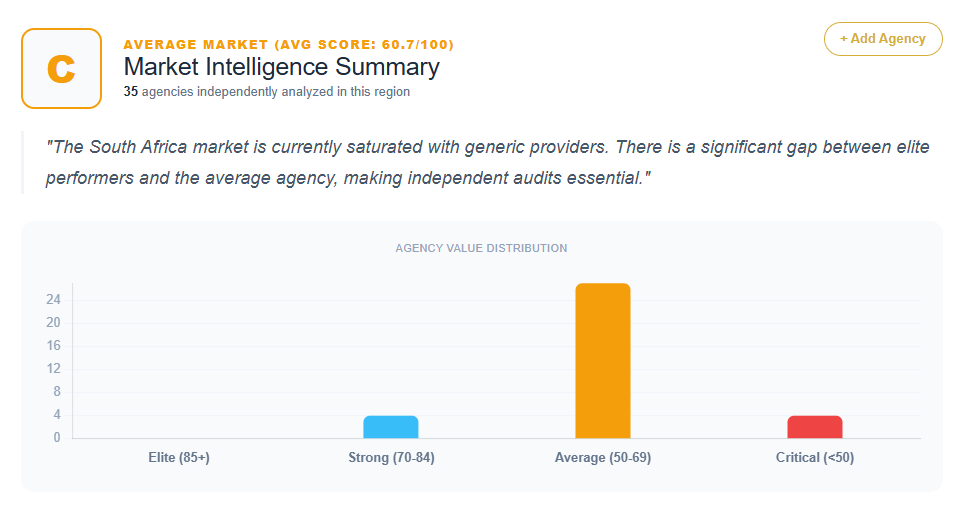
An analysis of the South African digital marketing landscape reveals a market characterized by high technical competence but a profound deficit in strategic differentiation. Based on diagnostic data from 30 distinct SEO agencies across the country’s major economic hubs—Johannesburg, Cape Town, Durban, and Pretoria—a clear pattern emerges: while agencies are proficient at delivering “services,” they largely fail to articulate unique “outcomes.”
The quantitative data shows a market with significant scoring variance. At the top of the spectrum sits Ruby Digital with a score of 82, followed by a mid-tier cluster including Semantica Digital (74), DigitLab (72), and NetMechanic (72). However, a substantial portion of the market (over 45% of the analyzed group) scores 58 or below. This group includes firms like AdIgnite, Marketing Strategy, Optimize SEO, and Comfort Digital. This score distribution highlights a critical gap between high-tier performance agencies and a saturated lower-tier market struggling with what the data calls “Generalist Dilution” and “Commodity Trap Syndrome.”
The “Commodity Trap”: A Recurring Market Weakness
Perhaps the most significant finding in this dataset is the prevalence of the “Commodity Trap.” Out of the 30 agencies reviewed, more than 20 were diagnosed with some variation of this strategic misalignment. The “Commodity Trap” occurs when an agency markets itself based on features—such as “rankings,” “traffic,” or “standard SEO checklists”—rather than proprietary methodologies or specific business growth outcomes.
Agencies like Websem (62), Synergistix Digital (64), and Search Engine Optimization (PTY) LTD (64) are noted for being “strategically invisible” or trapped in “commodity messaging.” This lack of differentiation has tangible financial consequences. The data suggests that agencies without a distinct Unique Selling Proposition (USP) are frequently forced into price-comparison traps. For instance, AdIgnite’s diagnosis suggests this lack of focus leads to a 20-30% loss in potential retainer value, while Webink (54) faces a 25-35% lower lead-to-close ratio on high-ticket contracts.
The Price-Value Paradox
A unique case in the market is Blackhat SEO Agency, which scores a 42. Its diagnosis points to a “Price-Value Paradox,” where the brand name creates an immediate trust deficit among sophisticated buyers, while its focus on “Cheap SEO” and “Affordable Packages” attracts high-churn, price-sensitive clients. This positioning creates a “race to the bottom” that prevents the agency from securing the high-value, long-term partnerships characteristic of market leaders like Ruby Digital or GnuWorld.
Geographic Patterns and Strategic Pigeonholing
The South African market exhibits clear regional characteristics, but these locations often act as strategic ceilings for the agencies involved.
The Cape Town and Johannesburg Hubs
Agencies in Cape Town and Johannesburg (specifically the Sandton and Bryanston areas) generally display higher visual branding and technical integration. Ruby Digital (82) and Semantica Digital (74), both based in Cape Town, represent the higher end of the market. However, even these firms are cautioned against “Commoditized Professionalism,” where polished aesthetics mask a lack of proprietary technical moats.
The Agency (64), based in Sandton, is diagnosed with “Generalist Ambiguity.” Despite being in Africa’s richest square mile, the firm fails to articulate a defensible advantage in SEO, defaulting to a broad service menu that makes it indistinguishable from hundreds of smaller competitors.
Regional Specialization vs. Limitation
Agencies in secondary hubs, such as Durban Digital (62), Bay Digital (62) in Gqeberha, and New Perspective Studio (64) in George, suffer from what the data describes as “Geographic Pigeonholing.” By anchoring their brand too closely to a specific city, they limit their perceived scale. For example, Bay Digital is noted for having high regional authority but lacks the “Strategic Depth” required to displace national incumbents in high-value tenders.
Recurring Themes: Generalist Dilution and Lack of Frameworks
A major theme across the dataset is “Generalist Dilution.” Agencies like EC Business & Digital Marketing (38) and Webink (54) attempt to offer high-stakes SEO services alongside administrative tasks such as CIPC registrations or general web design. This results in a “Generalist Trap,” where the agency signals a lack of technical depth. EC Business, for example, is noted to have a 65% lower average contract value (ACV) compared to specialized SEO boutiques.
The Absence of Proprietary Frameworks
A near-universal prescription for the analyzed agencies is the need to “productize” their services. The dataset shows that most South African agencies sell “SEO services” (a commodity) rather than a “proprietary system.” Firms ranging from DigitLab (72) to Tingley Media (58) are advised to develop and name internal frameworks—such as “The DigitLab SEO Engine” or “The Tingley Growth Matrix”—to move away from hourly or task-based perception. Even the highest-scoring agency, Ruby Digital, is encouraged to trademark a specific internal framework like the “Ruby Velocity Method” to lock in enterprise clients.
Technical vs. Commercial Positioning
The market is split between firms that focus on “Creative Vision” and those that focus on “Technical Performance.” New Perspective Studio (64) and Dutch Ink (62) represent the creative-led boutique model. However, their diagnoses suggest this creates “Generalist Friction.” By prioritizing aesthetic appeal over ROI-driven language, they fail to solve the specific pain points of high-intent South African businesses seeking market dominance.
On the other side, firms like SEO Pros (64) and SEO Lab (68) focus on “Performance Marketing.” While more aligned with business KPIs, they are warned that “performance” has become a commoditized term in the South African landscape. Without a unique mechanism—like a proprietary audit process—they are forced to compete on price and trust signals rather than a unique methodology.
Addressing South African Market Nuances
A key differentiator identified in the prescriptions is the ability to navigate localized challenges. AdIgnite and Search Engine Optimization (PTY) LTD are specifically advised to pivot their messaging to address South African-specific friction points, such as:
- Load-shedding impact on e-commerce reliability and digital performance.
- High data costs affecting mobile-heavy local networks.
- Localized search behavior and ZAR-denominated ROI.
Agencies like Comfort Digital (58) are encouraged to address unique challenges like “load speed over mobile-heavy local networks” to establish themselves as “Authoritative Specialists” rather than generic providers.
Conclusion: The Path to Market Dominance
The South African SEO market is currently a “Utility Market” rather than a “Strategic Partner Market.” With 30 agencies providing the baseline requirements for search visibility, the competitive edge is no longer technical execution—it is strategic narrative.
The data suggests that for an agency to move from the 50-60 score range into the 80-90 range, it must abandon the “Generalist Trap,” stop leading with “affordability” (which attracts high-churn clients), and start owning a unique, productized methodology. In a landscape where “rankings” are now seen as baseline requirements, the agencies that will dominate the next decade are those that can transition from “Digital Marketing Services” to “Organic Revenue Engineering.”
Get Your SEO Strategy