
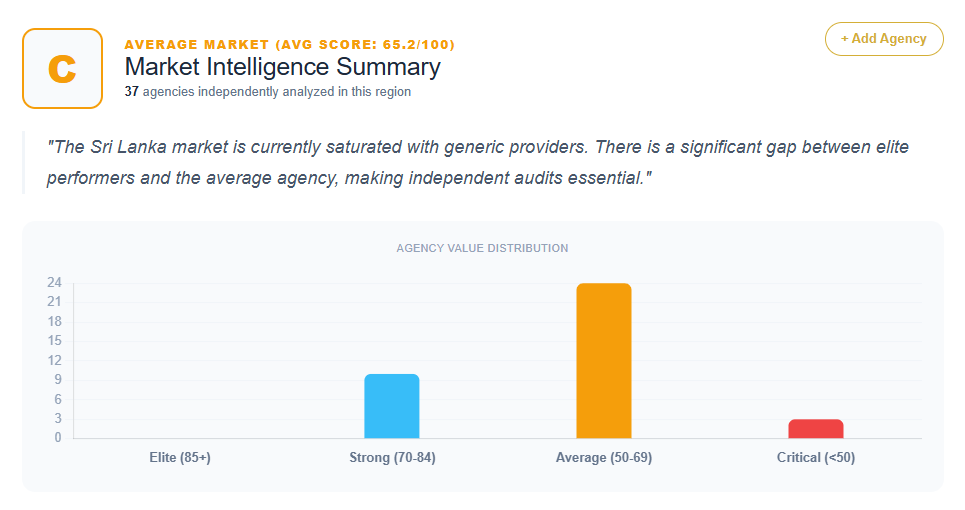
The digital marketing landscape in Sri Lanka, particularly centered around the commercial hub of Colombo, presents a market characterized by a significant friction point between historical prestige and technical performance. An audit of 37 SEO providers operating within the country reveals a sector where scores fluctuate from a floor of 42 to a peak of 84. This variance is not merely a reflection of technical capability, but a systemic failure across the majority of agencies to differentiate their value through unique mechanisms and outcome-based narratives.
According to the dataset, the Sri Lankan market is currently dominated by two distinct high-performers, while the remaining 35 providers struggle with “Generalist Dilution” or “Commodity Traps.” This analysis explores the quantitative patterns, local search nuances, and the high financial cost of strategic misalignment within the region.
We’ve evaluated all most important agencies in Sri Lanka with our Intelligence Engine.
Now you can compare their propositions and easily decide which one offers the right value for your business.
Quantitative Analysis of the SEO Tier Hierarchy
The scoring distribution of the 37 analyzed agencies highlights a “professional plateau” in the mid-60s. Only 5% of the market has successfully crossed the 80-point threshold for strategic excellence.
- The Elite Tier (80-84): Antyra Solutions (84) and eMarketingEye (82) lead the market. Antyra is recognized for its data-driven integrated approach, while eMarketingEye maintains dominance through high-tier specialization in the hospitality and travel sectors.
- The Performance Tier (72-78): Approximately 22% of the market (8 agencies) resides here. This includes Enfection (78), Digibrush (74), Surge Global (74), Loops Integrated (74), Dentsu Grant Group (74), 360 Digital (72), Seven Media Group (72), and Ishara Shehan (72). These firms represent the top of the local market but are frequently penalized for burying their SEO technicality under broader creative or corporate narratives.
- The Generalist Middle (62-68): This is the most saturated segment, containing roughly 43% of the agencies (16 providers). Names like Web Lankan (68), CheckFunnel (68), Xiteb (68), Prime One Global (64), Leads.lk (64), and TekGeeks (62) fall into this bracket. They are professionally sound but suffer from “Commoditization Fatigue.”
- The Tactical Floor (42-56): The bottom 27% (10 agencies) includes Cloud Solution (56), Weblook International (42), SEO Sri Lanka (42), and SEO Rank Sri Lanka (42). These providers rely on keyword-exact domains or “SEO Packages” that have reached functional obsolescence.
See why claims of being the best SEO service provider—and paid rankings—should be questioned.
Check our independent, unbiased and unpaid SEO agency rankings by country, based on our Business Strategy Value Proposition Diagnostic.
Submit missing agencies for free, compare their value propositions, and finally visit their websites to make sure they’re the right choice for you.
Recurring Themes: The “Generalist Trap” and Design-Led Friction
A pervasive issue identified in 15 of the 37 evaluations is “Generalist Dilution.” In the Sri Lankan market, there is a strong tendency for IT outsourcing firms and web development houses to offer SEO as a secondary utility.
EFutures (62), Prime One Global (64), and Xiteb (68) exemplify this trend. By positioning SEO as an “add-on” service alongside software development and BPO, these firms fail to project the specialized authority required to win high-stakes SEO contracts. The data suggests that for TekGeeks (62), the development background provides a technical advantage, yet their SEO narrative lacks “Growth-First intensity,” leading to a perception that they are vendors rather than strategic partners.
Parallel to this is the friction caused by “Design-Led Thinking.” High-authority agencies such as Digibrush (74), Ogilvy Digital (68), and Dentsu Grant Group (74) emphasize creative aesthetics and brand storytelling. While this builds “Prestige,” it creates strategic misalignment for performance-seeking clients. For Ogilvy Digital, the focus on creative prestige results in a 25% leakage in performance-focused search inquiries, as clients perceive the global brand as “too creative” or “too expensive” for technical search tasks.
Looking for the best AI SEO agency in Sri Lanka?
Find out who can actually improve your search visibility and bring you more customers.
The Trilingual Reality and Geographic Signaling
One of the most critical local nuances identified in the data is the necessity of navigating the Sinhala, Tamil, and English search landscape. Despite the importance of trilingual optimization for domestic market share, agencies like NexGen Digital Solutions (62) and WebDesigner.lk (64) are criticized for using “Commodity Loops” of generic claims instead of weaponizing these specific cultural hurdles in their value propositions.
Geography also plays a massive role in the “Colombo Trust Signal.” Five different agencies in the dataset—Web Lankan (68), WebX (64), NexGen Digital Solutions (62), DigitalMarketing.lk (68), and Leads.lk (64)—explicitly use their physical presence in the World Trade Center (WTC) to signal credibility. However, the diagnosis for DigitalMarketing.lk notes that while they have an exceptional domain and prime location, their messaging remains purely functional. This results in a “Commodity Trap” where high-intent traffic bounces due to a lack of visible “Proof of Concept” or sector-specific case studies.
Quantifying the ROI of Strategic Brand Weakness
Generic messaging in the Sri Lankan market is not just a branding flaw; it is a measurable financial drain. The diagnostic data provides specific percentages regarding the cost of these misalignments:
- Lead Conversion Leaks: SEO Sri Lanka (42) and Weblook International (42) likely experience a 30-45% loss in potential enterprise-level contract value because premium clients prioritize specialized expertise over generalist convenience.
- Lower Conversion Rates: CheckFunnel (68) and Invictus Digital (64) face an estimated 15-25% lower lead-to-close ratio. High-value prospects are forced to judge these agencies on price rather than value, leading to shorter retention rates and higher churn.
- Sales Cycle Duration: Even for market leaders like eMarketingEye (82), the reliance on “historical prestige” over “future-facing innovation” can lead to a 15-20% lower conversion rate for non-hospitality enterprise leads and an extended sales cycle.
- Margin Erosion: Agencies like Seven Media Group (72) and Loops Integrated (74) experience “Generalist Dilution” that results in a 15-20% lower margin on SEO services because search is sold on deliverables (hours) rather than value (performance).
The Path Forward: From Tasks to Systems
The diagnostic “Prescriptions” across all 37 agencies reveal a clear mandate for the Sri Lankan market: agencies must move from selling “Tasks” to selling “Proprietary Systems.”
Instead of generic “SEO Services,” the data suggests that agencies should transition to named methodologies—such as the “Lank-Organic Growth Engine” or the “TekGeeks Tech-SEO Framework”—to create intellectual property distinction. This move is designed to shift the conversation from “cheapest packages” to “Growth Blueprints.”
Furthermore, verticalization is identified as the key to market dominance. While eMarketingEye successfully owns the hospitality sector, there is a massive opportunity for other agencies to claim high-growth niches like Tea Export, Apparel, Real Estate, and SaaS exports. Tectera (62) and Doweby (62) are specifically urged to replace generic service lists with vertical-specific ROI case studies that quantify “Dollar-Value Growth” rather than just keyword positions.
Need AI SEO services in Sri Lanka?
See which services, capabilities, and propositions actually match what your business needs.
Conclusion: A Market Ripe for Disruption
The Sri Lankan SEO sector, with an average score in the 60s, is currently a market of high technical capability but low strategic differentiation. The reliance on exact-match domains, physical locations (WTC), and corporate heritage is costing the majority of providers between 15% and 45% of their potential annual recurring revenue (ARR).
The data confirms that the path to the 80+ score achieved by Antyra Solutions requires a radical pivot toward “Revenue-First” frameworks and “Search-to-Revenue” attribution. For the 35 agencies currently underperforming, the goal is clear: stop being a “one-stop-shop” and start being an indispensable revenue driver for Sri Lanka’s high-growth industries. Those who bridge the gap between design-led thinking and technical search ROI will move from being replaceable vendors to dominant market architects in the Colombo digital landscape.
Get Your SEO Strategy