
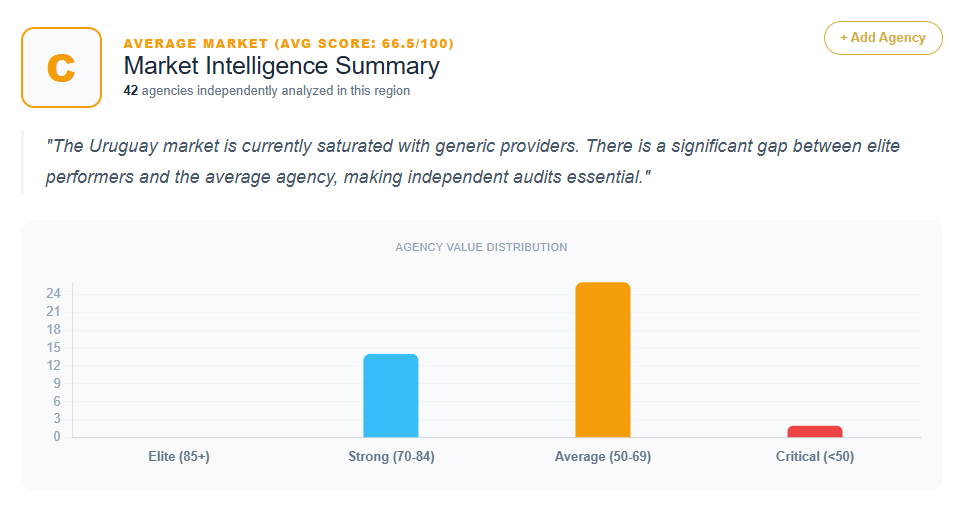
An exhaustive review of the digital marketing sector in Uruguay—primarily concentrated in the capital hub of Montevideo with secondary nodes in Punta del Este, Pula, and Salmiya—reveals a market defined by high technical standards but a profound struggle with strategic “only-ness.” Analysis of more than 40 distinct SEO providers shows a landscape where operational competence is high, yet the ability to articulate unique business outcomes is significantly underdeveloped.
The quantitative data provided indicates a broad performance spectrum. Agency scores peak at 82 (shared by Vanksen, Ingenio, and T-Digital) and reach a floor of 42 (shared by Gecos and Puntaweb). A significant portion of the market is clustered between scores of 62 and 68, representing nearly 60% of the analyzed group. This high concentration in the mid-tier suggests a “Sea of Sameness” where firms meet basic professional criteria but fall into the “Commodity Trap,” selling technical deliverables rather than strategic growth.
The Performance Hierarchy: Analyzing the Scoring Tiers
The Uruguayan SEO market is sharply tiered based on an agency’s ability to bridge the gap between “digital activities” and “financial ROI.”
The “Alpha” Tier (Scores 78–82)
This elite bracket includes regional goliaths and high-end performance specialists like Vanksen (82), Ingenio (82), T-Digital (82), iMarketings (84), Wasabi Digital (78), Wild Fi (78), and Pimod (78). These firms distinguish themselves through Google Premier Partner status and massive local brand equity, handling accounts for entities like McDonald’s, BBVA, and Tiendamia. However, the data notes that even these leaders suffer from “Corporate Dilution.” For instance, T-Digital is cautioned that its messaging is “too safe and corporate,” failing to capture the aggressive, performance-oriented sentiment of the current market.
The Professional Contenders (Scores 68–76)
This segment includes agencies like MD Marketing Digital (76), Solcre (72), Team Omni (72), Ranker Studio (72), SEOWilko (72), and specialized boutiques such as Neo (68), PIC Agency (68), and Managu Digital (68). These agencies are professionally stable but often penalized for “Generic Excellence Syndrome.” Ranker Studio, located in WTC Tower 3, is noted for a superior UI but lower “Authority signaling,” relying on industry buzzwords rather than a unique strategic methodology.
The Commodity and Regional Tier (Scores 42–64)
The largest segment of the market scores below 68. This includes firms like Conecta361 (64), Eficaz Media Digital (64), MDT Uruguay (64), Zoe Digital (62), SEO SUR (62), Crea Impacto (58), Arguez (58), and Gecos (42). These providers are consistently diagnosed with “Strategic Anemia” or “Generalist Dilution.” In many cases, SEO is marketed as a secondary technical add-on to unrelated services like hardware maintenance (Intermedia) or legacy IT infrastructure.
Looking for the best AI SEO agency in Uruguay?
Find out who can actually improve your search visibility and bring you more customers.
Recurring Strategic Weaknesses: The Generalist Trap
The most prevalent diagnosis across the 40+ providers is “Generalist Dilution.” In the Uruguayan market, agencies frequently lead with a “360-degree” or “Full-Service” narrative, which the data suggests is a primary cause of authority dilution.
Creative and Aesthetic Overreach
Firms such as Notable Publicidad (62), PIC Agency (68), and Noosphere (68) prioritize aesthetics, “Big Idea” creativity, and brand storytelling. The diagnostic data suggests that this “Aesthetic Overload” fails to satisfy the analytical requirements of modern SEO. For Notable Publicidad, the focus on creative awards creates a massive disconnect for clients seeking technical search dominance. Similarly, Pixel (72) is categorized as a “design leader but a strategic SEO follower,” where search visibility is treated as a post-launch add-on.
The Software Factory and IT Utility Trap
A significant market nuance in Uruguay is the prevalence of “Software Factories” like Trepcom (58), Solcre (72), and Intermedia (62). While these firms possess superior technical depth, they treat SEO as an auxiliary service. The diagnosis for Solcre notes that this lack of specialization makes the brand appear as a “dev shop that also does SEO” rather than a performance-driven leader. Intermedia, a Microsoft Gold Partner, fails to leverage its massive technical advantage, leading instead with a generic digital marketing umbrella that alienates CMOs seeking deep search expertise.
We’ve evaluated all most important agencies in Uruguay with our Intelligence Engine.
Now you can compare their propositions and easily decide which one offers the right value for your business.
Local Market Nuances: Language Barriers and Identity Conflicts
The dataset identifies specific findings on how agencies navigate the unique complexities of the Uruguayan and Southern Cone markets.
The English-Facing Paradox
SEOWilko (72) presents a unique case of strategic misalignment. Highly specialized in Legal SEO, the agency operates from Montevideo but uses an entirely English interface. The data identifies this as a “disconnected expert” persona, leading to a near-total loss of the high-ticket domestic market in Uruguay and a failure to leverage the “nearshore” advantage for US clients.
Legacy Identity Conflict
Firms like 1122 (Publicar) (58) and Puntaweb (42) struggle with their history as directories or regional portals. 1122 is diagnosed with a “Legacy Identity Conflict,” where clients perceive them as a “volume” business rather than a technical SEO partner. Puntaweb is heavily penalized for burying professional SEO services under tourist portal content, positioning them as a generalist “web shop” from a previous era.
Regional Genericization
Regional agencies like Sube Digital (72) and El Cielo Digital (68) are noted for using “templates” across LATAM. Sube Digital is criticized for failing to address the specific economic nuances of Uruguay, such as the high cost of acquisition relative to the smaller population, resulting in an estimated 15-20% loss in conversion efficiency.
Need AI SEO services in Uruguay?
See which services, capabilities, and propositions actually match what your business needs.
Quantifying the ROI of Strategic Misalignment
The financial consequences of poor differentiation are explicitly quantified in the dataset’s ROI notes:
- Lower Conversion Rates: Generic messaging for firms like Sube Digital and Team Omni likely results in a 15-25% lower conversion rate for high-intent organic leads.
- “Generalist Discount”: For agencies like MD Marketing Digital (76) and Conecta361 (64), the lack of a sharp SEO-first narrative forces them into price-based competition with freelancers, costing an estimated 20-30% premium in potential service fees.
- Revenue Opportunity Gaps: Ingenio (82) is estimated to suffer a 10-15% leakage in potential high-value contracts because their sophisticated data capabilities are buried under generic growth claims.
- Lead Quality Leakage: Gecos (42) and Zoe Digital (62) face a 30-50% lower lead-to-close ratio because their messaging attracts budget-conscious SMEs rather than high-LTV enterprise partners.
See why claims of being the best SEO service provider—and paid rankings—should be questioned.
Check our independent, unbiased and unpaid SEO agency rankings by country, based on our Business Strategy Value Proposition Diagnostic.
Submit missing agencies for free, compare their value propositions, and finally visit their websites to make sure they’re the right choice for you.
Strategic Prescriptions for Market Dominance
Across the 40+ agencies, the recommendations for growth center on the transition from “what we do” to “the financial outcomes we generate.” To lead the Uruguayan market, agencies are urged to:
- Move to “Revenue-First” Headlines: Transition from service lists to quantifiable claims. The data suggests replacing “SEO Services” with narratives like “Scaling Uruguayan Businesses to the Region” or “Organic Market Share Domination.”
- Vertical Specialization: Instead of “General Digital Marketing,” agencies are encouraged to become the authority for specific sectors like “Uruguayan Tech Export,” “FinTech,” or “Agri-business.”
- Decouple Specialized Services: High-tier firms like Intermedia and 1122 must bifurcate their brand experience to separate high-level SEO strategy from basic IT support or directory listings.
- Productize the Offering: Agencies like DAHSEO and CMC are advised to move away from hourly billing by naming their processes (e.g., “Search Performance & Revenue Growth”) to create perceived intellectual property value.
Conclusion: Strategic Outlook
The Uruguay SEO market is technically sound but strategically quiet. The industry is currently home to many “safe” generalists and very few “strategic architects.” With an average score lingering in the mid-60s, there is a massive opportunity for a specialized firm to claim market leadership by adopting an aggressive, ROI-centric narrative that speaks the language of the C-suite.
The data concludes that technical proficiency is no longer a differentiator in Montevideo; it is the floor. The agencies that will dominate the next decade are those that can successfully decouple their marketing from generic jargon, bridge the gap between “creative design” and “algorithmic performance,” and prove clinical ROI in a market that is increasingly demanding data-driven scaling over aesthetic presence.
Get Your SEO Strategy