
Executive Summary
The SEO market in Japan is characterized by a high degree of “Generalist Dilution,” where agencies struggle to differentiate technical SEO authority from broader creative, PR, or “Global Communication” services. While the market possesses a strong physical infrastructure and a specialized niche for “bilingual bridge” agencies, there is a significant gap in proprietary technical methodologies and data-driven transparency. The average agency performance is hampered by a reliance on safe, descriptive messaging rather than diagnostic, results-oriented positioning. International firms frequently fail to enter this market due to a total lack of localization, while domestic agencies often fall into the “Commodity Trap,” competing on price rather than unique strategic value.
We’ve evaluated all most important agencies in Japan with our Intelligence Engine.
Now you can compare their propositions and easily decide which one offers the right value for your business.
Market Maturity Score
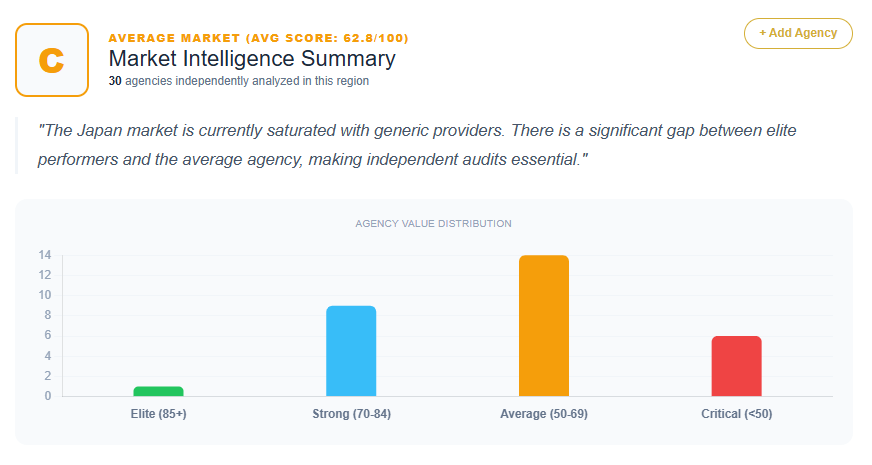
- Average Agency Score: 62.8
- Score Distribution:
- 80–89: 2 agencies
- 70–79: 8 agencies
- 60–69: 12 agencies
- <60: 8 agencies
- Market Maturity Classification: Saturated Generalist Market
Differentiation Density
- % of agencies with proprietary frameworks: ~7% (Most agencies are prescribed to develop these as they currently lack branded methodologies).
- % with vertical specialization: ~23% (Primarily focused on “Japan Market Entry” or “Cross-border” services).
- % with strong social proof: ~30% (Largely concentrated in the top-tier bilingual and domestic “powerhouse” agencies).
- % with unique mechanisms: ~10% (Specifically those integrating PR-driven link building or developer-led technical audits).
See why claims of being the best SEO service provider—and paid rankings—should be questioned.
Check our independent, unbiased and unpaid SEO agency rankings by country, based on our Business Strategy Value Proposition Diagnostic.
Submit missing agencies for free, compare their value propositions, and finally visit their websites to make sure they’re the right choice for you.
Commodity Trap Index
- % using generic messaging: 83% (Widespread use of terms like “results-driven,” “data-driven,” “total support,” and “comprehensive marketing”).
- % relying on service lists instead of outcomes: 70% (Many agencies list SEO as a secondary digital add-on alongside SNS and Web Design).
- % with no unique mechanism: 87% (Most value propositions rely on “bilingual capability” or “local presence” rather than a proprietary search engine optimization framework).
Need AI SEO services in Japan?
See which services, capabilities, and propositions actually match what your business needs.
Top Agencies in Japan (By Score)
- Info Cubic Japan — 86
- Info Cubic Japan Co., Ltd. — 82
- Zo Digital Japan — 78
- Tamlo — 74
- Kakushin Digital — 74
Strengths of the Japan SEO Market
- Cross-Border Expertise: Strong specialized capability in bridging the gap between Western strategy and Japanese execution for international brands.
- Bilingual Infrastructure: A high concentration of agencies in Tokyo (Minato-ku, Chiyoda-ku, Shibuya-ku) offering high-quality English-Japanese support.
- PR-SEO Synergy: A growing trend of integrating traditional media relations with digital PR and high-quality backlink acquisition.
- Cultural Nuance: Local agencies demonstrate a deep understanding of Japanese search behavior, including the complex interplay between Kanji, Hiragana, and Katakana.
Weaknesses of the Japan SEO Market
- Technical Dilution: SEO is frequently messaged as a secondary “creative” service rather than a data-first technical competency.
- Linguistic Barrier for Global Firms: Significant trust deficit and functional invisibility for international agencies lacking native Japanese-language assets and physical presence.
- Strategic Misalignment: Many agencies focus on “ease of access” or “vibe” rather than quantifiable ROI or proprietary “how-to” frameworks.
- Lack of Transparency: A deficit in deep-dive technical audits and performance-led data visualization compared to global industry standards.
Looking for the best AI SEO agency in Japan?
Find out who can actually improve your search visibility and bring you more customers.
ROI Impact Summary
- Estimated Conversion Loss: 20–35% for agencies failing to lead with performance data; up to 70–80% for non-localized offshore providers.
- Estimated ACV Compression: 15–25% due to the “Generalist Tax” and agencies being forced into price-based competition.
- Estimated Sales Cycle Extension: Significant lengthening of sales cycles for agencies perceived as creative boutiques rather than revenue-driving growth partners.
Market Archetype Classification
- Saturated Generalist Market
Sector Opportunities in Japan
- Technical Search Defensibility: Specialized audits for foreign entrants navigating the Google JP/Yahoo! Japan split.
- Linguistic Intent Mapping: Agencies that can quantify the risk of non-localized SEO and map multi-script keyword intent.
- PR-Driven Link Building: Utilizing Japan’s trust-based media landscape to acquire high-authority local backlinks.
- Developer-Led SEO: Leveraging system development backgrounds to execute high-end technical audits that standard marketing firms cannot.
Methodology
- Number of Agencies: 30
- Scoring System Reference: 100-point diagnostic scale evaluating value proposition, location verification, market competitiveness, and ROI alignment.
- Data Source: Agency Value Proposition Audits (Japan Market)
- Year: 2026