
Executive Summary
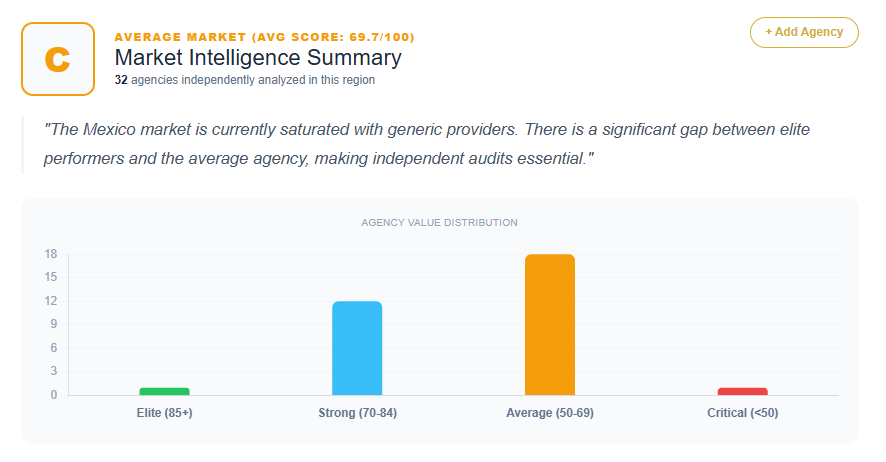
The Mexican SEO market is characterized by a high level of technical proficiency and institutional credibility, yet it remains hindered by widespread strategic stagnation. While the market features several “high-authority” players and Google Premier Partners, the majority of agencies are currently caught in a “Commodity Trap,” offering generic service lists rather than outcome-centric growth frameworks. With 32 agencies evaluated, the market shows a healthy average score of 69.5, indicating professional stability. However, a defining insight is that even top-tier firms struggle to move beyond “360-degree” messaging, leading to significant price sensitivity and extended sales cycles as clients struggle to distinguish between mid-tier boutiques and enterprise-level partners.
Market Maturity Score
- Average agency score: 69.5
- Score distribution:
- 80–89: 3 agencies (Azurally, Punto Rojo, Octopus Digital Marketing)
- 70–79: 10 agencies (Smarketing, Sube Agencia Digital, Grit Marketing Studio, Futurite, Carlos García, Altura Interactive, ABC Digital, Chili, MCK Agency, Punto Commerce)
- 60–69: 16 agencies (SEONET, Solomono, SUBE Agencia, Serna Group [68], Digitalina SEO, Selfish, Keycode, SEO Secreto, SEO en México, Factor SEO, Tijuana SEO, Agencia Publika, SEO.pe, Serna Group [62], Interatika, MKT Marketing Digital)
- <60: 3 agencies (GMB Start, GDL Systems, Pubsa)
- Market maturity classification: High‑Authority but Low‑Differentiation
Looking for the best AI SEO agency in Mexico?
Find out who can actually improve your search visibility and bring you more customers.
Differentiation Density
- % of agencies with proprietary frameworks: 0% (While many agencies have “internal processes,” 100% of the dataset diagnoses highlight the absence of a named, productized, or unique proprietary methodology).
- % with vertical specialization: 18.7% (Specialists identified in E-commerce, B2B Tech, SaaS, Startups, and Local SEO).
- % with strong social proof: 18.7% (High-authority signals such as Google Premier Partner status, HubSpot Platinum status, or “Most Awarded” designations).
- % with unique mechanisms: 6.25% (Only a few firms, such as Grit Marketing Studio and Azurally, utilize sophisticated “Growth Studio” or global-standard technical positioning that deviates from standard service menus).
Commodity Trap Index
- % using generic messaging: 78% (Extensive use of “results-driven,” “360-degree solutions,” “data-driven,” and “your best ally”).
- % relying on service lists instead of outcomes: 84% (Messaging primarily focuses on “what we do”—SEO, PPC, Web Design—rather than “what the business achieves”).
- % with no unique mechanism: 93.7% (Most agencies are diagnosed with “Strategic Misalignment” or “Commodity Messaging,” lacking a proprietary “hook” to justify premium pricing).
Top Agencies in Mexico (By Score)
- Azurally — Score: 88
- Punto Rojo — Score: 82
- Octopus Digital Marketing — Score: 82
- Futurite — Score: 78
- Grit Marketing Studio — Score: 78
We’ve evaluated all most important agencies in Mexico with our Intelligence Engine.
Now you can compare their propositions and easily decide which one offers the right value for your business.
Strengths of the Mexico SEO Market
- Strong Institutional Credibility: A high concentration of Google Premier Partners and established international certifications.
- Geographic Hubs: Deep physical presence in major economic centers including CDMX, Monterrey, Querétaro, and Guadalajara.
- High Technical Foundation: Most agencies demonstrate high-tier technical authority and professional site execution.
- Regional Specialization: Emergence of specialized expertise in border-related “binational” marketing and LATAM-wide expansion strategies.
Weaknesses of the Mexico SEO Market
- Pervasive Commodity Messaging: A reliance on generic “full-service” value propositions that fail to differentiate between agencies.
- Agency-Centric Positioning: Messaging that focuses on agency awards and “ego” rather than specific client financial outcomes.
- Lack of Industry Verticalization: Few agencies offer dedicated landing pages or frameworks for high-demand sectors like Fintech or Real Estate.
- Strategic Stagnation: A “safe vendor” syndrome where agencies prioritize professional appearance over aggressive, ROI-centric performance narratives.
See why claims of being the best SEO service provider—and paid rankings—should be questioned.
Check our independent, unbiased and unpaid SEO agency rankings by country, based on our Business Strategy Value Proposition Diagnostic.
Submit missing agencies for free, compare their value propositions, and finally visit their websites to make sure they’re the right choice for you.
ROI Impact Summary
- Estimated conversion loss: 15–35% leakage in the lead-to-close ratio due to prospects perceiving services as interchangeable commodity expenses.
- Estimated ACV compression: 20–30% lower average contract values as agencies are forced into price-based comparisons during the RFP process.
- Estimated sales cycle extension: 15–30% increase in sales cycle duration for enterprise leads who require “Revenue-First” justification that is missing from primary messaging.
Market Archetype Classification
High‑Authority but Low‑Differentiation
Need AI SEO services in Mexico?
See which services, capabilities, and propositions actually match what your business needs.
Sector Opportunities in Mexico
- High-Demand Verticals: Fintech, Real Estate, E-commerce, and SaaS/B2B Tech are consistently identified as underserved sectors for specialized SEO.
- Technical Niches: “Technical Debt Audits” and “Core Web Vitals for Mobile” represent major untapped revenue streams for the local e-commerce and retail sectors.
- Industrial/Manufacturing: Opportunities for specialized lead generation in the Bajío region and northern industrial hubs (Monterrey/Tijuana).
Methodology
- Number of agencies: 32
- Scoring system reference: 0–100 scale based on Strategic Alignment, Value Proposition Clarity, and Market Differentiation.
- Data source: Comprehensive audits of established digital agencies with a verified presence in Mexico.
- Year: 2026