
Executive Summary
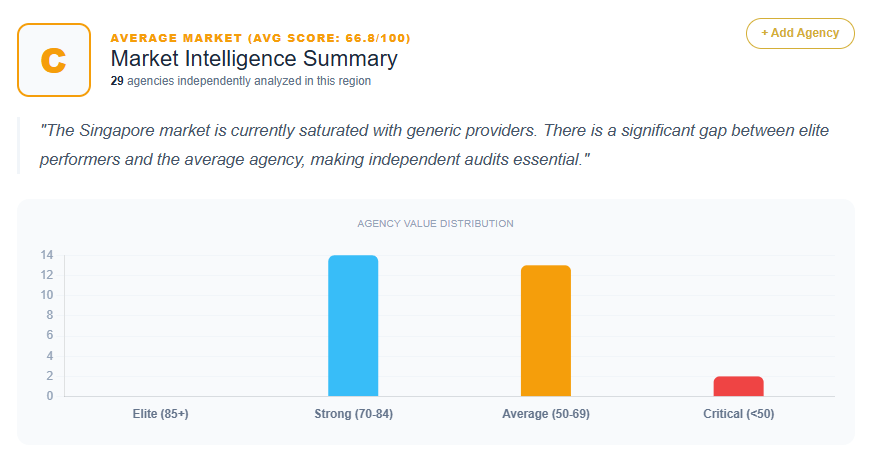
The Singapore SEO market in 2026 is characterized by high professional execution and a strong reliance on local authority signals, yet it remains hindered by widespread strategic sameness. While many agencies demonstrate high-tier market presence and technical competence, the majority fall into a “Commodity Trap,” offering nearly identical “results-driven” value propositions. The market is heavily influenced by local trust markers, such as physical CBD presence and PSG grant eligibility, creating a protective barrier for incumbents while simultaneously stifling unique strategic innovation. With an average score of 66.17 across 29 evaluated firms, the market represents a high-performing but undifferentiated landscape where “bespoke” strategies are frequently overshadowed by “biggest” claims.
Looking for the best AI SEO agency in Singapore?
Find out who can actually improve your search visibility and bring you more customers.
Market Maturity Score
- Average Agency Score: 66.17/100
- Score Distribution:
- 80–89: 1 Agency
- 70–79: 13 Agencies
- 60–69: 8 Agencies
- <60: 7 Agencies
- Market Maturity Classification: Saturated Generalist Market
Differentiation Density
- % of agencies with proprietary frameworks: 0% (Most agencies rely on generic descriptors; prescriptions across the dataset emphasize the need to develop named methodologies like “Alpha Growth Engine” or “Velocity Framework” to escape commodity pricing).
- % with vertical specialization: 17.2% (Agencies specifically targeting B2B Tech, FinTech, Web3, or Executive Reputation).
- % with strong social proof: 31% (Agencies leveraging high-authority client portfolios, Google Premier Partner status, or extensive local awards).
- % with unique mechanisms: 0% (Strategic “anonymity” and “anemia” are cited as primary frictions, with agencies lacking proprietary tech or LLM-based content workflows).
See why claims of being the best SEO service provider—and paid rankings—should be questioned.
Check our independent, unbiased and unpaid SEO agency rankings by country, based on our Business Strategy Value Proposition Diagnostic.
Submit missing agencies for free, compare their value propositions, and finally visit their websites to make sure they’re the right choice for you.
Commodity Trap Index
- % using generic messaging: 79% (Widespread use of “data-driven,” “results-oriented,” “ROI-focused,” and “full-service”).
- % relying on service lists instead of outcomes: 62% (Messaging prioritized “what we do” over specific “economic impact” or “unique mechanisms”).
- % with no unique mechanism: 100% (Every agency evaluated received a prescription to develop a branded, proprietary framework to distinguish their technical execution from competitors).
Need AI SEO services in Singapore?
See which services, capabilities, and propositions actually match what your business needs.
Top Agencies in Singapore (By Score)
- MediaOne Marketing: 82
- Found: 78
- Primal Digital Agency: 78
- Impossible Marketing: 78
- OOm Pte Ltd: 78
Strengths of the Singapore SEO Market
- High Institutional Trust: Market leaders maintain deep credibility through Google Premier Partnerships, ISO certifications, and verified physical presences in the CBD (e.g., Robinson Road, Tras Street).
- Government Integration: A significant segment of the market leverages the PSG (Productivity Solutions Grant) as a primary hook, lowering the barrier to entry for SMEs.
- Regional Footprint: Many agencies use Singapore as a “Gateway to SE Asia,” positioning themselves as regional powerhouses for brands looking to expand across APAC.
- Visual and Aesthetic Professionalism: High scores were consistently awarded for professional presentation and minimalist, sophisticated design-led growth narratives.
Weaknesses of the Singapore SEO Market
- Strategic Anonymity: A pervasive “Safety in Numbers” approach where agencies claim to do exactly what everyone else does, just “better” or “bigger.”
- TLD and Geographic Friction: Non-local entities (using .my domains or lacking physical offices) suffer significant trust deficits and “offshore” stigmas.
- Credential Inflation: An over-reliance on awards and partner badges that have become baseline expectations, leading to “Comparison Fatigue” among prospects.
- Linguistic Barriers: Agencies operating in non-English languages are categorized as having total market irrelevance for the domestic Singaporean landscape.
ROI Impact Summary
- Estimated Conversion Loss: 15–25% for agencies failing to differentiate their technical mechanism, as prospects default to price-based comparisons.
- Estimated ACV Compression: 25–40% loss in potential retainer value for agencies that position themselves as grant-supported vendors rather than high-tier strategic growth partners.
- Estimated Sales Cycle Extension: Significant friction for sophisticated buyers results in longer decision cycles as agencies fail to provide a “Category-of-One” reason for selection.
We’ve evaluated all most important agencies in Singapore with our Intelligence Engine.
Now you can compare their propositions and easily decide which one offers the right value for your business.
Market Archetype Classification
- High-Authority but Low-Differentiation
Sector Opportunities in Singapore
- Underserved Verticals: B2B SaaS, FinTech-specific SEO, and Executive Branding for APAC leaders are identified as high-value niches with low specialized competition.
- Technical Opportunities: Advanced “Edge SEO,” proprietary LLM-based content workflows, and ROI-centric “Revenue Intelligence” frameworks represent significant gaps in the current agency offerings.
- Oversaturated Verticals: Generalist SME digital marketing and grant-subsidized SEO services are highly commoditized, leading to lower margins and higher churn.
Methodology
- Number of agencies: 29
- Scoring system reference: Proprietary value proposition audit measuring strategic alignment, local authority, and unique mechanism presence.
- Data source: 2026 Singapore Agency Audit Dataset.
- Year: 2026