

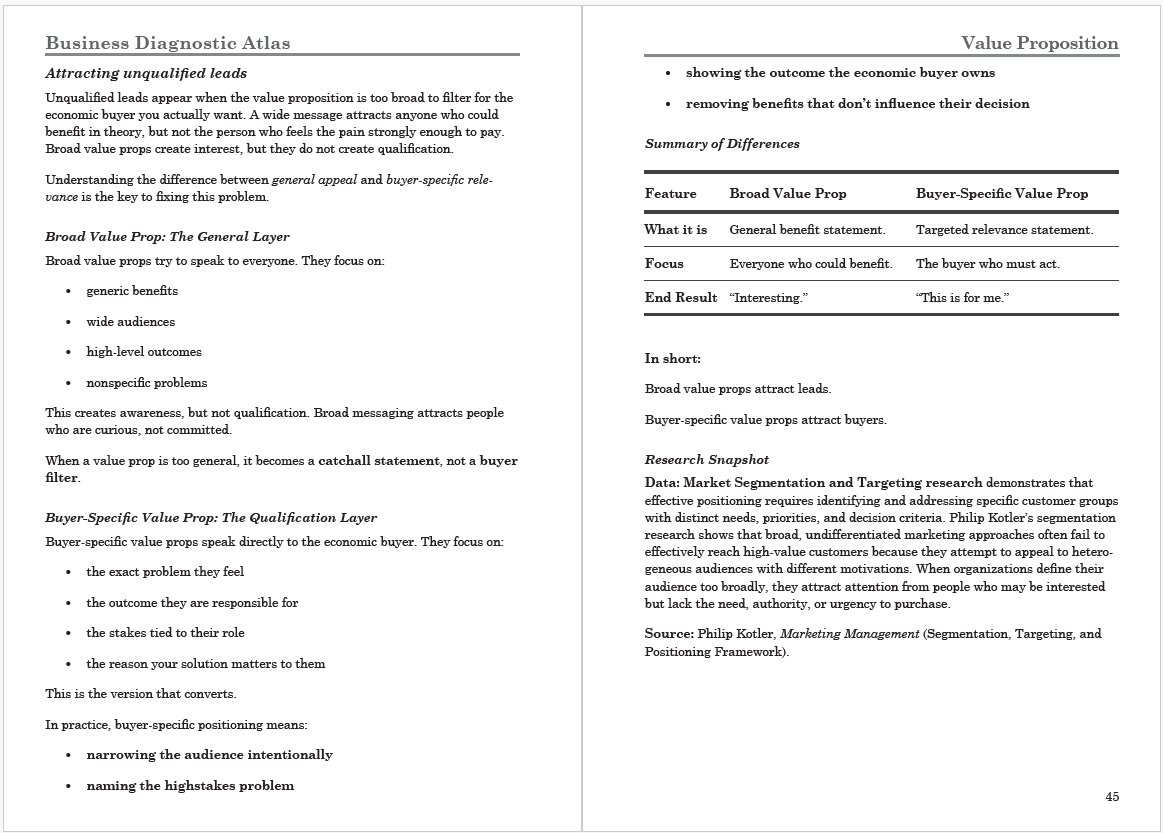
Unqualified leads appear when the value proposition is too broad to filter for the economic buyer you actually want. A wide message attracts anyone who could benefit in theory, but not the person who feels the pain strongly enough to pay. Broad value props create interest, but they do not create qualification.
Understanding the difference between general appeal and buyer‑specific relevance is the key to fixing this problem.
Broad Value Prop: The General Layer
Broad value props try to speak to everyone. They focus on:
- generic benefits
- wide audiences
- high‑level outcomes
- non‑specific problems
This creates awareness, but not qualification. Broad messaging attracts people who are curious, not committed.
When a value prop is too general, it becomes a catch‑all statement, not a buyer filter.
Buyer‑Specific Value Prop: The Qualification Layer
Buyer‑specific value props speak directly to the economic buyer. They focus on:
- the exact problem they feel
- the outcome they are responsible for
- the stakes tied to their role
- the reason your solution matters to them
This is the version that converts.
In practice, buyer‑specific positioning means:
- narrowing the audience intentionally
- naming the high‑stakes problem
- showing the outcome the economic buyer owns
- removing benefits that don’t influence their decision
Summary of Differences
| Feature | Broad Value Prop | Buyer‑Specific Value Prop |
|---|---|---|
| What it is | General benefit statement. | Targeted relevance statement. |
| Focus | Everyone who could benefit. | The buyer who must act. |
| End Result | “Interesting.” | “This is for me.” |
In short:
Broad value props attract leads.
Buyer‑specific value props attract buyers.
Five Real-World Examples – Broad vs. Buyer-Specific Value Propositions
Example 1: A commercial cleaning company
Broad value proposition:
“We provide reliable cleaning services for homes, offices and commercial properties, helping our customers maintain clean and healthy environments.”
The message appeals to a wide range of potential customers.
But qualification is missing:
“Who is actually responsible for buying this service?”
A buyer-specific version could say:
“For facilities managers responsible for multi-site offices: keep every location consistently clean without managing separate cleaning teams, suppliers and quality checks.”
Now the message speaks directly to the person responsible for the problem and the purchasing decision.
Before spending more on ads, redesigns or agency retainers, our E-commerce Audit Service can identify what is actually holding your store back.
Get a clear diagnosis of the problems worth fixing first, so you can stop spending money on the wrong solutions.
Example 2: An HR software company
Broad value proposition:
“Our HR platform helps businesses manage employees, automate processes and improve workplace efficiency.”
The message sounds useful to almost any business.
But qualification is missing:
“Is this actually designed for the kind of HR problem I have?”
A buyer-specific version could say:
“For HR teams managing 500+ employees: automate onboarding, leave and employee records without maintaining spreadsheets across multiple departments.”
Now the message identifies a specific buyer, business size and operational problem.
SaaS marketing problems are often harder to spot than product problems.
The 1EuroSeo Strategic Business SaaS Marketing Audit can help you see where your positioning, messaging, audience or conversion strategy is working against the product — and what to fix first.
Example 3: A commercial property consultant
Broad value proposition:
“We help property owners maximise the performance and value of their real estate investments.”
The message could attract almost any property owner.
But qualification is missing:
“Is this relevant to the scale and type of property I manage?”
A buyer-specific version could say:
“For owners of commercial portfolios worth €10m+: identify underperforming assets and the changes that could increase rental income and portfolio value.”
Now the message filters for the economic buyer with the relevant asset scale and financial responsibility.
Building an affiliate site around keywords can work until the strategy behind the site starts working against it.
The 1EuroSEO Affiliate Marketing Audit can reveal weaknesses in your content strategy, competitive position, brand positioning and monetisation, so you can see where the biggest opportunities for recovery are.
Example 4: A cybersecurity consultancy
Broad value proposition:
“We help businesses protect their data, systems and employees from cyber threats.”
Almost any business could see itself in the message.
But qualification is missing:
“Is this solving a problem serious enough for me to buy?”
A buyer-specific version could say:
“For financial firms handling sensitive client data: identify the security weaknesses most likely to expose you to a costly breach before attackers find them.”
Now the message speaks to a specific industry, risk and high-stakes responsibility.
Example 5: A leadership training company
Broad value proposition:
“We provide leadership training that helps managers develop stronger teams and improve performance.”
The message can attract anyone interested in management training.
But qualification is missing:
“What specific business problem would make me pay for this?”
A buyer-specific version could say:
“For companies promoting technical specialists into management: equip new managers to lead teams, handle difficult conversations and improve performance without losing their best people.”
Now the message identifies the specific buyer situation, problem and outcome that justify the investment.
Ask a Question or Share Your Opinion