
Looking for a specific business problem?
You don’t need to buy the book to find the answer.
Browse the knowledge index below and go directly to the diagnosis you’re looking for. Every diagnosis is available online as an individual article, organised across the same 14 strategic dimensions as the Business Diagnostic Atlas.
The articles in this problems knowledge base give perfect exact-match answers to each specific business problem.
Of course, if you prefer having all 149 diagnoses in one place… or simply think the book would look rather impressive on your shelf, we’ve got you covered too.
Value Proposition
Problems caused by weak or unclear value propositions, where a business fails to communicate what it offers, why it matters, and why customers should choose it. Covers issues related to poor differentiation, generic messaging, unclear value, and offers that don’t align with customer priorities.
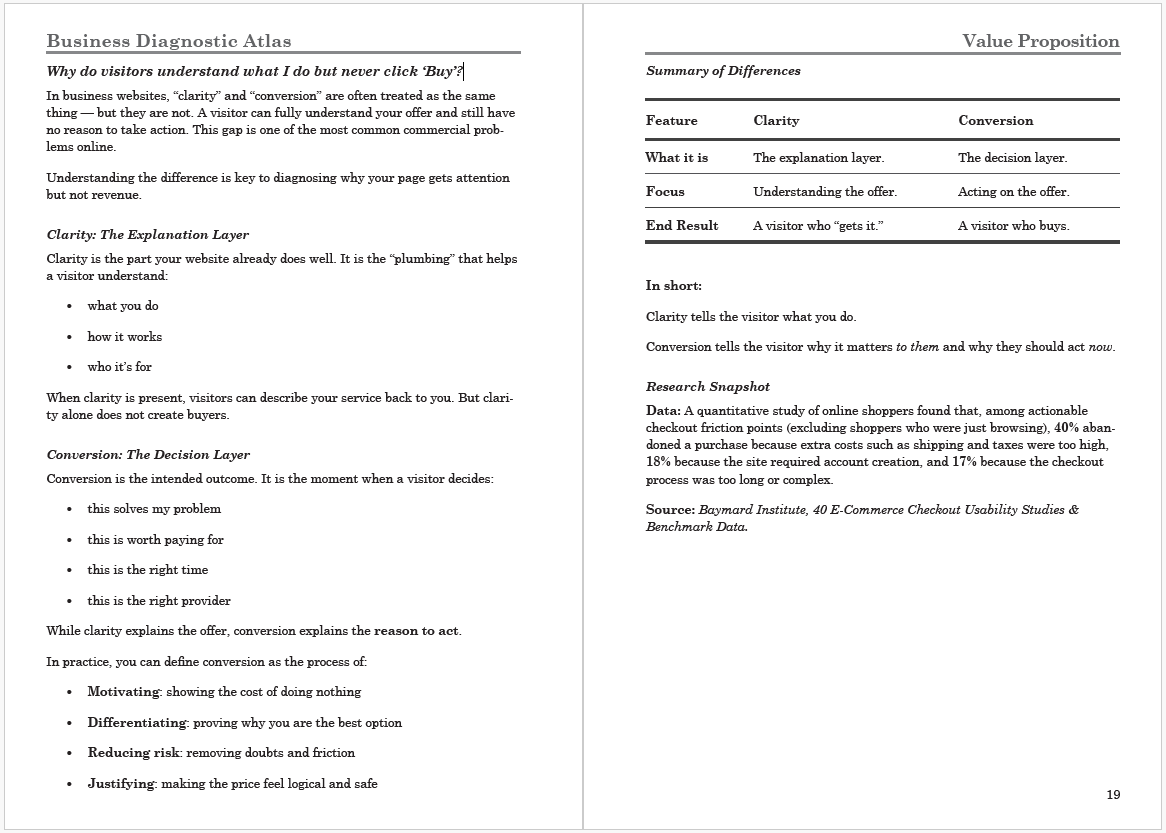
Why do visitors understand what I do but never click ‘Buy’?
In business websites, “clarity” and “conversion” are often treated as the same thing — but they are not. A visitor can fully understand your offer and still have no reason to take action. This gap is one of the most common commercial problems online.
Understanding the difference is key to diagnosing why your page gets attention but not revenue.
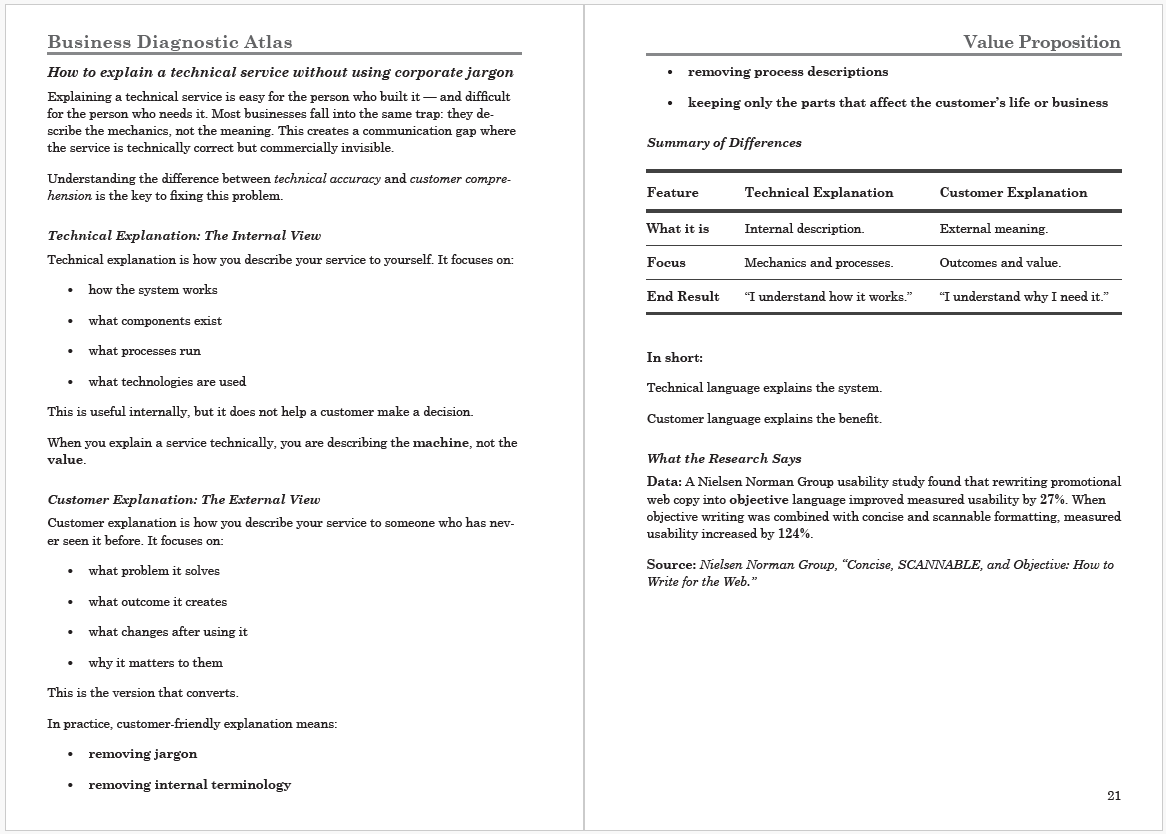
How to explain a technical service without using corporate jargon
Explaining a technical service is easy for the person who built it — and difficult for the person who needs it. Most businesses fall into the same trap: they describe the mechanics, not the meaning. This creates a communication gap where the service is technically correct but commercially invisible.
Understanding the difference between technical accuracy and customer comprehension is the key to fixing this problem.
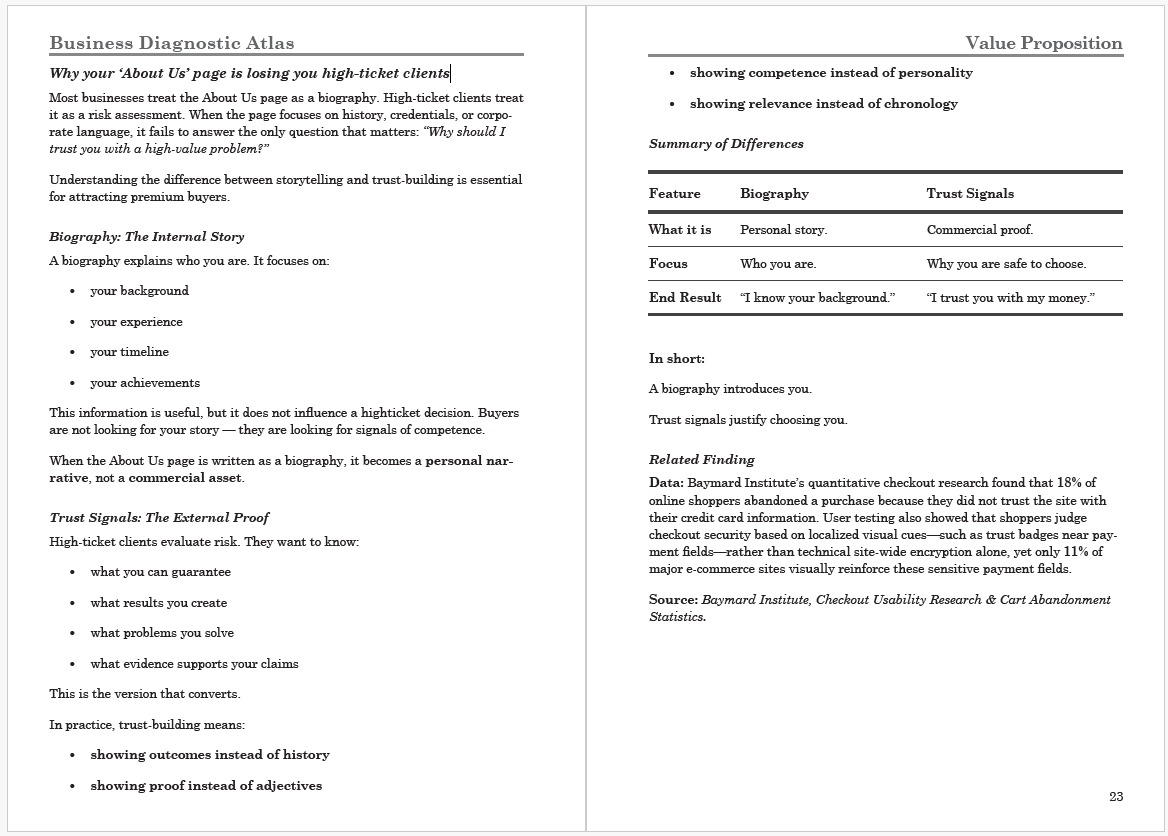
Why your ‘About Us’ page is losing you high-ticket clients
Most businesses treat the About Us page as a biography. High‑ticket clients treat it as a risk assessment. When the page focuses on history, credentials, or corporate language, it fails to answer the only question that matters: “Why should I trust you with a high‑value problem?”
Understanding the difference between storytelling and trust‑building is essential for attracting premium buyers.
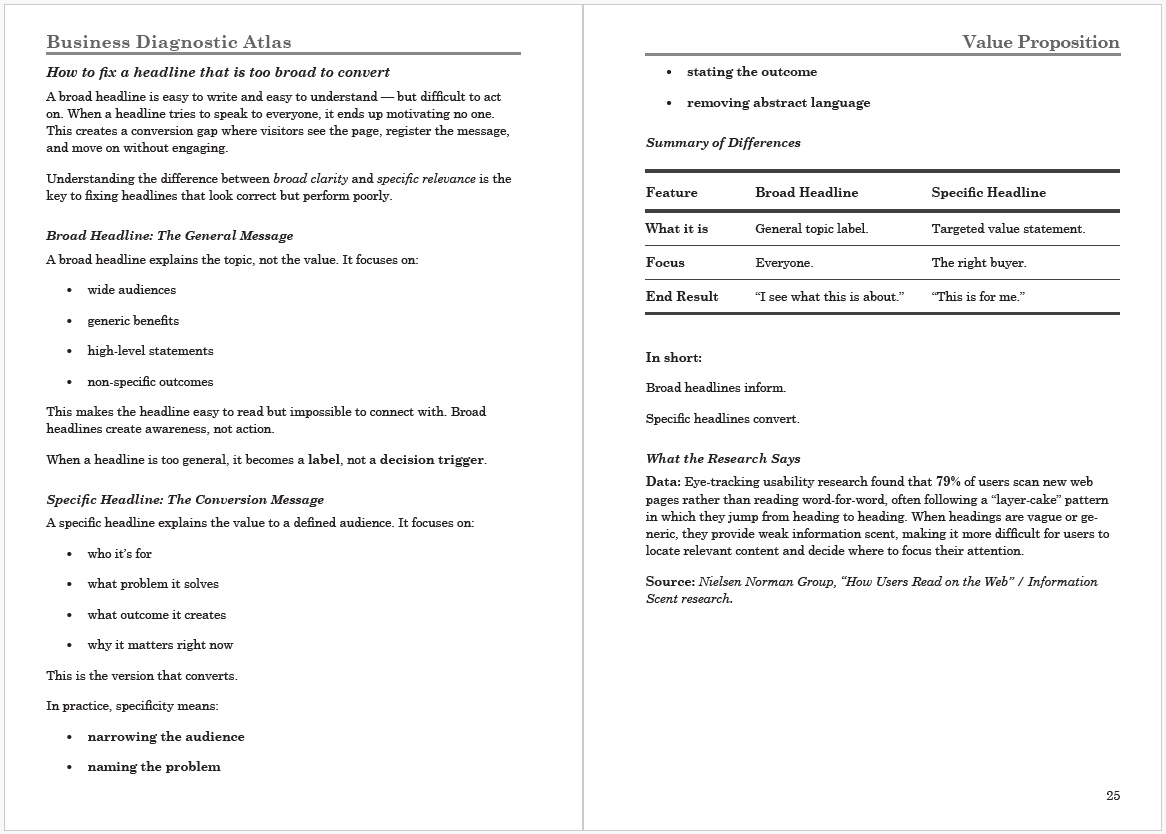
How to fix a headline that is too broad to convert
A broad headline is easy to write and easy to understand — but difficult to act on. When a headline tries to speak to everyone, it ends up motivating no one. This creates a conversion gap where visitors see the page, register the message, and move on without engaging.
Understanding the difference between broad clarity and specific relevance is the key to fixing headlines that look correct but perform poorly.
Why your website feels like a brochure instead of a sales tool
Many websites look polished, professional, and well‑designed — yet they behave like brochures. They inform, but they don’t convert. This happens when the site focuses on presenting information instead of guiding decisions. A brochure explains. A sales tool influences.
Understanding the difference between presentation and conversion is the key to turning a static website into a commercial asset.
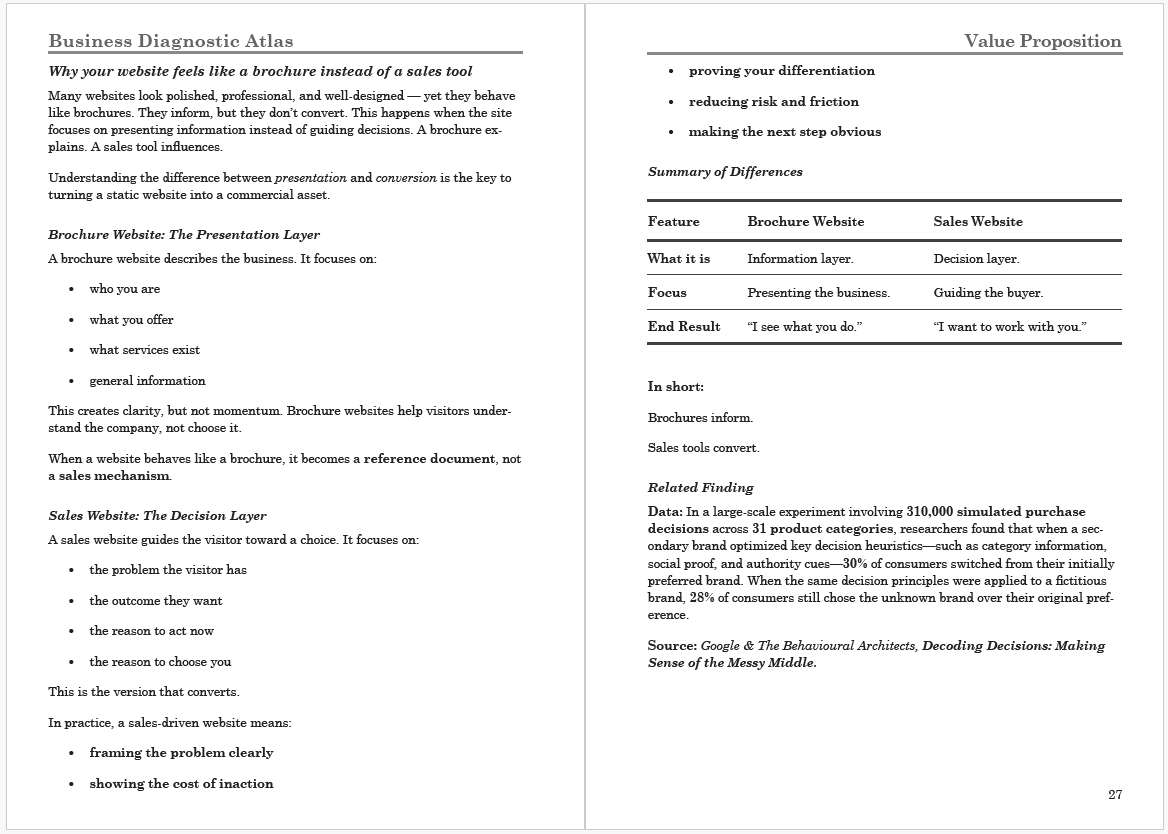
Sales tools convert.
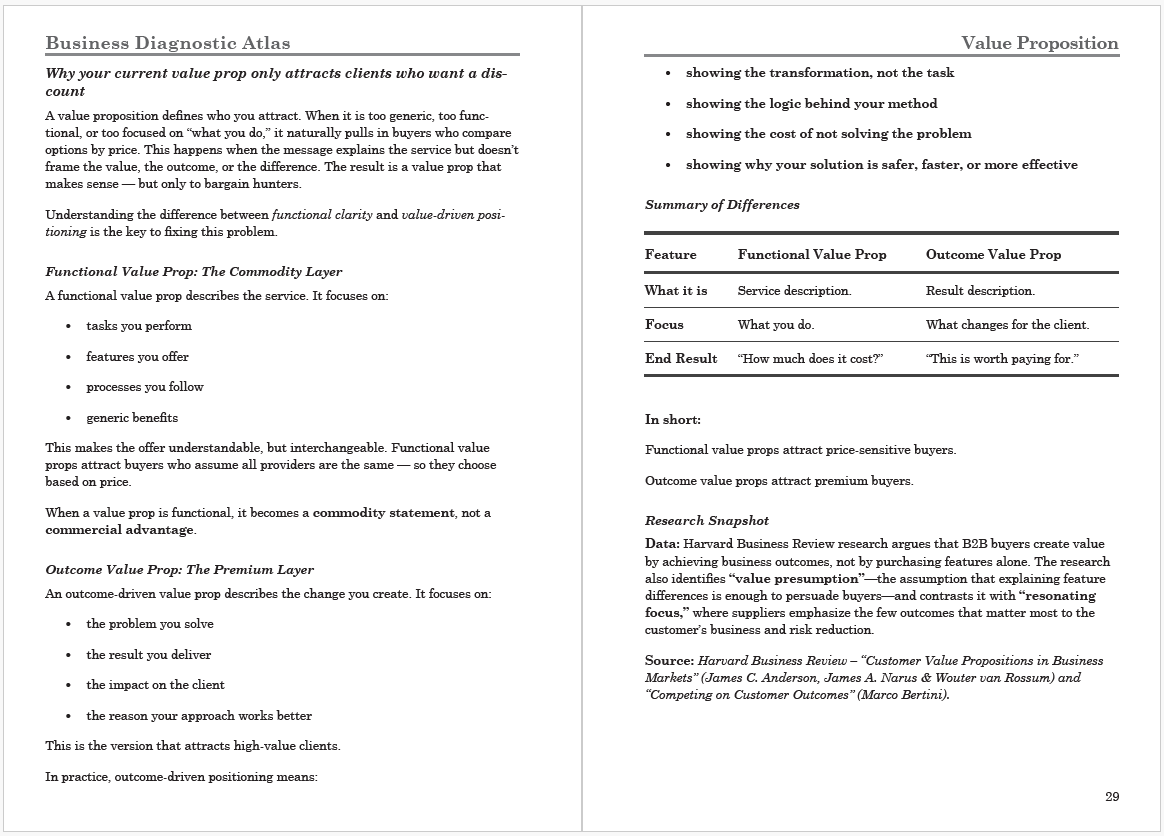
Outcome value props attract premium buyers.
Why your current value prop only attracts clients who want a discount
A value proposition defines who you attract. When it is too generic, too functional, or too focused on “what you do,” it naturally pulls in buyers who compare options by price. This happens when the message explains the service but doesn’t frame the value, the outcome, or the difference. The result is a value prop that makes sense — but only to bargain hunters.
Understanding the difference between functional clarity and value‑driven positioning is the key to fixing this problem.
How to identify the one “Why Buy” trigger that actually matters
Every buyer has multiple reasons to consider an offer, but only one reason that actually drives the decision. When your messaging tries to cover all possible motivations, it becomes broad, diluted, and hard to act on. The key is identifying the single trigger that moves your ideal buyer from interest to commitment.
Understanding the difference between general benefits and the primary buying trigger is essential for building a value prop that converts.
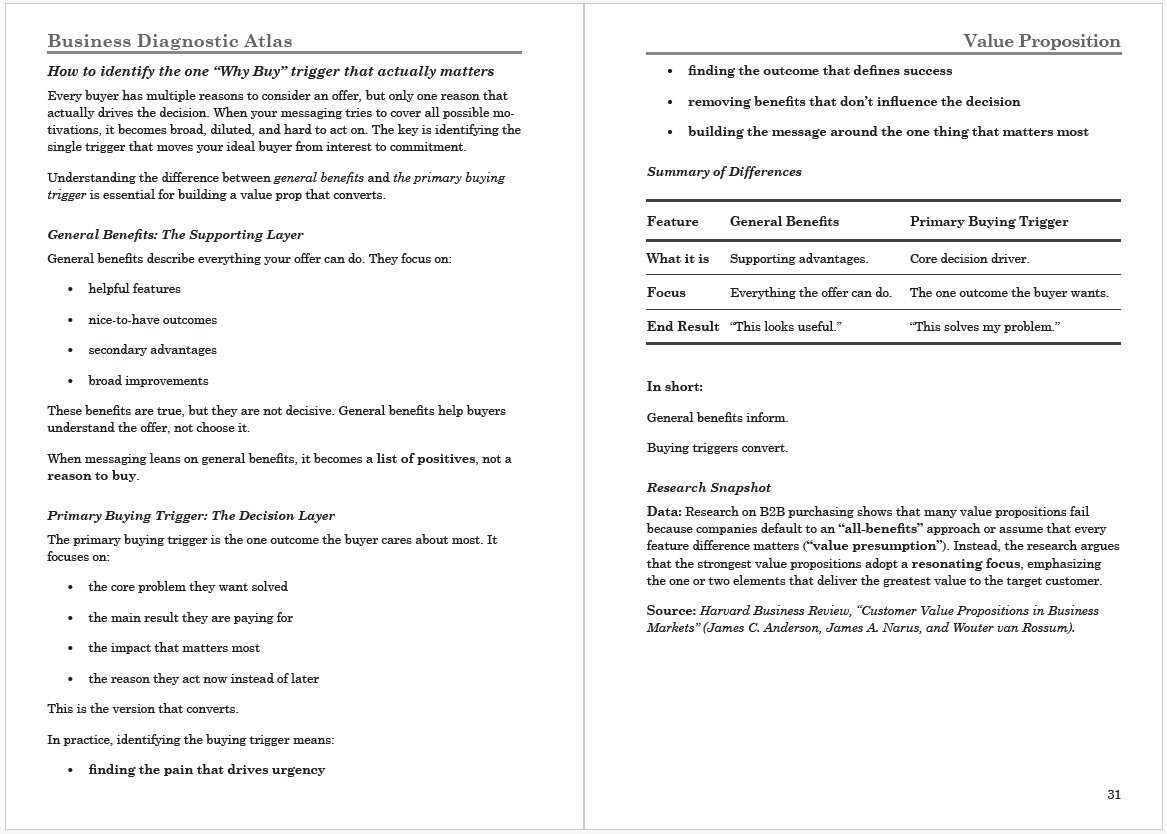
Buying triggers convert.
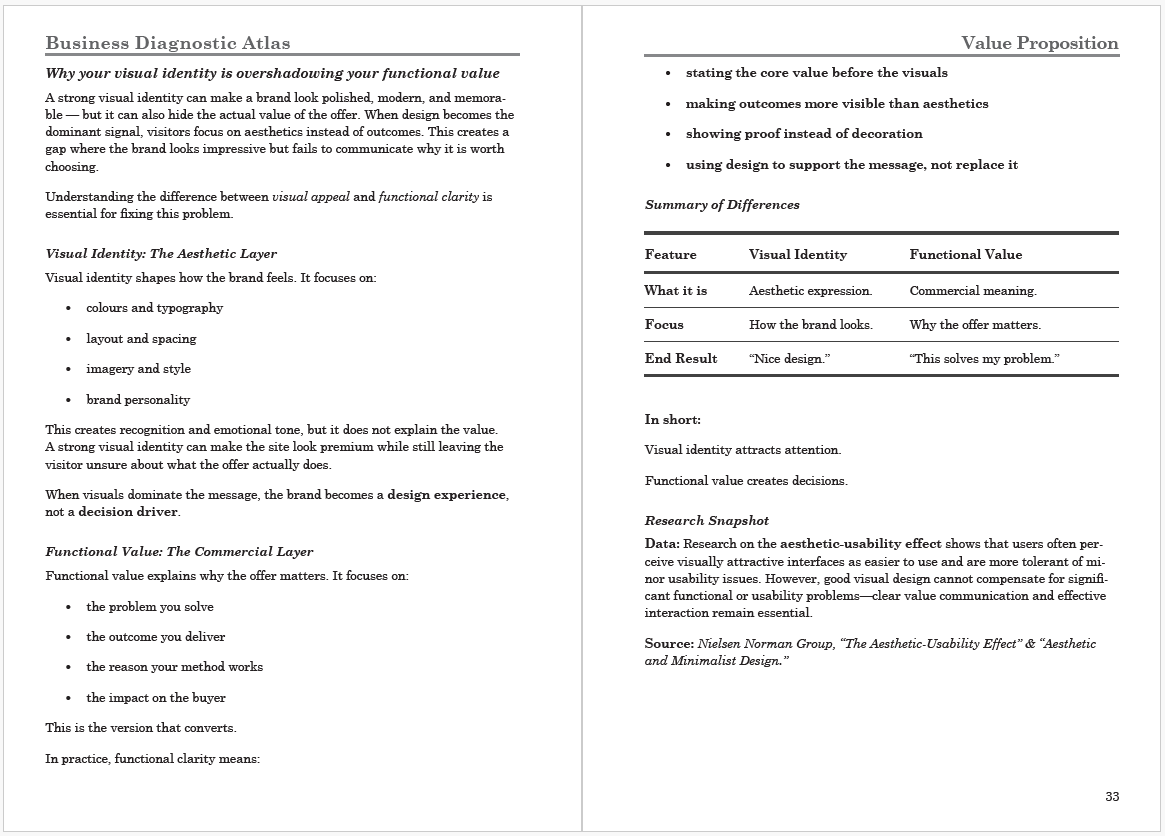
Functional value creates decisions.
Why your visual identity is overshadowing your functional value
A strong visual identity can make a brand look polished, modern, and memorable — but it can also hide the actual value of the offer. When design becomes the dominant signal, visitors focus on aesthetics instead of outcomes. This creates a gap where the brand looks impressive but fails to communicate why it is worth choosing.
Understanding the difference between visual appeal and functional clarity is essential for fixing this problem.
How to turn a complex B2B process into a 5‑second value hook
Complex B2B offers often rely on long explanations, diagrams, and multi‑step processes. They make sense internally, but they overwhelm buyers who only want to know one thing: “Why should I care?” A 5‑second value hook is the shortest possible expression of the outcome your process creates. It removes the mechanics and keeps the meaning.
Understanding the difference between process explanation and value compression is the key to making complex offers instantly clear.
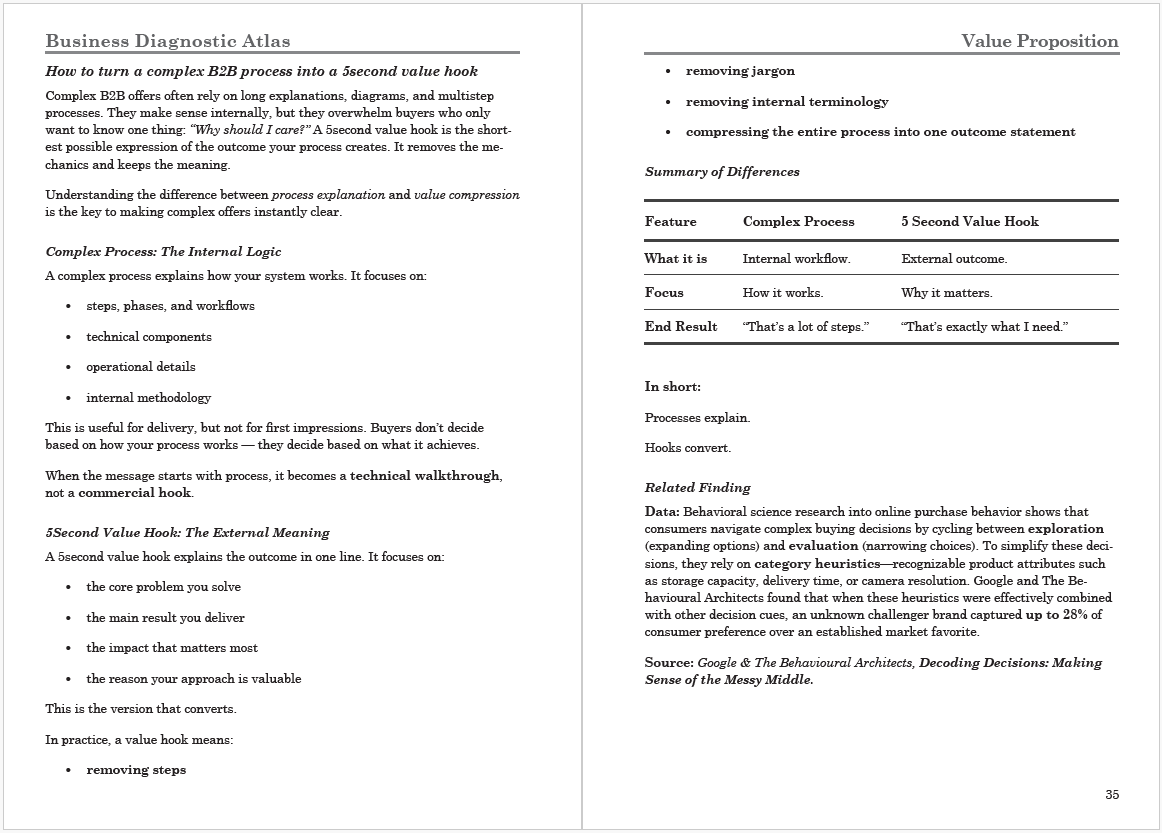
Hooks convert.
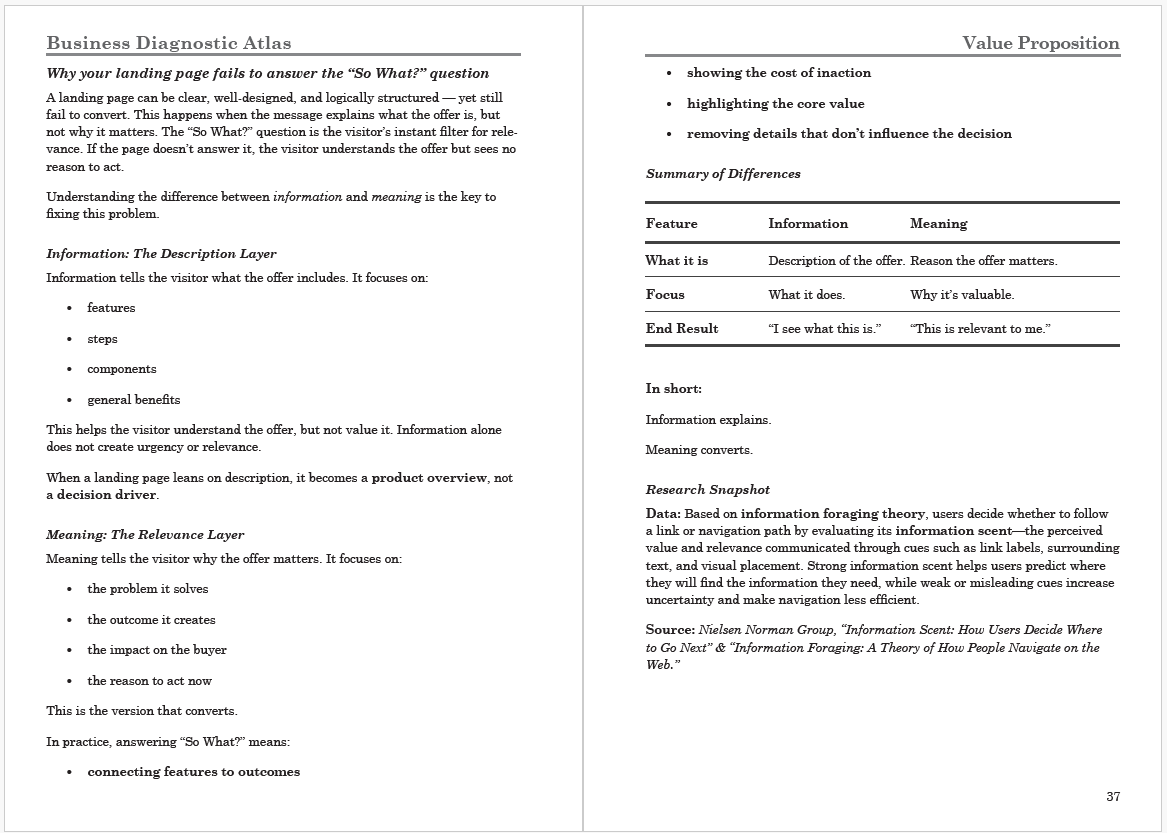
Meaning converts.
Why your landing page fails to answer the “So What?” question
A landing page can be clear, well‑designed, and logically structured — yet still fail to convert. This happens when the message explains what the offer is, but not why it matters. The “So What?” question is the visitor’s instant filter for relevance. If the page doesn’t answer it, the visitor understands the offer but sees no reason to act.
Understanding the difference between information and meaning is the key to fixing this problem.
High traffic but zero conversions
High traffic with no conversions means the visitor understands the offer but doesn’t understand its relevance. They see what you do, but they don’t see why it matters to them within the first five seconds. Without immediate relevance, the page becomes informational instead of motivational.
Understanding the difference between clarity and impact is the key to fixing this problem.
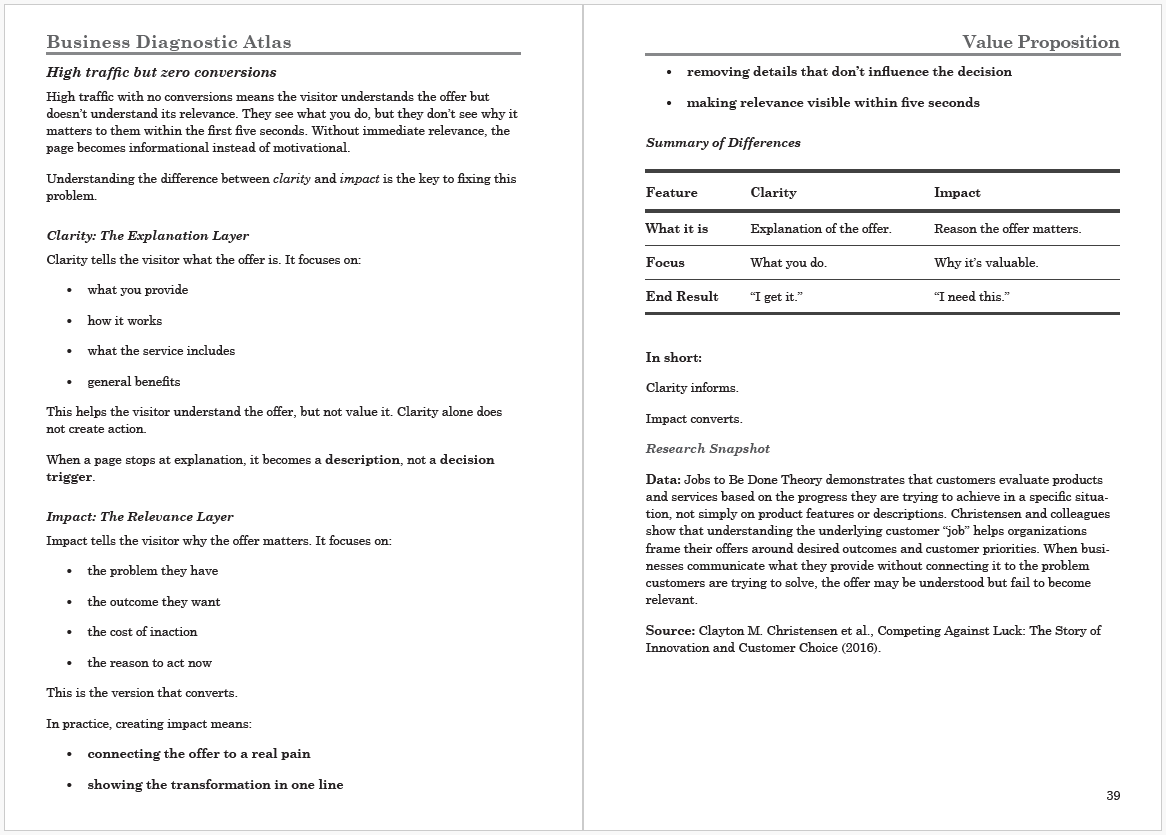
Impact converts.
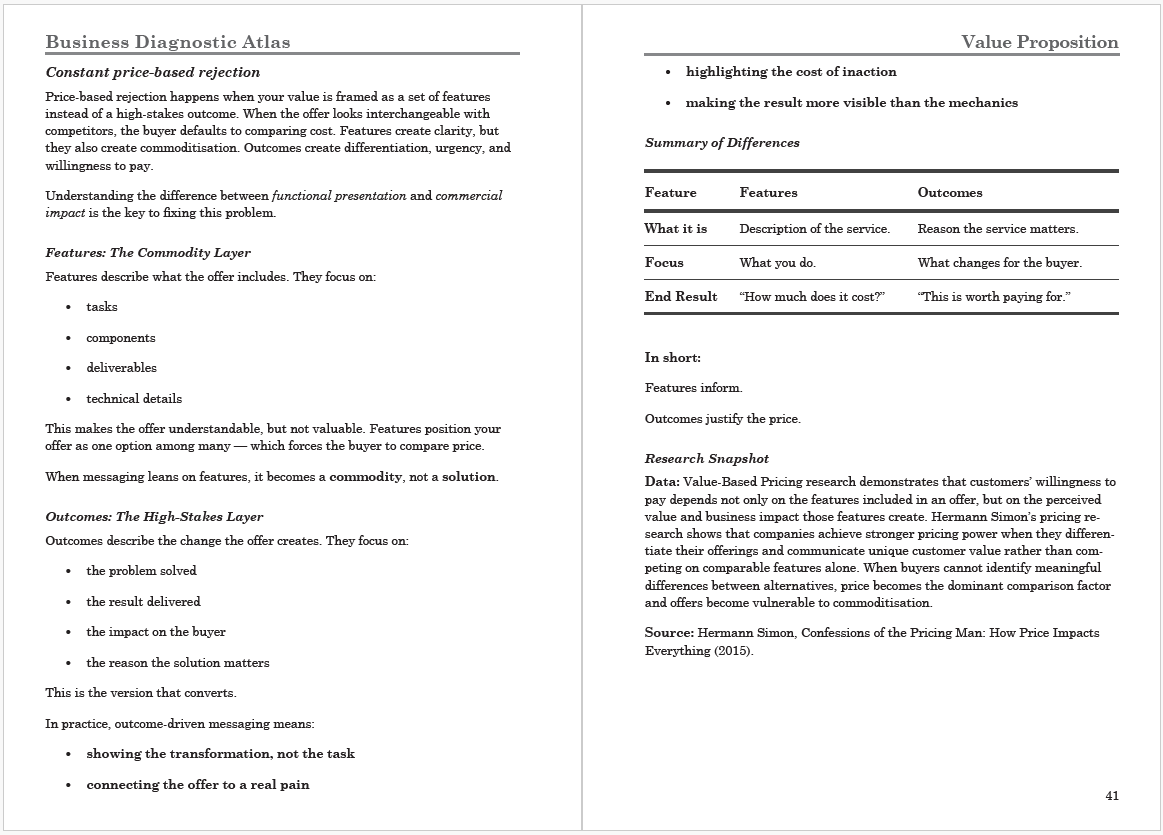
Outcomes justify the price.
Constant price‑based rejection
Price‑based rejection happens when your value is framed as a set of features instead of a high‑stakes outcome. When the offer looks interchangeable with competitors, the buyer defaults to comparing cost. Features create clarity, but they also create commoditisation. Outcomes create differentiation, urgency, and willingness to pay.
Understanding the difference between functional presentation and commercial impact is the key to fixing this problem.
A high bounce rate in the hero section usually means the headline talks about your company instead of the transformation the visitor wants. When the message focuses on history, process, or internal narrative, the visitor sees information — not relevance. They understand who you are, but not why they should stay.
Understanding the difference between company‑centric messaging and user‑centric transformation is the key to fixing this problem.
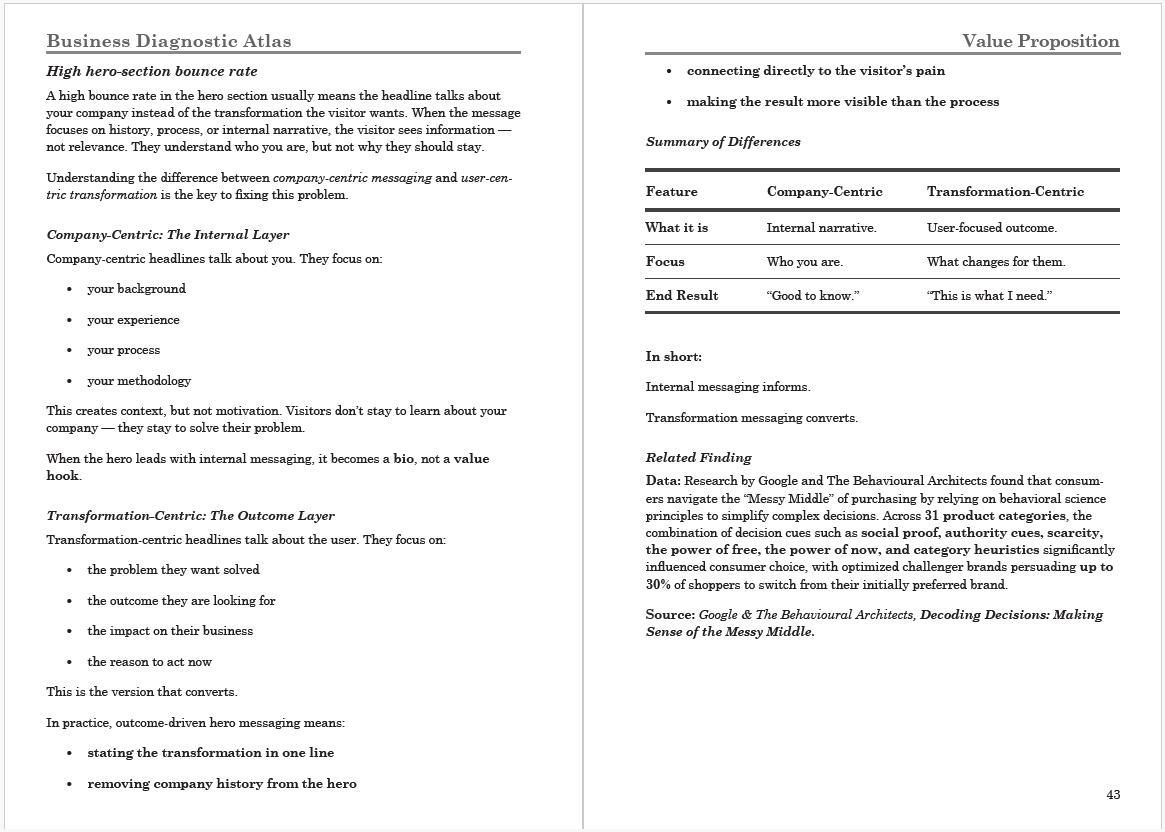
Transformation messaging converts.
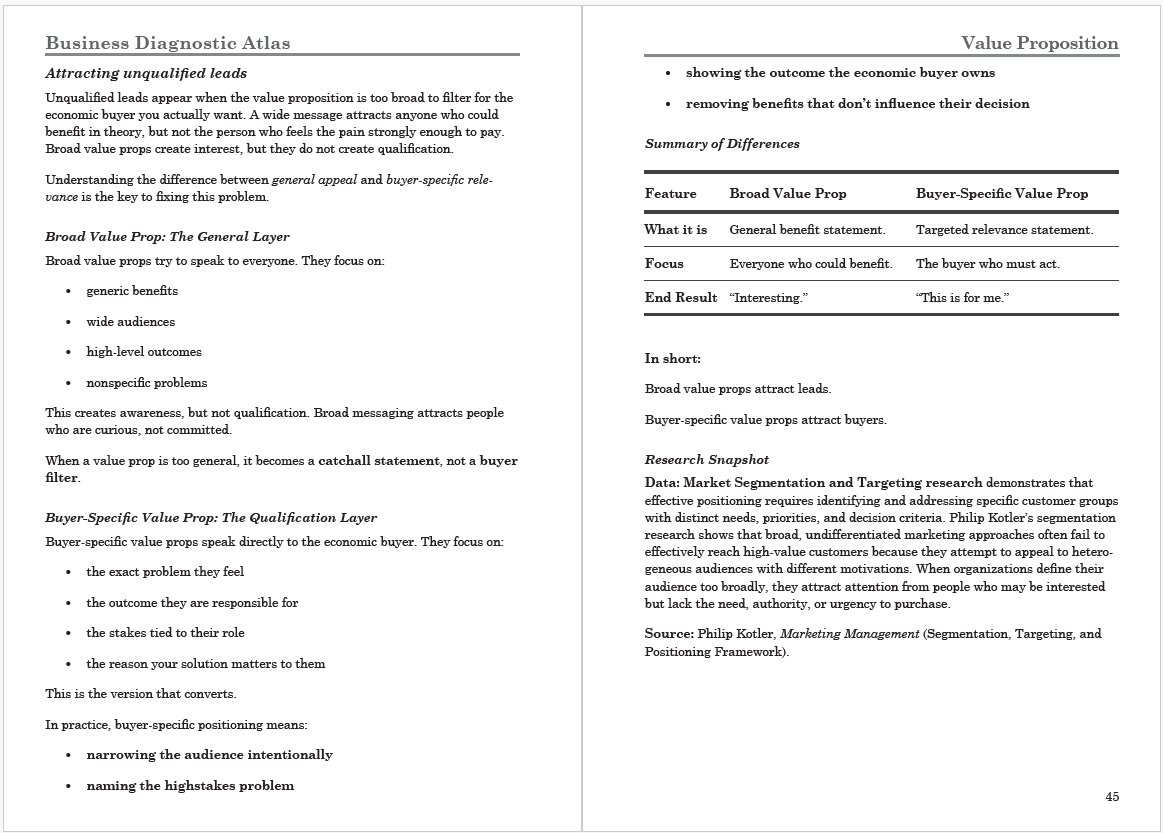
Buyer‑specific value props attract buyers.
Unqualified leads appear when the value proposition is too broad to filter for the economic buyer you actually want. A wide message attracts anyone who could benefit in theory, but not the person who feels the pain strongly enough to pay. Broad value props create interest, but they do not create qualification.
Understanding the difference between general appeal and buyer‑specific relevance is the key to fixing this problem.
Comparison‑shopping fatigue happens when your value proposition is interchangeable with your top competitors. If the buyer cannot see a deterministic reason to choose you, they default to comparing features, price, and surface‑level differences. This creates friction, slows decisions, and pushes the buyer toward the cheapest or most familiar option.
Understanding the difference between category sameness and unique commercial advantage is the key to fixing this problem.
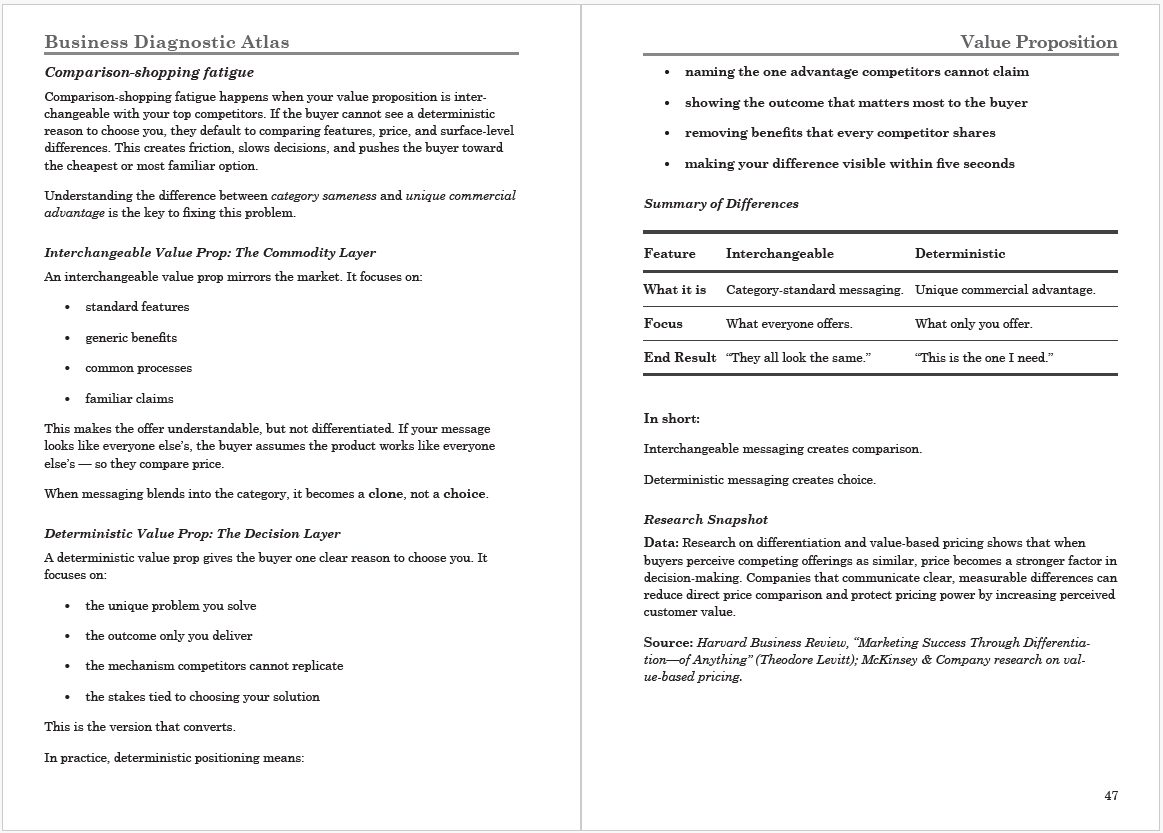
Deterministic messaging creates choice.
Target Audience
Problems where your brand is speaking to the wrong people, too many people, or people who will never buy. This category deals with audience dilution, unclear buyer definition, and misalignment between your messaging and the specific decision‑maker responsible for the high‑stakes problem you solve. The focus is on tightening the brand around one commercially valuable buyer segment so relevance, authority, and demand increase.
Why am I getting leads that can’t afford my rates?
How to stop your blog from attracting only your competitors
Why your marketing works for SMEs but fails for Enterprise
How to identify the person who actually signs the check
Why you are speaking to the ‘Doer’ instead of the ‘Decision Maker’
Why your audience doesn’t recognize themselves in your messaging
How to filter out ‘Information Seekers’ who waste your time
Why your website traffic is high but your lead quality is garbage
How to find the ‘Hidden Pain’ that drives a high-ticket purchase
Why your geographic targeting is limiting your commercial scale
Brand Positioning
Problems caused by weak or undifferentiated brand positioning, where a business fails to communicate who it is for, what unique problem it owns, and why it is the deterministic choice in its category. Covers issues related to market sameness, interchangeable messaging, unclear differentiation, and positioning that doesn’t align with the priorities of the economic buyer.
Why am I losing market share to competitors with worse technology?
How to stop being seen as a “cheap local shop” and start being a partner
Why high-end clients are avoiding your website
How to scale a business that is currently trapped by the founder’s name
Why your brand positioning is 5 years behind the current market reality
How to pivot your brand without alienating your legacy customers
Why you are perceived as a generalist in a market that pays for specialists
How to fix a brand identity that looks like a mass‑market commodity
Why your website doesn’t reflect the authority you actually have
How to bridge the gap between technical brilliance and executive trust
Pricing Strategy
This category isolates problems where your rates are structurally misaligned with the buyer’s perceived stakes, market expectations, or the value signals your brand emits. It focuses on diagnosing why your pricing attracts the wrong tier, triggers resistance, or fails to map to the commercial risk you remove. The goal is to expose gaps between your actual value and your pricing architecture — then rebuild your price, framing, and justification so premium buyers see your number as logical, expected, and commercially safe.
How to justify a price increase without a mass exodus of clients
Why your ‘Request a Quote’ button is a conversion killer
How to stop your pricing from feeling like a ‘hidden cost.’
Why transparent pricing is scaring away your best prospects
How to move from ‘Billable Hours’ to ‘Value‑Based’ fees
Why being the ‘Cheapest Option’ is a death sentence in your niche
How to use a ‘Low‑Friction’ entry product to sell high‑ticket services
Why your pricing table is causing ‘Decision Paralysis.’
How to frame your cost as an investment rather than an expense
Why your discount strategy is permanently eroding your brand value
Communication Tone
Problems caused by weak, unclear, or low‑authority communication that collapses perceived value, reduces buyer confidence, or signals vendor‑level positioning. Covers issues where phrasing, posture, and linguistic framing fail to convey stakes, expertise, or decisiveness, resulting in diluted commercial impact. Focuses on tightening language so every message emits clarity, authority, and strategic weight aligned with high‑accountability buyers.
Why your professional tone makes you sound untrustworthy
How to stop using buzzwords that mean nothing to your customers
Why your sales copy sounds like a robot wrote it
How to use ‘Expert Authority’ without sounding condescending
Why your brand voice is too quiet for a loud market
How to write emails that your prospects actually want to read
Why your marketing feels like a lecture instead of a conversation
How to find the balance between ‘Friendly’ and ‘Boutique Authority’
Why your website copy is focused on ‘You’ instead of ‘Them.’
How to create a signature brand voice that competitors can’t copy
Portfolio Strengths
Problems caused by a portfolio that fails to demonstrate commercial relevance, strategic depth, or differentiated capability. Covers issues where case studies, past work, or proof points are too generic, too tactical, or too disconnected from the buyer’s real stakes. Focuses on identifying gaps in how your portfolio communicates outcomes, authority, and market alignment — then strengthening it so every example reinforces credibility, competence, and the specific value your brand delivers.
Why your Case Studies feel like homework instead of sales tools
How to show proof of work when your clients are under NDAs
Why a list of logos isn’t enough to prove you’re an expert
How to turn a single ‘Win’ into a repeatable marketing asset
Why your testimonials sound fake (even when they’re real)
How to show technical depth without boring the CEO
Why your ‘Our Work’ page is the most ignored part of your site
How to use ‘Negative Results’ to build massive trust with prospects
Why your portfolio is attracting the wrong kind of projects
How to prove you can handle enterprise‑scale problems
SEO Analysis
Problems caused by SEO analysis that fails to translate signals into strategic, commercial, or decision‑ready insight. Covers issues where audits are too technical, too tool‑driven, too fragmented, or too disconnected from business stakes — resulting in analysis that informs but doesn’t persuade. Focuses on identifying gaps in clarity, prioritization, and narrative so your SEO evaluation becomes a strategic asset that shapes decisions, aligns stakeholders, and reveals the real levers of growth.
Why your high‑ranking pages aren’t generating any revenue
How to stop optimizing for ‘Bots’ and start optimizing for ‘Buyers’
Why Google AI Overviews are stealing your traffic (and how to stop it)
How to identify the ‘Money Keywords’ your competitors missed
Why your technical SEO is perfect but your rankings are stuck
How to build ‘Semantic Authority’ so LLMs recommend you
Why your site architecture is confusing both Google and your users
How to fix ‘Keyword Cannibalization’ that is killing your visibility
Why your local SEO is failing even though you’re a local leader
How to survive the shift from ‘Search Engines’ to ‘Answer Engines’
Customer Journey Gaps
Problems caused by missing, weak, or misaligned steps in the buyer journey that break momentum, reduce trust, or stop prospects from advancing. Covers issues where your content, messaging, or experience fails to match buyer intent at each stage — creating friction, confusion, or drop‑off. Focuses on identifying where prospects lose clarity, confidence, or direction so your journey becomes a seamless, decision‑ready path instead of a fragmented sequence. Strengthens how you map intent, remove blockers, and align every touchpoint with the buyer’s next move.
Why people are adding to cart but never finishing the purchase
How to fix the ‘Trust Gap’ between your ad and your landing page
Why your sales funnel has a hole at the most critical moment
How to stop users from bouncing at your pricing page
Why your ‘Thank You’ page is a wasted commercial opportunity
How to identify where your visitors are getting ‘stuck’ in the funnel
Why your mobile journey is twice as hard as your desktop one
How to use ‘Micro‑Conversions’ to move cold leads to a sale
Why your retargeting ads are annoying people instead of converting them
How to simplify a complex B2B buying journey
UX/UI Elements
Problems caused by interface components that create friction, confusion, or hesitation at critical moments in the journey. Covers issues where buttons, forms, layouts, interactions, or visual hierarchy fail to guide users, forcing them to think, guess, or work harder than necessary. Focuses on identifying where design choices break momentum, weaken clarity, or reduce confidence — turning simple actions into effort. Strengthens how each element supports intent, reduces cognitive load, and moves users forward without resistance.
Why your ‘Creative’ design is actually hurting your sales
Why your navigation menu hides your most important pages
Why your site speed is costing you 20% of your conversions
How to design a ‘Mobile‑First’ experience that doesn’t feel limited
Why your ‘Hero Image’ is pushing your value prop off the screen
How to use ‘White Space’ to increase reading time and trust
Why your ‘Call to Action’ buttons are invisible to your users
How to fix ‘Rage Clicking’ caused by bad UI logic
Why your site looks ‘Old’ to Gen Z and ‘Confusing’ to Boomers
How to design for ‘Skimmers’ without losing the ‘Deep Readers’
Key Competitors
Problems caused by rival products, services, or brands shaping user expectations before they ever reach you. Covers issues where competitors set higher standards for speed, clarity, pricing, UX, or messaging — making your experience feel weaker, slower, or less trustworthy by comparison. Focuses on identifying where competitor strengths create friction in your own journey, where their positioning reframes your value, and where their UX patterns redefine what users consider “normal.” Strengthens how your product differentiates, counters competitive advantages, and aligns with the expectations users bring from the market.
Why you are ignoring the competitor who is actually stealing your sales
How to monitor competitors without becoming a copycat
Why ‘Big Brand’ competitors are more vulnerable than you think
How to spot a new market entrant before they disrupt you
Why your ‘Old Rival’ isn’t your biggest threat anymore
How to find the ‘Silent Competitors’ in the AI search results
Why you shouldn’t benchmark against an industry leader’s mistakes
How to use competitor reviews to find your next product feature
Why your competitor’s ‘Low Price’ is their biggest weakness
How to identify ‘Indirect Competitors’ who are solving the same problem
Differentiation Factors
Problems caused by unclear, weak, or inconsistent signals that fail to show why your product is the better choice. Covers issues where your value isn’t obvious, your strengths aren’t communicated, or your positioning blends into the competitive noise. Focuses on identifying the elements that make you meaningfully different — not louder, not cheaper, not more features — but more aligned with what the customer actually values. Strengthens how your product stands out, how your messaging frames your advantages, and how your experience reinforces the reasons to choose you over any alternative.
Why ‘Better’ is a losing strategy compared to ‘Different.’
How to find a ‘Unique Angle’ in a saturated commodity market
Why your ‘USP’ is actually something everyone else claims
How to weaponize your ‘Boutique’ size against massive agencies
Why your personal ‘Methodology’ is your only true differentiator
How to stop being a ‘Me‑Too’ brand in a crowded niche
Why your biggest differentiator is something you aren’t talking about
How to differentiate on ‘Speed’ without sacrificing ‘Quality.’
Why ‘Trust’ isn’t a differentiator (everyone claims it)
How to build a ‘Moat’ that competitors can’t easily cross
Competitive Advantages
Problems caused by weak, misunderstood, or under-leveraged strengths that should give you an edge but currently don’t. Covers issues where your inherent advantages — expertise, data, efficiency, locality, niche focus, brand equity — exist, but aren’t being used strategically, communicated clearly, or converted into market power. Focuses on identifying the assets competitors can’t easily copy and turning them into structural advantages that compound over time. Strengthens how you position, prove, and weaponize the things that make you harder to beat, not just nicer to choose.
Why your ‘Technical Depth’ is a double‑edged sword
How to leverage ‘Proprietary Data’ to dominate your niche
Why ‘Customer Service’ is a weak competitive advantage
How to use ‘Locality’ to beat national‑scale competitors
Why your ‘Founder Expertise’ is your strongest sales asset
How to turn ‘Operational Efficiency’ into a pricing advantage
Why your ‘Niche Focus’ allows you to charge 3x more
How to identify the ‘Unfair Advantage’ you’re currently wasting
Why your ‘Network’ is your most defensible asset
How to build ‘Brand Equity’ that survives market downturns
Weaknesses vs Competitors
Problems created when your weaknesses become more visible than your strengths — especially in direct comparison to a rival. Covers issues where competitors outperform you in speed, trust, UX, awareness, technology, content, or convenience, making your offering look outdated, slow, or harder to choose. Focuses on identifying structural disadvantages, perception gaps, and friction points that push prospects toward competitors. Strengthens how you diagnose, prioritize, and eliminate weaknesses that actively lose you deals, while counter‑positioning against the areas where competitors currently hold the upper hand.
Why your ‘Legacy Tech’ is making you look slow and expensive
How to fix the ‘Brand Awareness’ gap between you and your rival
Why your competitor’s ‘Mobile App’ is winning the convenience war
How to close the ‘Trust Gap’ when a competitor has more reviews
Why your ‘Customer Support’ is driving people to your competitors
How to identify the ‘Structural Weakness’ in your service model
Why your rival’s ‘Content Library’ is their biggest competitive wall
How to fix a ‘UX Friction’ that your competitors solved years ago
Why your ‘Sales Process’ is too slow for modern buyers
How to counter a competitor’s ‘Aggressive Advertising’ budget
Emerging Threats
Problems created when external forces evolve faster than your business model, making your current strengths irrelevant and your weaknesses fatal. Covers threats from AI disruption, search ecosystem shifts, privacy laws, market saturation, platform dependency, and structural changes that erode your competitive position. Focuses on identifying early signals, diagnosing existential risks, and adapting before the environment makes your current strategy obsolete. Strengthens how you anticipate, counter, and out‑maneuver threats that competitors will ignore until it’s too late.
Why ‘Search Generative Experience’ (SGE) is your biggest threat
How to survive when ‘Zero‑Click’ searches become the norm
Why ‘Commoditized AI’ is destroying the value of your services
How to pivot before ‘Vertical Search’ kills your organic traffic
Why your ‘Middle‑Man’ business model is at risk of disruption
How to identify the ‘Technology Shift’ that will make you obsolete
Why ‘Privacy Regulations’ are going to break your lead generation
How to deal with ‘Market Saturation’ in the high‑ticket SEO space