

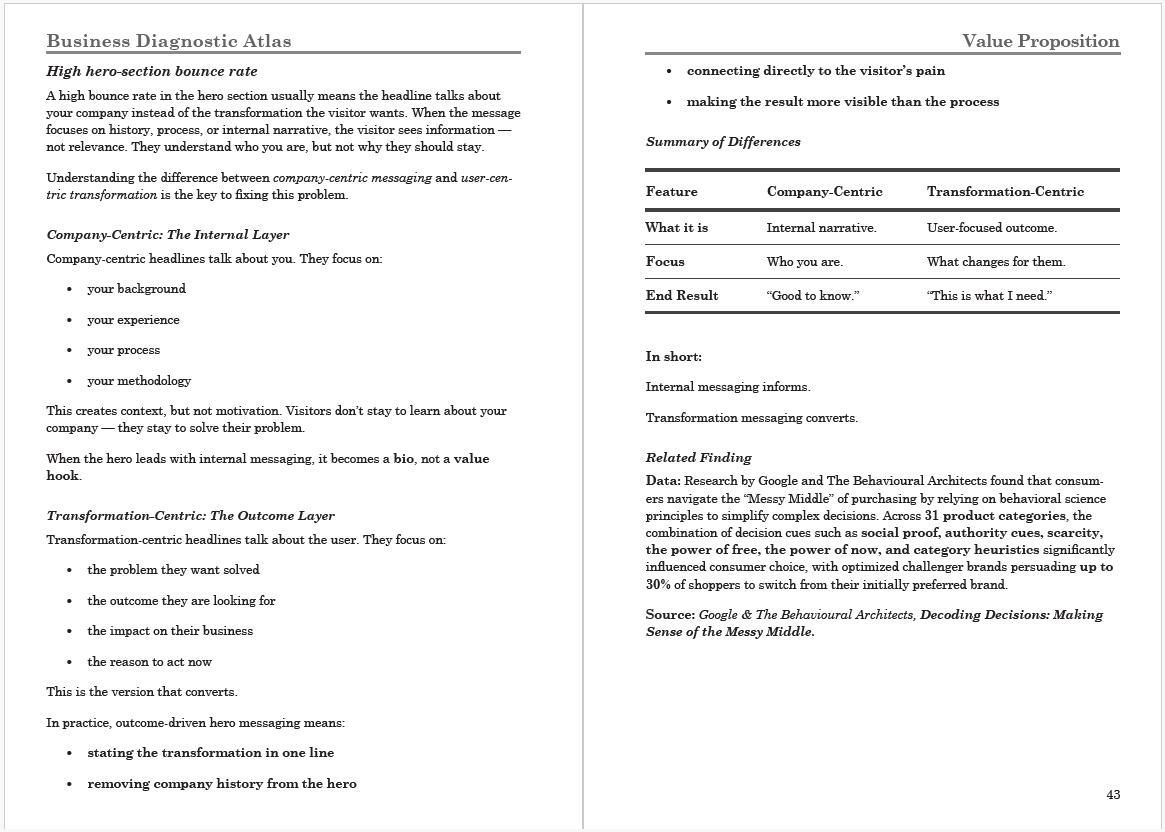
A high bounce rate in the hero section usually means the headline talks about your company instead of the transformation the visitor wants. When the message focuses on history, process, or internal narrative, the visitor sees information — not relevance. They understand who you are, but not why they should stay.
Understanding the difference between company‑centric messaging and user‑centric transformation is the key to fixing this problem.
Company‑Centric: The Internal Layer
Company‑centric headlines talk about you. They focus on:
- your background
- your experience
- your process
- your methodology
This creates context, but not motivation. Visitors don’t stay to learn about your company — they stay to solve their problem.
When the hero leads with internal messaging, it becomes a bio, not a value hook.
Transformation‑Centric: The Outcome Layer
Transformation‑centric headlines talk about the user. They focus on:
- the problem they want solved
- the outcome they are looking for
- the impact on their business
- the reason to act now
This is the version that converts.
In practice, outcome‑driven hero messaging means:
- stating the transformation in one line
- removing company history from the hero
- connecting directly to the visitor’s pain
- making the result more visible than the process
Summary of Differences
| Feature | Company‑Centric | Transformation‑Centric |
|---|---|---|
| What it is | Internal narrative. | User‑focused outcome. |
| Focus | Who you are. | What changes for them. |
| End Result | “Good to know.” | “This is what I need.” |
In short:
Internal messaging informs.
Transformation messaging converts.
Company-Centric vs. Transformation-Centric Hero Sections: Real Examples
Example 1: A business consultant
Company-centric hero:
“We are a leading management consultancy with over 20 years of experience helping organisations improve performance through our proven strategic methodology.”
The visitor learns about the consultancy.
But motivation is missing:
“What can you actually change for my business?”
A transformation-centric version could say:
“Turn a business that depends on its founder into one that can grow without every decision coming back to you.”
Now the visitor sees the business transformation they may actually want.
High-ticket clients often make their decision about your expertise before the first conversation, based on what they find online.
The 1EuroSEO Personal Brand Audit can uncover gaps in your positioning, authority signals and client journey, so you can see exactly where your online presence is costing you opportunities.
Example 2: A solar energy company
Company-centric hero:
“With more than 15 years of experience, our team designs and installs high-quality solar energy systems using leading technology and professional installation methods.”
The visitor learns about the company and its experience.
But motivation is missing:
“What difference will solar actually make to my home?”
A transformation-centric version could say:
“Cut your home’s dependence on the grid and generate more of the electricity you use yourself.”
Now the visitor sees the change they are buying, rather than the company’s credentials.
Example 3: A recruitment agency
Company-centric hero:
“We are an established recruitment agency with a team of experienced consultants specialising in permanent and temporary recruitment across multiple industries.”
The visitor learns about the agency.
But motivation is missing:
“How will you solve my hiring problem?”
A transformation-centric version could say:
“Fill the specialist roles your internal team can’t — without spending months searching through unsuitable candidates.”
Now the visitor sees the specific hiring problem the service is designed to solve.
If visitors arrive but hesitate or leave without buying, the E-commerce Website Audit can uncover the strategic gaps affecting trust, positioning and conversion.
Discover the problems you may not see from inside your own business — and where fixing them could have the biggest impact.
Example 4: A home renovation company
Company-centric hero:
“We are a family-run renovation company with over 25 years of experience delivering high-quality residential projects across the region.”
The visitor learns about the company’s history.
But motivation is missing:
“What will my home look like after working with you?”
A transformation-centric version could say:
“Turn your outdated ground floor into the open, functional living space your family actually needs.”
Now the visitor can immediately picture the transformation they want.
SaaS marketing problems are often harder to spot than product problems.
The 1EuroSeo Strategic Business SaaS Marketing Audit can help you see where your positioning, messaging, audience or conversion strategy is working against the product — and what to fix first.
Example 5: A corporate training provider
Company-centric hero:
“We deliver innovative leadership development programmes designed by experienced trainers and delivered to organisations across Europe.”
The visitor learns about the provider.
But motivation is missing:
“What will change in my organisation after this training?”
A transformation-centric version could say:
“Turn technically strong employees into managers who can lead people, resolve conflict and make better decisions.”
Now the visitor sees the specific transformation the training is expected to create.
Ask a Question or Share Your Opinion