

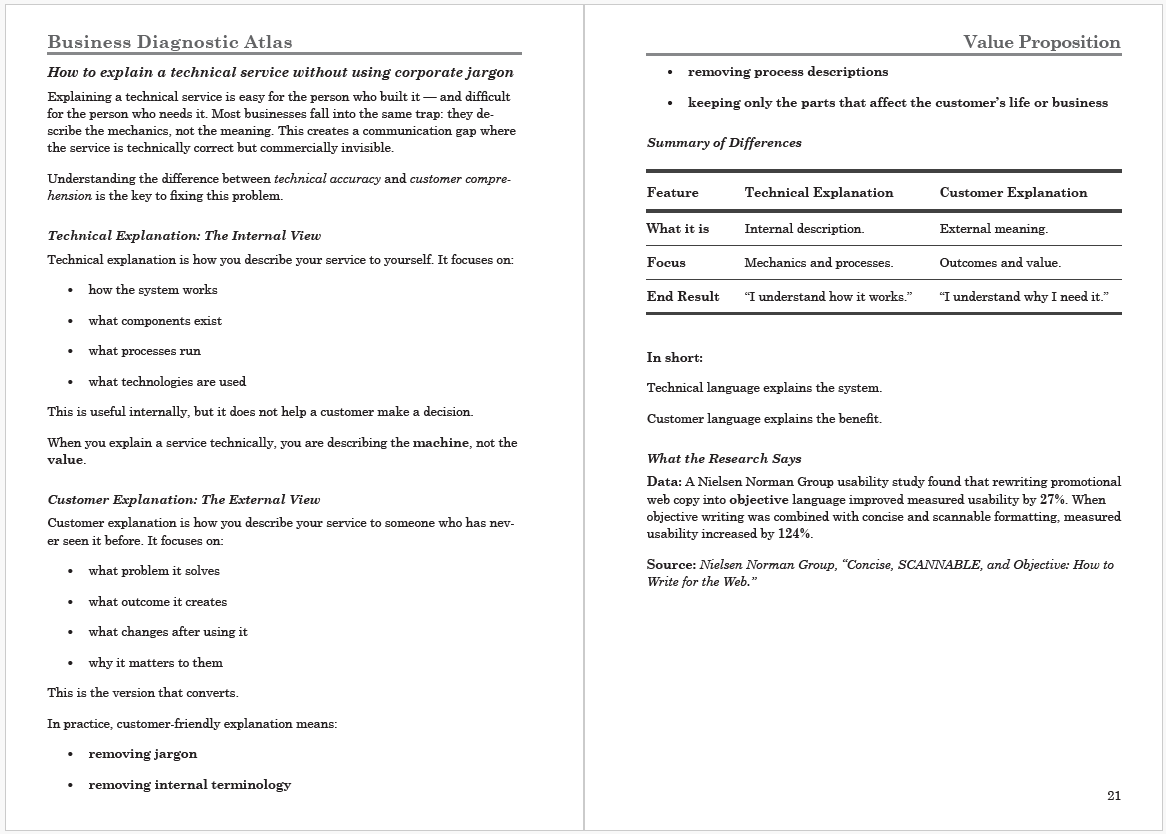
Explaining a technical service is easy for the person who built it — and difficult for the person who needs it. Most businesses fall into the same trap: they describe the mechanics, not the meaning. This creates a communication gap where the service is technically correct but commercially invisible.
Understanding the difference between technical accuracy and customer comprehension is the key to fixing this problem.
Technical Explanation: The Internal View
Technical explanation is how you describe your service to yourself. It focuses on:
- how the system works
- what components exist
- what processes run
- what technologies are used
This is useful internally, but it does not help a customer make a decision.
When you explain a service technically, you are describing the machine, not the value.
Customer Explanation: The External View
Customer explanation is how you describe your service to someone who has never seen it before. It focuses on:
- what problem it solves
- what outcome it creates
- what changes after using it
- why it matters to them
This is the version that converts.
In practice, customer‑friendly explanation means:
- removing jargon
- removing internal terminology
- removing process descriptions
- keeping only the parts that affect the customer’s life or business
Summary of Differences
| Feature | Technical Explanation | Customer Explanation |
|---|---|---|
| What it is | Internal description. | External meaning. |
| Focus | Mechanics and processes. | Outcomes and value. |
| End Result | “I understand how it works.” | “I understand why I need it.” |
In short: Technical language explains the system. Customer language explains the benefit.
Technical Explanation vs. Customer Explanation: Five Real-World Examples
Example 1: A cybersecurity company
Technical explanation:
“Our platform uses continuous endpoint monitoring, behavioural analysis and automated threat detection.”
The service is technically well explained.
But customer comprehension is missing:
“What does this actually do for my business?”
A customer-focused version could say:
“We monitor your computers around the clock and alert you when something looks like a cyberattack — before it becomes a bigger problem.”
Now the customer understands the benefit: protection without needing to understand the technology.
SaaS marketing problems are often harder to spot than product problems.
The 1EuroSeo Strategic Business SaaS Marketing Audit can help you see where your positioning, messaging, audience or conversion strategy is working against the product — and what to fix first.
Example 2: A cloud backup company
Technical explanation:
“Our solution performs automated encrypted incremental backups with geographically redundant storage.”
The mechanics are clear.
But customer comprehension is missing:
“Why should I care about incremental backups?”
A customer-focused version could say:
“If your computer fails, gets stolen or is hit by ransomware, you can restore your files without losing your work.”
Now the customer understands the outcome.
Example 3: An SEO consultant
Technical explanation:
“We analyse your website’s crawlability, structured data, canonicalisation and internal linking architecture.”
The SEO professional understands exactly what is being offered.
But customer comprehension is missing:
“What does any of that mean for my business?”
A customer-focused version could say:
“We find the technical problems that can prevent Google from properly understanding and ranking your website.”
Now the customer understands why the service matters.
If your SaaS website attracts visitors but fails to generate enough qualified leads, the One Euro SEO SaaS SEO Audit can reveal whether you’re reaching the right searches and the right buyers.
Find the gaps your competitors may already be exploiting — and identify where your organic visibility could generate more opportunities.
Example 4: A software developer
Technical explanation:
“We build scalable API-driven applications using a modular microservices architecture.”
The technology is clearly described.
But customer comprehension is missing:
“What do I get from that?”
A customer-focused version could say:
“We build software that can grow with your business without forcing you to replace the whole system when you need more features.”
Now the customer understands the business benefit.
Example 5: A heating engineer
Technical explanation:
“We install high-efficiency air-source heat pumps with variable-speed compressors and smart thermostatic controls.”
The equipment is accurately described.
But customer comprehension is missing:
“Why should I install one?”
A customer-focused version could say:
“We install heating systems designed to keep your home comfortable while using less energy than traditional heating.”
Now the customer understands the reason to care, without needing to understand how the system works.
Ask a Question or Share Your Opinion