

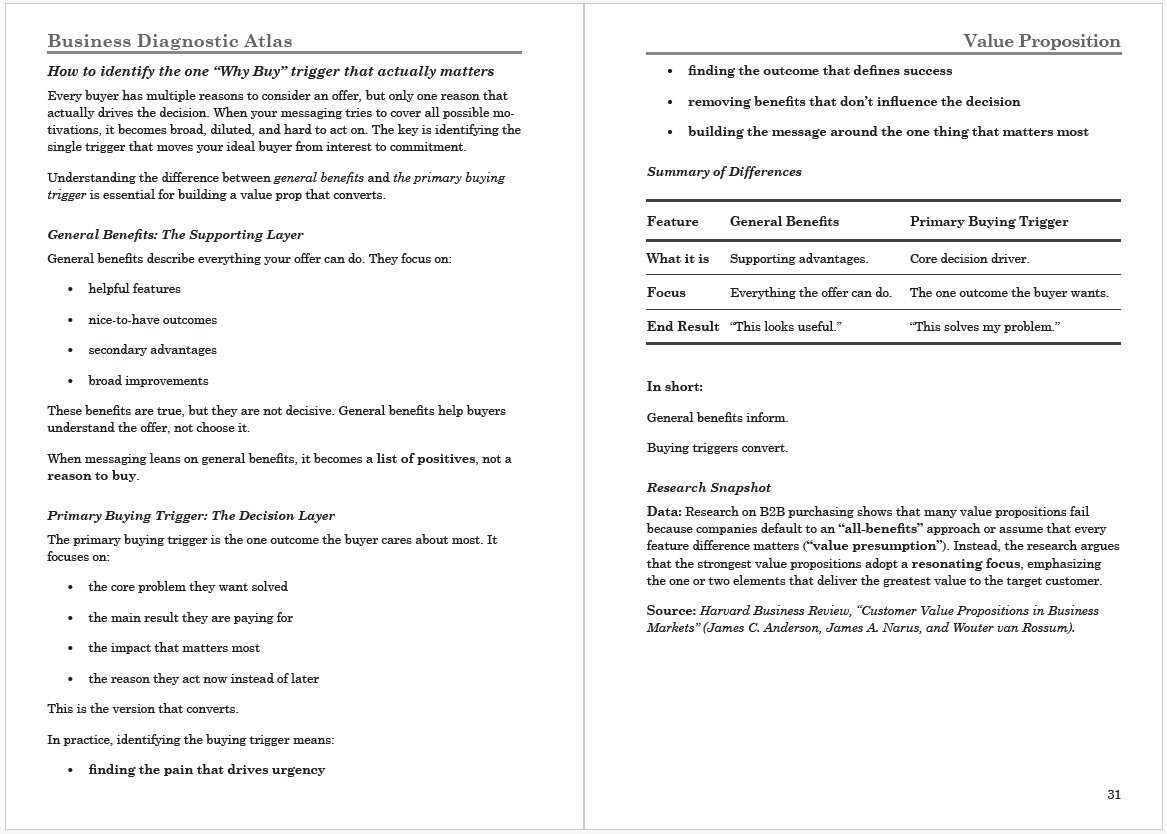
Every buyer has multiple reasons to consider an offer, but only one reason that actually drives the decision. When your messaging tries to cover all possible motivations, it becomes broad, diluted, and hard to act on. The key is identifying the single trigger that moves your ideal buyer from interest to commitment.
Understanding the difference between general benefits and the primary buying trigger is essential for building a value prop that converts.
General Benefits: The Supporting Layer
General benefits describe everything your offer can do. They focus on:
- helpful features
- nice‑to‑have outcomes
- secondary advantages
- broad improvements
These benefits are true, but they are not decisive. General benefits help buyers understand the offer, not choose it.
When messaging leans on general benefits, it becomes a list of positives, not a reason to buy.
Primary Buying Trigger: The Decision Layer
The primary buying trigger is the one outcome the buyer cares about most. It focuses on:
- the core problem they want solved
- the main result they are paying for
- the impact that matters most
- the reason they act now instead of later
This is the version that converts.
In practice, identifying the buying trigger means:
- finding the pain that drives urgency
- finding the outcome that defines success
- removing benefits that don’t influence the decision
- building the message around the one thing that matters most
Summary of Differences
| Feature | General Benefits | Primary Buying Trigger |
|---|---|---|
| What it is | Supporting advantages. | Core decision driver. |
| Focus | Everything the offer can do. | The one outcome the buyer wants. |
| End Result | “This looks useful.” | “This solves my problem.” |
In short:
General benefits inform.
Buying triggers convert.
Five Real Examples
Example 1: A payroll service
General benefits:
“We handle payroll, calculate taxes, provide employee payslips and keep your payroll records organised.”
The visitor understands what the service provides.
But the primary buying trigger is missing:
“Which of these benefits actually makes me want to switch?”
A trigger-focused version could say:
“Never worry about missing a payroll deadline or paying employees incorrectly again. We calculate, process and submit your payroll for you.”
Now the message is built around the problem that creates the strongest urgency.
Before spending more on ads, redesigns or agency retainers, our E-commerce Audit Service can identify what is actually holding your store back.
Get a clear diagnosis of the problems worth fixing first, so you can stop spending money on the wrong solutions.
Example 2: A home security company
General benefits:
“Our security systems include cameras, motion sensors, smart locks and 24/7 monitoring.”
The visitor sees everything the system can do.
But the primary buying trigger is missing:
“What am I actually buying this to prevent?”
A trigger-focused version could say:
“Know immediately when someone enters your property — and have our monitoring team respond when you can’t.”
Now the message focuses on the specific outcome that makes the purchase important.
Example 3: A recruitment agency
General benefits:
“We source candidates, screen applicants, conduct interviews and manage the recruitment process.”
The visitor understands the service.
But the primary buying trigger is missing:
“Why do I need an agency rather than hiring myself?”
A trigger-focused version could say:
“Fill difficult specialist roles without spending weeks screening unsuitable candidates.”
Now the message focuses on the problem creating the strongest reason to buy.
After a Google update, the hardest part is knowing what actually caused the drop — content quality, topical authority, internal linking, site architecture, or something else.
The 1 Euro SEO Affiliate Audit can identify the strategic weaknesses behind your lost visibility, so you know what to fix first instead of guessing.
Example 4: A wedding venue
General benefits:
“Our venue offers beautiful gardens, elegant reception rooms, catering, accommodation and dedicated event staff.”
The visitor can see all the advantages.
But the primary buying trigger is missing:
“What would make me choose this venue for my wedding?”
A trigger-focused version could say:
“Have your ceremony, reception and overnight stay in one place — so you don’t spend your wedding day moving guests between venues.”
Now the message focuses on the one practical problem the venue removes.
Example 5: A business continuity provider
General benefits:
“We provide cloud backup, disaster recovery, monitoring and emergency IT support.”
The visitor understands the services.
But the primary buying trigger is missing:
“Why do I need all of this now?”
A trigger-focused version could say:
“Get your business back online quickly after a cyberattack, hardware failure or major outage — instead of losing days of revenue while your systems are down.”
Now the message focuses on the consequence that creates urgency to buy.
SaaS marketing problems are often harder to spot than product problems.
The 1EuroSeo Strategic Business SaaS Marketing Audit can help you see where your positioning, messaging, audience or conversion strategy is working against the product — and what to fix first.
Ask a Question or Share Your Opinion