

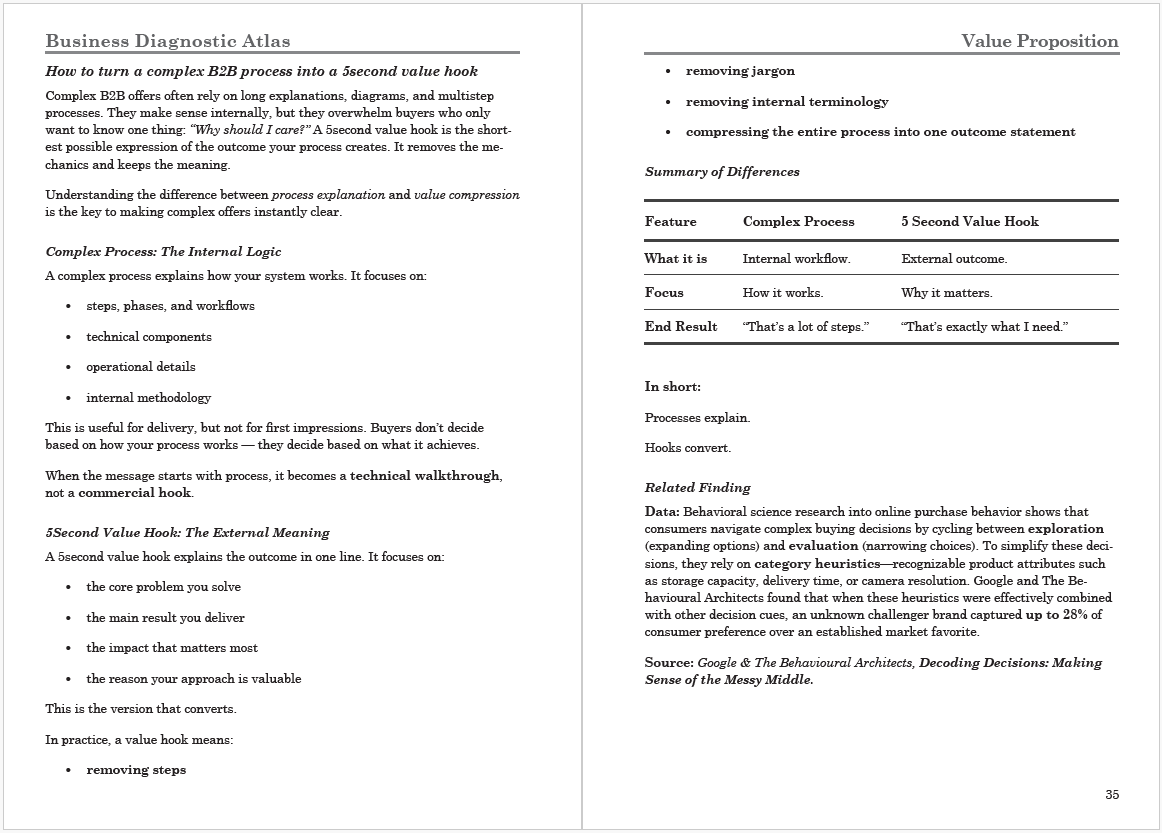
Complex B2B offers often rely on long explanations, diagrams, and multi‑step processes. They make sense internally, but they overwhelm buyers who only want to know one thing: “Why should I care?” A 5‑second value hook is the shortest possible expression of the outcome your process creates. It removes the mechanics and keeps the meaning.
Understanding the difference between process explanation and value compression is the key to making complex offers instantly clear.
Complex Process: The Internal Logic
A complex process explains how your system works. It focuses on:
- steps, phases, and workflows
- technical components
- operational details
- internal methodology
This is useful for delivery, but not for first impressions. Buyers don’t decide based on how your process works — they decide based on what it achieves.
When the message starts with process, it becomes a technical walkthrough, not a commercial hook.
5‑Second Value Hook: The External Meaning
A 5‑second value hook explains the outcome in one line. It focuses on:
- the core problem you solve
- the main result you deliver
- the impact that matters most
- the reason your approach is valuable
This is the version that converts.
In practice, a value hook means:
- removing steps
- removing jargon
- removing internal terminology
- compressing the entire process into one outcome statement
Summary of Differences
| Feature | Complex Process | 5‑Second Value Hook |
|---|---|---|
| What it is | Internal workflow. | External outcome. |
| Focus | How it works. | Why it matters. |
| End Result | “That’s a lot of steps.” | “That’s exactly what I need.” |
In short:
Processes explain.
Hooks convert.
Complex Process vs. Quick Value Hook: Examples
Example 1: A supply chain consultancy
Complex process:
“We conduct a multi-stage supply chain assessment covering supplier segmentation, inventory analysis, demand forecasting, logistics mapping and procurement optimisation.”
The buyer can see that the consultancy has a detailed methodology.
But the value is buried:
“What will all of this actually do for my business?”
A 5-second value hook could say:
“Find where your supply chain is wasting money — and identify the changes that can reduce your operating costs.”
Now the buyer sees the commercial outcome without needing to understand the methodology.
Publishing more content won’t necessarily strengthen a site whose topical coverage is already fragmented.
The One Euro SEO Affiliate Marketing Content Audit can uncover gaps in topic coverage, content relationships and internal linking, helping you focus your effort on the content that can actually strengthen the site.
Example 2: An industrial automation company
Complex process:
“We integrate PLC systems, industrial sensors, machine vision, robotic controls and MES connectivity into a unified production environment.”
The technical process is clear to an engineer.
But the value is buried:
“What changes on my production floor?”
A 5-second value hook could say:
“Automate repetitive production tasks and reduce the downtime that slows your factory down.”
Now the buyer understands the business impact before seeing the technical architecture.
Example 3: A corporate relocation company
Complex process:
“Our relocation programme coordinates immigration documentation, temporary accommodation, household shipment, school placement and local registration through a dedicated case-management workflow.”
The buyer can understand the process.
But the value is buried:
“Why should I outsource all of this?”
A 5-second value hook could say:
“Move your employees to a new country without making your HR team manage every relocation detail.”
Now the buyer sees the problem being removed, rather than the list of services.
Example 4: A data analytics consultancy
Complex process:
“We consolidate data from multiple sources, build transformation pipelines, develop dimensional models and deploy interactive business intelligence dashboards.”
The technical workflow is understandable to a data professional.
But the value is buried:
“What does this help me decide?”
A 5-second value hook could say:
“Turn disconnected business data into one view that shows where your revenue, costs and performance are moving.”
Now the buyer understands the decision-making value without needing to understand the data architecture.
SaaS marketing problems are often harder to spot than product problems.
The 1EuroSeo Strategic Business SaaS Marketing Audit can help you see where your positioning, messaging, audience or conversion strategy is working against the product — and what to fix first.
Example 5: A commercial property advisory firm
Complex process:
“We conduct market analysis, asset benchmarking, tenant reviews, financial modelling and scenario analysis before developing a property optimisation strategy.”
The buyer sees a comprehensive process.
But the value is buried:
“What will I actually gain from this analysis?”
A 5-second value hook could say:
“Find out where your property portfolio is underperforming and where the biggest opportunities to increase its value are.”
Now the buyer sees the financial outcome behind the entire process.
Before spending more on ads, redesigns or agency retainers, our E-commerce Audit Service can identify what is actually holding your store back.
Get a clear diagnosis of the problems worth fixing first, so you can stop spending money on the wrong solutions.
Ask a Question or Share Your Opinion