

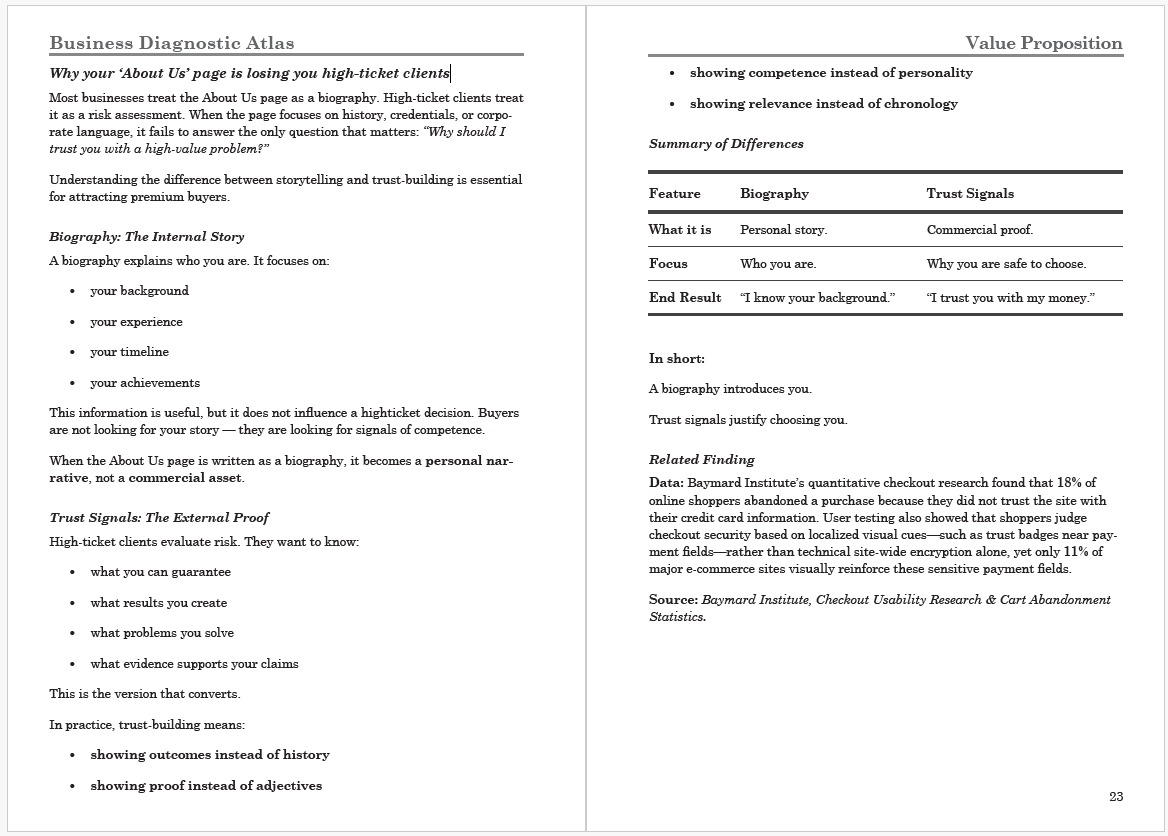
Most businesses treat the About Us page as a biography. High‑ticket clients treat it as a risk assessment. When the page focuses on history, credentials, or corporate language, it fails to answer the only question that matters: “Why should I trust you with a high‑value problem?”
Understanding the difference between storytelling and trust‑building is essential for attracting premium buyers.
Biography: The Internal Story
A biography explains who you are. It focuses on:
- your background
- your experience
- your timeline
- your achievements
This information is useful, but it does not influence a high‑ticket decision. Buyers are not looking for your story — they are looking for signals of competence.
When the About Us page is written as a biography, it becomes a personal narrative, not a commercial asset.
Trust Signals: The External Proof
High‑ticket clients evaluate risk. They want to know:
- what you can guarantee
- what results you create
- what problems you solve
- what evidence supports your claims
This is the version that converts.
In practice, trust‑building means:
- showing outcomes instead of history
- showing proof instead of adjectives
- showing competence instead of personality
- showing relevance instead of chronology
Summary of Differences
| Feature | Biography | Trust Signals |
|---|---|---|
| What it is | Personal story. | Commercial proof. |
| Focus | Who you are. | Why you are safe to choose. |
| End Result | “I know your background.” | “I trust you with my money.” |
In short: A biography introduces you. Trust signals justify choosing you.
Biography vs. Trust Signals: Five Real-World Examples
Example 1: A corporate lawyer
Biography-focused About Us:
“Our firm was founded in 1998 by John Smith. Since then, we have grown to 25 lawyers across three offices and have received numerous industry awards.”
The visitor learns the firm’s history.
But trust is missing:
“Why should I trust this firm with a €500,000 legal dispute?”
A trust-focused version could say:
“Our litigation team has represented businesses in complex commercial disputes worth more than €100 million, including cases involving shareholder and contract disputes.”
Now the client sees relevant evidence of competence.
High-ticket clients often make their decision about your expertise before the first conversation, based on what they find online.
The 1EuroSEO Personal Brand Audit can uncover gaps in your positioning, authority signals and client journey, so you can see exactly where your online presence is costing you opportunities.
Example 2: An architect
Biography-focused About Us:
“Founded by Maria Rossi in 2005, our studio has grown from a small practice into an award-winning architectural firm.”
The visitor learns about the studio.
But trust is missing:
“Can they handle my €2 million development?”
A trust-focused version could say:
“We have designed and delivered 18 residential developments valued between €1 million and €8 million, from planning through completion.”
Now the client sees relevant experience at the required scale.
Example 3: A private wealth manager
Biography-focused About Us:
“Our team has decades of combined experience in banking and investment management. We are passionate about helping clients achieve their financial goals.”
The visitor learns about the team.
But trust is missing:
“Can I trust them with my wealth?”
A trust-focused version could say:
“We manage portfolios for 140 private clients, with a typical portfolio value above €1 million. Every client receives a documented investment strategy and quarterly performance review.”
Now the visitor sees evidence, relevance and accountability.
Being visible for your name is not enough if search doesn’t communicate the expertise and authority you want to be known for.
Our SEO Brand Audit can reveal gaps in your search visibility, content and positioning, helping you understand what potential clients are actually finding when they look for you.
Example 4: A specialist medical clinic
Biography-focused About Us:
“Our clinic was established in 2010 by Dr. Sarah Williams. Our team is dedicated to providing compassionate, patient-centred care.”
The visitor learns about the clinic.
But trust is missing:
“Are these the right specialists for my problem?”
A trust-focused version could say:
“Our specialists have performed more than 2,000 procedures in this field, and each treatment plan is reviewed by two consultants before treatment begins.”
Now the visitor sees specific evidence that reduces perceived risk.
Example 5: A luxury interior designer
Biography-focused About Us:
“Our studio was founded from a passion for beautiful interiors. Today, our talented team creates unique spaces inspired by art, travel and contemporary design.”
The visitor learns about the company’s personality.
But trust is missing:
“Can I trust them with a €300,000 project?”
A trust-focused version could say:
“We manage complete interior projects from €150,000 to €500,000, coordinating architects, contractors and specialist suppliers from initial concept through final installation.”
Now the client sees evidence that the firm can handle the scale and complexity of the project.
Ask a Question or Share Your Opinion