

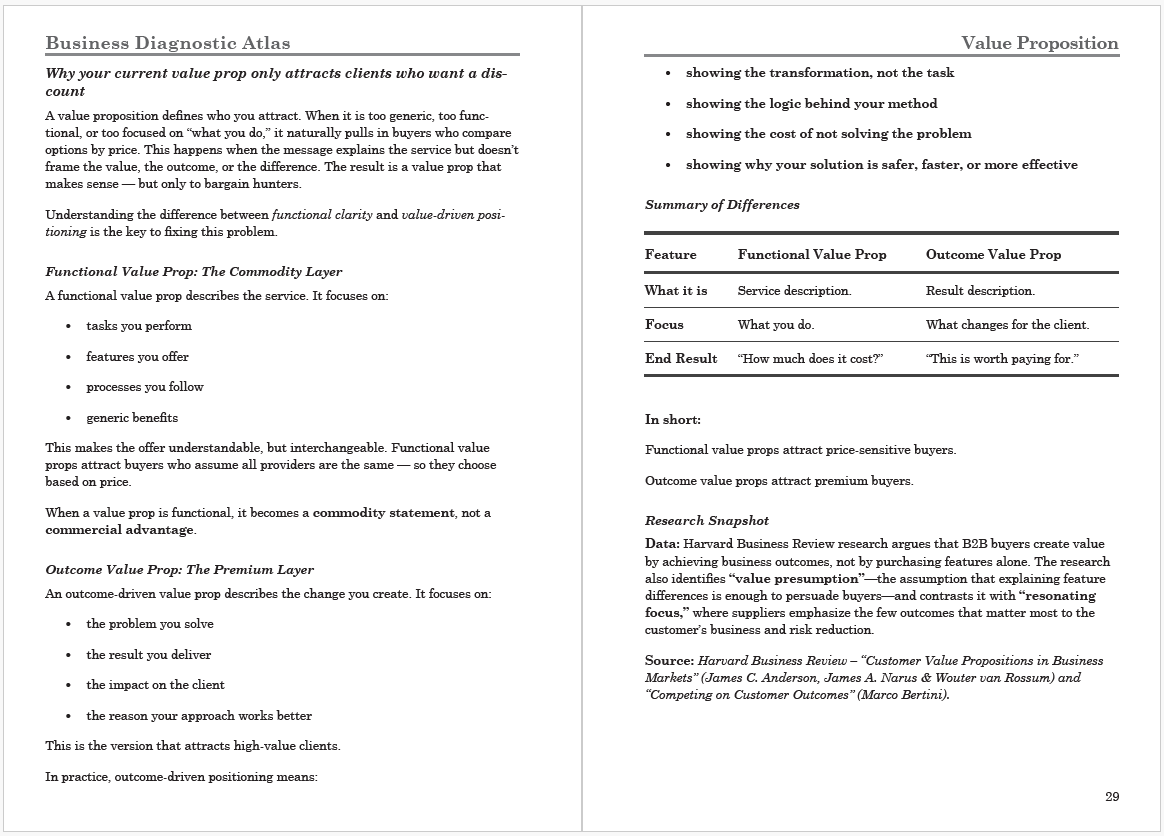
A value proposition defines who you attract. When it is too generic, too functional, or too focused on “what you do,” it naturally pulls in buyers who compare options by price. This happens when the message explains the service but doesn’t frame the value, the outcome, or the difference. The result is a value prop that makes sense — but only to bargain hunters.
Understanding the difference between functional clarity and value‑driven positioning is the key to fixing this problem.
Functional Value Prop: The Commodity Layer
A functional value prop describes the service. It focuses on:
- tasks you perform
- features you offer
- processes you follow
- generic benefits
This makes the offer understandable, but interchangeable. Functional value props attract buyers who assume all providers are the same — so they choose based on price.
When a value prop is functional, it becomes a commodity statement, not a commercial advantage.
Outcome Value Prop: The Premium Layer
An outcome‑driven value prop describes the change you create. It focuses on:
- the problem you solve
- the result you deliver
- the impact on the client
- the reason your approach works better
This is the version that attracts high‑value clients.
In practice, outcome‑driven positioning means:
- showing the transformation, not the task
- showing the logic behind your method
- showing the cost of not solving the problem
- showing why your solution is safer, faster, or more effective
Summary of Differences
| Feature | Functional Value Prop | Outcome Value Prop |
|---|---|---|
| What it is | Service description. | Result description. |
| Focus | What you do. | What changes for the client. |
| End Result | “How much does it cost?” | “This is worth paying for.” |
In short:
Functional value props attract price‑sensitive buyers.
Outcome value props attract premium buyers.
Functional vs. Outcome Value Propositions: Real Examples
Example 1: A commercial cleaning company
Functional value proposition:
“We provide professional office cleaning services, including daily cleaning, carpet cleaning and window cleaning.”
The visitor understands what the company does.
But the value is easy to compare on price:
“How much do you charge compared with the other cleaning companies?”
An outcome-focused version could say:
“Keep your workplace consistently clean without managing cleaners, chasing missed tasks or dealing with staff complaints. We handle the cleaning schedule and quality checks for you.”
Now the offer focuses on the problem removed and the operational value created, rather than the cleaning tasks themselves.
Example 2: A business coach
Functional value proposition:
“We provide one-to-one business coaching covering strategy, leadership, marketing and business development.”
The visitor understands the service.
But the value is easy to compare on price:
“Why should I pay this coach more than another coach?”
An outcome-focused version could say:
“Turn a business that depends on you into one that can grow without you being involved in every decision, sale and operational problem.”
Now the offer focuses on the business transformation, rather than listing coaching topics.
SaaS marketing problems are often harder to spot than product problems.
The 1EuroSeo Strategic Business SaaS Marketing Audit can help you see where your positioning, messaging, audience or conversion strategy is working against the product — and what to fix first.
Example 3: A commercial photographer
Functional value proposition:
“We provide professional photography for businesses, including corporate portraits, product photography and marketing images.”
The visitor understands what the photographer offers.
But the value is easy to compare on price:
“Why should I pay €2,000 for this when another photographer charges €800?”
An outcome-focused version could say:
“Create a consistent visual identity across your website, campaigns and sales materials so your business looks as credible as the clients you want to win.”
Now the offer connects photography to a commercial outcome that is harder to compare purely by price.
High-ticket clients often make their decision about your expertise before the first conversation, based on what they find online.
The 1EuroSEO Personal Brand Audit can uncover gaps in your positioning, authority signals and client journey, so you can see exactly where your online presence is costing you opportunities.
Example 4: An IT support company
Functional value proposition:
“We provide managed IT support, cloud services, cybersecurity and network management for small and medium-sized businesses.”
The visitor understands the services.
But the value is easy to compare on price:
“What do you charge per user?”
An outcome-focused version could say:
“Keep your team working without the downtime, security problems and technical interruptions that pull employees away from their jobs.”
Now the offer focuses on the business cost of technical problems, rather than the list of IT services.
Example 5: A corporate lawyer
Functional value proposition:
“We provide legal advice on contracts, commercial agreements, employment matters and business disputes.”
The visitor understands what the firm does.
But the value is easy to compare on price:
“What is your hourly rate compared with another lawyer?”
An outcome-focused version could say:
“Identify the contractual risks that could cost your business far more than the legal fee before you sign the agreement.”
Now the offer focuses on the financial consequence of the problem and the value of preventing it, rather than the legal task itself.
Building an affiliate site around keywords can work until the strategy behind the site starts working against it.
The 1EuroSEO Affiliate Marketing Audit can reveal weaknesses in your content strategy, competitive position, brand positioning and monetisation, so you can see where the biggest opportunities for recovery are.
Ask a Question or Share Your Opinion