

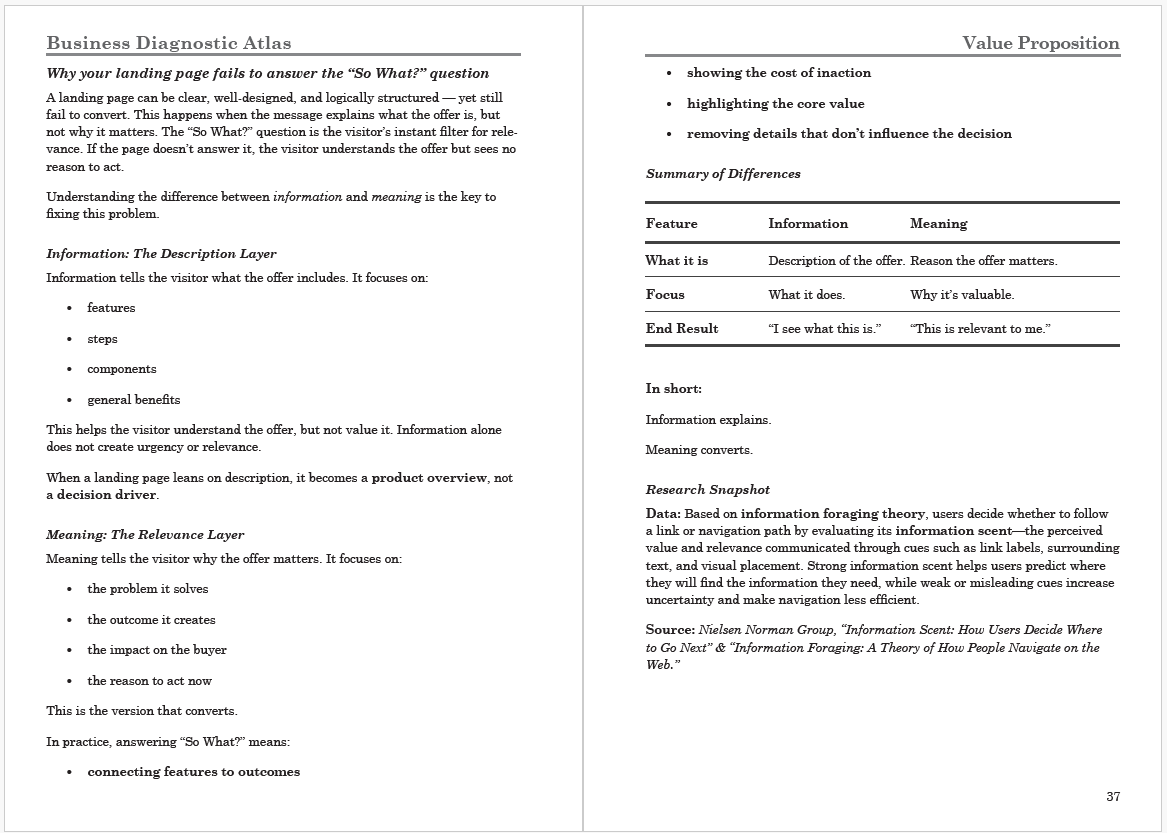
A landing page can be clear, well‑designed, and logically structured — yet still fail to convert. This happens when the message explains what the offer is, but not why it matters. The “So What?” question is the visitor’s instant filter for relevance. If the page doesn’t answer it, the visitor understands the offer but sees no reason to act.
Understanding the difference between information and meaning is the key to fixing this problem.
Information: The Description Layer
Information tells the visitor what the offer includes. It focuses on:
- features
- steps
- components
- general benefits
This helps the visitor understand the offer, but not value it. Information alone does not create urgency or relevance.
When a landing page leans on description, it becomes a product overview, not a decision driver.
Meaning: The Relevance Layer
Meaning tells the visitor why the offer matters. It focuses on:
- the problem it solves
- the outcome it creates
- the impact on the buyer
- the reason to act now
This is the version that converts.
In practice, answering “So What?” means:
- connecting features to outcomes
- showing the cost of inaction
- highlighting the core value
- removing details that don’t influence the decision
Summary of Differences
| Feature | Information | Meaning |
|---|---|---|
| What it is | Description of the offer. | Reason the offer matters. |
| Focus | What it does. | Why it’s valuable. |
| End Result | “I see what this is.” | “This is relevant to me.” |
In short:
Information explains.
Meaning converts.
Five Real Examples
Example 1: A project management platform
Information:
“Our platform lets teams create projects, assign tasks, set deadlines, share files and track progress from one central dashboard.”
The visitor understands what the platform does.
But the “So What?” is missing:
“Why does having all of these features matter to my team?”
A meaning-focused version could say:
“Stop losing project updates across email, spreadsheets and chat. Give everyone one place to see what needs to happen, who is responsible and what is falling behind.”
Now the visitor understands the problem being removed and why the platform matters.
SaaS marketing problems are often harder to spot than product problems.
The 1EuroSeo Strategic Business SaaS Marketing Audit can help you see where your positioning, messaging, audience or conversion strategy is working against the product — and what to fix first.
Example 2: A commercial energy consultant
Information:
“We analyse your energy consumption, review supplier contracts and identify opportunities for efficiency improvements.”
The visitor understands the service.
But the “So What?” is missing:
“What difference will this analysis actually make to my business?”
A meaning-focused version could say:
“Find out where your business is wasting energy and which changes could reduce your annual energy bill before you sign another expensive contract.”
Now the visitor sees the financial consequence and the reason to act.
Publishing more content won’t necessarily strengthen a site whose topical coverage is already fragmented.
The One Euro SEO Affiliate Marketing Content Audit can uncover gaps in topic coverage, content relationships and internal linking, helping you focus your effort on the content that can actually strengthen the site.
Example 3: A recruitment software platform
Information:
“Our platform automates job advertising, candidate screening, interview scheduling and applicant communication.”
The visitor understands the features.
But the “So What?” is missing:
“Why should I change the way we recruit?”
A meaning-focused version could say:
“Spend less time screening hundreds of applications so your recruiters can focus on the candidates who are actually worth interviewing.”
Now the visitor understands the business impact behind the automation.
Example 4: A home renovation company
Information:
“We provide complete renovation services including design, building work, plumbing, electrical installation and finishing.”
The visitor understands what is included.
But the “So What?” is missing:
“Why does using one company matter to me?”
A meaning-focused version could say:
“Renovate your entire home with one team responsible for every stage, so you don’t have to coordinate different contractors when something goes wrong.”
Now the visitor sees the practical problem being removed.
If visitors arrive but hesitate or leave without buying, the E-commerce Website Audit can uncover the strategic gaps affecting trust, positioning and conversion.
Discover the problems you may not see from inside your own business — and where fixing them could have the biggest impact.
Example 5: A business data security service
Information:
“We provide encrypted backups, continuous monitoring, automated recovery and secure cloud storage for business data.”
The visitor understands the service.
But the “So What?” is missing:
“Why do I need all of this if nothing has gone wrong?”
A meaning-focused version could say:
“If ransomware, hardware failure or human error destroys your business data, recover what you need to keep operating instead of starting from scratch.”
Now the visitor understands the consequence the service protects against and why that protection matters.
Ask a Question or Share Your Opinion