

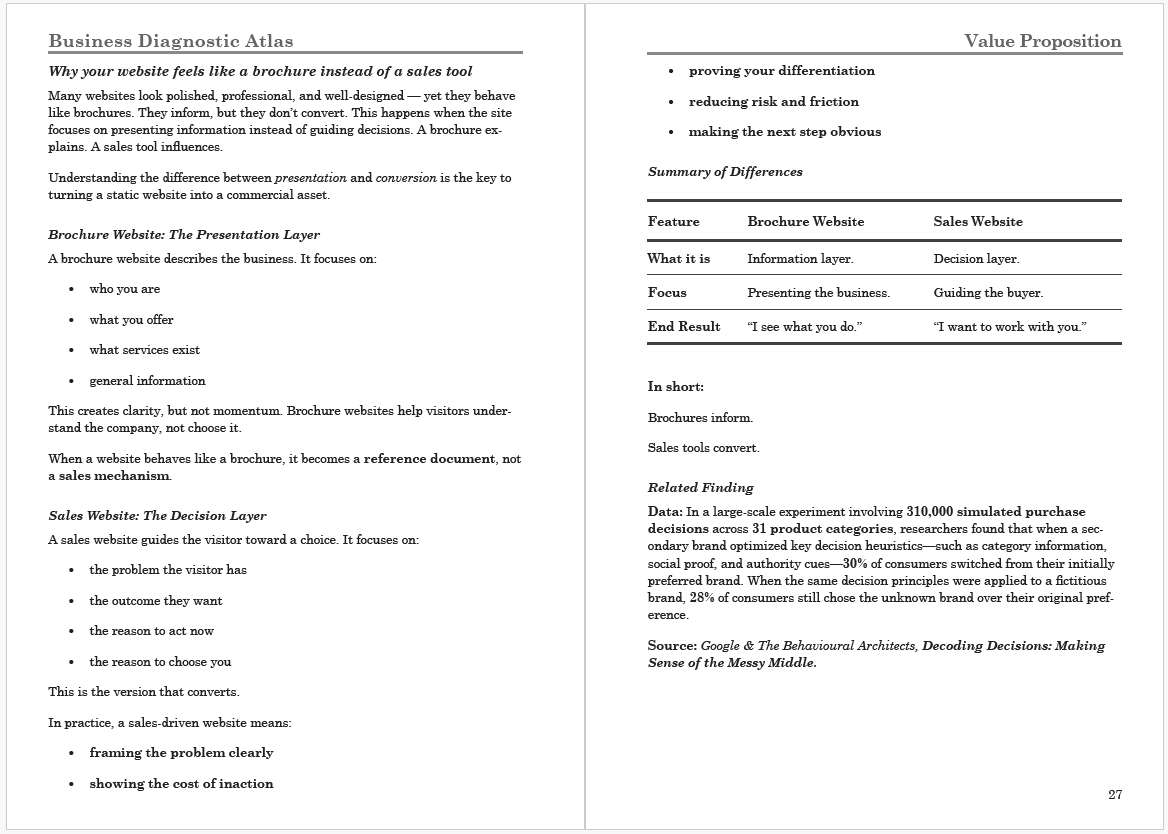
Many websites look polished, professional, and well‑designed — yet they behave like brochures. They inform, but they don’t convert. This happens when the site focuses on presenting information instead of guiding decisions. A brochure explains. A sales tool influences.
Understanding the difference between presentation and conversion is the key to turning a static website into a commercial asset.
Brochure Website: The Presentation Layer
A brochure website describes the business. It focuses on:
- who you are
- what you offer
- what services exist
- general information
This creates clarity, but not momentum. Brochure websites help visitors understand the company, not choose it.
When a website behaves like a brochure, it becomes a reference document, not a sales mechanism.
Sales Website: The Decision Layer
A sales website guides the visitor toward a choice. It focuses on:
- the problem the visitor has
- the outcome they want
- the reason to act now
- the reason to choose you
This is the version that converts.
In practice, a sales‑driven website means:
- framing the problem clearly
- showing the cost of inaction
- proving your differentiation
- reducing risk and friction
- making the next step obvious
Summary of Differences
| Feature | Brochure Website | Sales Website |
|---|---|---|
| What it is | Information layer. | Decision layer. |
| Focus | Presenting the business. | Guiding the buyer. |
| End Result | “I see what you do.” | “I want to work with you.” |
In short:
Brochures inform.
Sales tools convert.
Brochure Website vs. Sales Website: Five Real Examples
Example 1: A luxury car dealership
Brochure website:
“We offer a selection of premium vehicles from leading manufacturers, with flexible finance options and professional after-sales support.”
The visitor understands what the dealership offers.
But the sales direction is missing:
“Why should I buy my next car from this dealership?”
A sales-focused version could say:
“Looking for a premium car without the pressure of a traditional dealership? Compare our available models online, see the exact monthly cost, and book a private test drive at a time that suits you.”
Now the website gives the visitor a reason to continue, a reason to choose the dealership, and a clear next step.
If visitors arrive but hesitate or leave without buying, the E-commerce Website Audit can uncover the strategic gaps affecting trust, positioning and conversion.
Discover the problems you may not see from inside your own business — and where fixing them could have the biggest impact.
Example 2: An interior design studio
Brochure website:
“We create bespoke interiors for residential and commercial clients, combining functionality, quality materials and contemporary design.”
The visitor understands the service.
But the sales direction is missing:
“Why should I trust this studio with my expensive renovation?”
A sales-focused version could say:
“Planning a high-end renovation but don’t want to coordinate ten different suppliers? We manage the design, sourcing and installation from one place, giving you a single team responsible for the finished interior.”
Now the website addresses a specific problem, demonstrates the value of the service, and reduces the perceived complexity of buying it.
Example 3: A business insurance broker
Brochure website:
“We provide tailored business insurance solutions for companies across a range of industries, including property, liability and professional indemnity cover.”
The visitor understands what the broker sells.
But the sales direction is missing:
“What could go wrong if I choose the wrong policy?”
A sales-focused version could say:
“Think your business insurance covers everything? We review your existing policy, identify gaps that could leave you exposed, and explain exactly what you would be paying to protect.”
Now the website creates a reason to investigate the problem before simply comparing insurance prices.
Example 4: A software company
Brochure website:
“Our platform provides powerful project management tools that help teams collaborate, manage tasks and track progress in one centralised workspace.”
The visitor understands what the software does.
But the sales direction is missing:
“Why should I move my team from the system we’re already using?”
A sales-focused version could say:
“Still chasing project updates across email, spreadsheets and chat? Bring tasks, deadlines and progress into one place so your team can see what needs attention without another status meeting.”
Now the website connects the product to a recognisable problem and a measurable improvement in how the team works.
SaaS marketing problems are often harder to spot than product problems.
The 1EuroSeo Strategic Business SaaS Marketing Audit can help you see where your positioning, messaging, audience or conversion strategy is working against the product — and what to fix first.
Example 5: A private education consultant
Brochure website:
“We provide personalised educational consulting for families seeking independent advice on school selection, admissions and academic planning.”
The visitor understands the service.
But the sales direction is missing:
“Why should I pay someone to help when I can research schools myself?”
A sales-focused version could say:
“Choosing the wrong school can mean years of disruption and a costly change later. We assess your child’s needs, shortlist suitable schools and guide your family through the application process.”
Now the website explains the cost of making the wrong decision, the value of expert help, and what the client actually receives.
Ask a Question or Share Your Opinion